Anthony Codispoti (00:01)
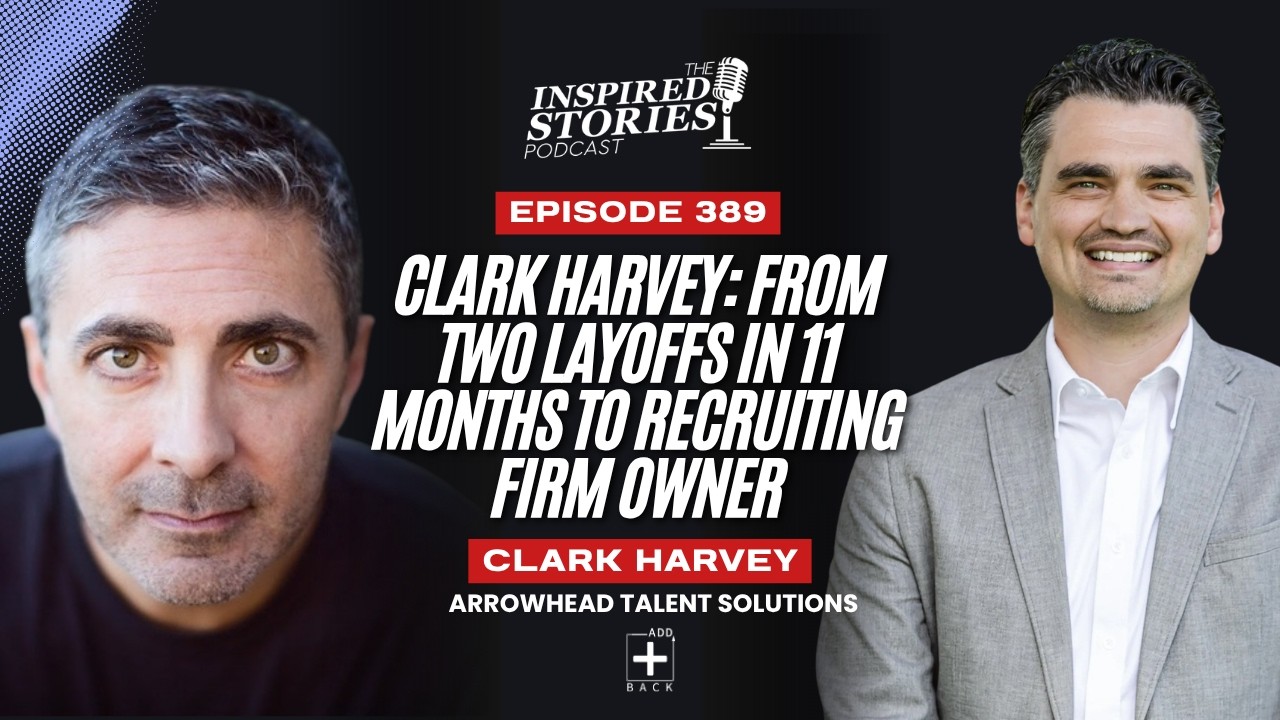
Welcome to another edition of the inspired stories podcast where leaders share their experiences so we can learn from their successes and be inspired by how they've overcome adversity. name is Anthony Cotus Bodie and today's guest is Clark Harvey, president and founder of Arrowhead talent solutions. Clark grew up in small town, Ohio, navigated layoffs and setbacks and turned those challenges into a mission. Connecting people with meaningful work and supporting community needs.
After years in HR and recruiting at major manufacturing firms, Clark launched Arrowhead to deliver honest, values-driven, direct hire recruitment for mid-market manufacturers, helping honorable companies build teams while refusing to work with organizations that mistreat people. He is also the driving force behind Brighter Days Foundation, which funds cancer care, scholarships, and essential services for families in need.
In this conversation, we're going to dig into the highs and lows of entrepreneurship, how hardship shaped his approach to hiring and mentorship, and the practical systems he's built to scale relationships and impact. Get ready for a candid, hopeful conversation about resilience, leadership, and doing business with purpose. But before we get into all that good stuff, today's episode is brought to you by my company, Ad Back Benefits Agency.
Listen, if you run a business, you are likely stuck in the cycle of rising insurance premiums and soaring deductibles. You're paying more, but your team is getting less, and many people can't afford coverage at all. We do things differently. We offer a solution that provides your staffing employees with unlimited access to doctors, therapists, and prescriptions that's always free for them to use. And it works great for temporary frontline workers too. But here's where you really need to pay attention.
Our program is structured to put money back into your company's pockets. We recently helped a client increase net profits by $900 per employee per year. Results vary, but the consultation is free. See if you qualify today at addbackbenefits.com. All right, back to our guest today, the president of Arrowhead Talent Solutions, Clark Harvey. Thanks for making the time to share your story today.
Clark Harvey (02:16)
Thanks for having me, Anthony.
Anthony Codispoti (02:18)
So fun little side note for the listeners, ⁓ Clark's business is based in my hometown of North Canton, Ohio. And when I started to a little bit of research on him, I saw the address. It was on a street name I was familiar with. I'm like, wait a minute, that's a residential area. How can he have a business there? And then I saw a picture of this giant red barn that their business is located in. And I was taken back to memories from
30, 40 years ago. It was a big landmark that told us where to turn, how to get to our friends' houses. I just, I had to throw that in there in case there's any North Camp listeners. These guys are right there on the corner of Brumbaw and Cleveland Avenue, Main Street. All right, so easy to find. Yep, can't miss it. All right, so Clark, tell me about an early memory growing up that really shaped who you are today.
Clark Harvey (02:57)
Yep, easy to find.
Hmm. Well, there's of course a lot of them, but I would say just generally sports for me was an athlete. My dad was ⁓ a coach for pretty much every sport I participated in. So there's some advantages, but very distinct disadvantages to having your father ⁓ be your coach in all your athletic endeavors, especially mine. He was a real driver, expected nothing short of excellence, I would say. And, and so I think there's some.
negatives you can take away from that, especially for somebody who's a little bit more sensitive like I am, I'm inclined that way. But I think the positive that you can glean from those experiences would be, and it sets you up for a life of motivation, and you have those expectations for yourself because someone else expected that of you from an early age. So I remember the highs and lows of athletic competition. Thankfully, ⁓ baseball and track and basketball I did fairly well.
for a small town athlete. So the results were pretty good. ⁓ But I think those lessons always stuck with me from an individual perspective of expecting excellence from myself from a very early age. And then the team aspect was really important too. I was lucky to be on some really good high school sports teams in particular basketball. Great memories, but also really good life lessons embedded in there that you don't realize until...
you have the benefit of hindsight. I learned how to be, hopefully, I learned how to be a good teammate, ⁓ a good leader, a good cheerleader for my friends when I was hurt or sick ⁓ or not playing or whatever. So I think you learn a lot of good lessons along the way. So sports early on in life really formed me and I think those good teams really helped a lot too.
Anthony Codispoti (04:51)
Which small town did you grow up in?
Clark Harvey (04:53)
Oh man, no one's gonna know what it is. If you do, I'll give you $5. It's called Lucas, Ohio. And so if you've heard of Mansfield, we're about halfway between Cleveland and Columbus. We're a very small town of about 600 or 700 people right outside of Mansfield, Ohio.
Anthony Codispoti (05:09)
Okay, that is a small one. And I drive through Mansfield all the time and I've never heard of Lucas, so you can keep your five bucks.
Clark Harvey (05:16)
That's great. Blink and you miss it.
Anthony Codispoti (05:18)
Yeah. So I want to go back to those early days. It sounds like there's some combination of gratitude as well as, I don't know, tell me if I'm reading this right, like a little bit of ⁓ angst against some of the hard driving things that you experienced from your father in the world of sports.
Clark Harvey (05:40)
heck yeah. I mean, there's there's good and bad to it for sure. I tried to give you a little bit more of a sanitized version there, obviously. ⁓ But yeah, there's there's good and bad. And the bad is that it creates a little bit of angst in you, ⁓ anxiety and I would say a lack of security moving forward in your life if you're not careful. Then I think over the years, I've had to really focus on that and ensure that those stories don't necessarily serve me.
as much as they used to. And that's hard work even for a 40-something-year-old adult like me. Because in an early formative age, you're learning those lessons from a parent who's the most important person in world to you at the time. You have to make sure that you're telling yourself the right stories as you get older. But yeah, for sure. And we've got someone always looking over your shoulder as a kid and ⁓ making sure that you're the best player out there and a lot of stern messages coming from dad.
Yeah, angst for sure accompanies that.
Anthony Codispoti (06:41)
What were some of the stories that you had to learn to let go of and what did you replace them?
Clark Harvey (06:47)
Well, I think I'm still trying to let them go to be clear, Anthony. And I think the stories that would be reinforced early on are things like you're not good enough or you're only good enough if you're perfect. So even if I had an outstanding game, let's say a basketball game where I hit 10 of 11 shots, ⁓ four assists, five rebounds, ⁓ one turnover, my dad would often focus on.
the one shot I missed or the turnover I had or when I was out of position on defense or something like that. So those are things that you really absorb without realizing it consciously, especially when you're a kid. And so those would be the two. You're not good enough. The second being a little bit more profound. I think that you're only a good enough if you're perfect or something like that. And so those are hard things to listen to and absorb. those run, those stories run consciously in your mind.
in my opinion, and you have to catch those thoughts and redirect them and hopefully develop new mental pathways as you get older. But I still get caught up in those patterns quite a
Anthony Codispoti (07:55)
What's that personal development work look like for you over the years? How have you been trying to resolve this?
Clark Harvey (08:02)
boy, I don't wanna move my camera because I wanna be ⁓ mindful of the audio visual and all that stuff on this podcast. But I could position my camera a little bit and you'd see bookshelves full of books. So I read a ton and that would be one of the starting points, I think. ⁓ Reading and learning about how your past impacts your present ⁓ and your mindset. And I think that's probably been the biggest self-development I've done over the years.
I've got a great relationship with my wife who's thankfully supportive and listens to a lot, listens to me a lot. And that's been extremely helpful. So those would be two. And then I think, you know, just through personal development, through groups that I'm involved into, different, different social groups, I've got a good group of friends, a board of directors who functions as, you know, also a really good group of friends who through my business journey have said, man, that doesn't sound right.
What you're saying about yourself right now isn't an accurate reflection of how we see you as a person, as an entrepreneur, as a leader. So having good people in your life who can speak the truth to you is super valuable. And that's been a life wrap for me, especially at low points in my business career, I would say.
Anthony Codispoti (09:15)
Yeah, you know, and we're going to get into sort of the way that you founded the company and the success that you've had along the way and some of the, you know, the struggles that you've overcome in building the business. But it's interesting to me, even Clark, you know, somebody sitting here today with a very successful business that you continue to doubt yourself, right? And, and I'm putting you on the spot a little bit because I want others to hear this and know that they're not alone. You're sitting there and you're doubting whether you can do
this big project at work, or if you're starting a business or you have a business, if you can overcome the hardship or work your way towards better growth. And most people, they sort of get trapped in their own heads and think, I'm the only one. I'm the only one who struggles or doubts myself or suffers. Everybody else looks like they've got it all put together. And so we're kind of pulling back the curtain a little bit. And Clark's saying, yeah, I've got this successful business here and I still need people around me to build me up and support me and remind me of who I am and what I can do.
Clark Harvey (10:14)
gosh, yeah, I mean, you're not alone if you have those thoughts, rather, and I'm an open book, probably to a fault, and I think it makes some people uncomfortable, ⁓ and so I try to temper that, but for the sake of this discussion, I feel like ⁓ I owe it to your listeners to be very honest and unvarnished, and I apologize if that makes anybody feel a little bit, like I said, uncomfortable, but yeah, I mean, I think many, many people doubt themselves, and I've had the privilege to talk to you.
folks way more successful than me with bigger companies and all sorts of things. And they're still riddled with self doubt and fears. And I think we're all human, but heck yeah. I mean, it's very kind of you to say that I'm successful. Most days I don't even, wouldn't even give myself that moniker honestly. And I go, what are you doing, man? Like what are you doing with your life? What have you done today that's even worthwhile?
⁓ I hear that a lot and feel that a lot. so yeah, I think a lot of people feel that it's more universal than we realize.
Anthony Codispoti (11:14)
You know, something I tell my kids and remind myself of often is that growth comes from the uncomfortable edges of life. So we embrace the discomfort here, Clark. We welcome it. ⁓ You know, I'm curious, as you talk about that bookshelf behind you, is there one book in particular that you would point out as being, you know, particularly helpful?
Clark Harvey (11:38)
boy, there's a lot. I would say one that's the easiest to read is called Soundtracks. And the author's escaping me. But it's again called Soundtracks. It was written in the last few years and it kind of talks about what we just went through a little bit. How you have in the back of your mind or your subconscious, whatever you want to call it. Soundtracks is what he refers to them as, but these mental scripts that are running and a lot of times you're not even fully conscious of what you're telling yourself. These are well-worn mental pathways.
in ⁓ this author, John Acuff, I just remembered, J-O-N-A-C-U-F-F, I believe, talks about ways you can counter those and then overcome those. And he's a big believer in affirmations and those sorts of things. That can be a little woo-woo for my taste, but I still try to make myself do some of those things and hopefully absorb those messages. So that's been very helpful. That's the most proudly practical and easy read that I've come across on the subject in the last couple of years.
Anthony Codispoti (12:36)
You know, and I'm hearing you talk about and I respect the fact that you have got a lot of self doubt, right? And you say, you know, most days you wake up, you would not even characterize yourself as being successful. And it reminds me of a conversation I had with a previous guest who talked about this very thing, labeled it imposter syndrome, right? This idea that I think I'm not good enough, that, you know, I'm going to wake up one day and everybody's going to discover I'm a fraud. And I just got lucky to get to where I am.
⁓ and it was interesting because I hear a lot of guests talk about this. lot of high achievers have that imposter syndrome, but what's interesting about his mental approach was he had flipped it around and kind of turned it into his superpower. He actually, he says that that imposter syndrome is what kicks him in the butt every morning to get out of bed and get up and do a better job and to just continually improve himself. And so I, you know, I
guilty of imposter syndrome on a pretty regular basis. And I often think back to that conversation, like, okay, how can I take this and sort of flip it on its head and leverage this for good for myself?
Clark Harvey (13:47)
Yeah, you just have to embrace your ignorance in a weird sort of a way. And I have a friend who's a whiz in all things, mergers and acquisitions and finance and all these things. ⁓ And every time I hear him talk, I feel dumber, but I know I'm learning a little bit in the process. And so I'm just like, hey, man, just teach me. I'll call him and listen to him opine on these topics. And it's so edifying and interesting.
So if you embrace that, I think it can be good for a couple of reasons. Just one, you're learning your edification, but then two, I think when you express vulnerability to people or just very real raw honesty to people, it breaks down barriers so quickly. And if I'm in a discussion with a stranger or someone I'm trying to get to know better, or even an old friend, if I'm the first to kind of confess something, you can feel the posture, everything in the room changes in a good way.
You can see people's postures change. You can see them lean forward more because the conversation gets more real and everyone wants to be part of a real conversation. And I mean, I don't want to go to any more lunches where I'm just talking about EBITDA and all these financial and entrepreneurial terms. I can do that anytime. But if you're having a real discussion with people, ⁓ that kind of talk really is authentic and shortens the distance between two people.
And then it helps you just outsource your life too. I'm very honest about what I'm good at, which isn't much, candidly. So I just know, like, I've got a buddy who's good at X. I ask him to help me with X. I've got a buddy who's good at Y. She helps me with Y. I get better because I leverage the talents of others and everybody wins. So I think it's good for those three reasons.
Anthony Codispoti (15:31)
Yeah, I love what you're talking about here. And I think people listening might ask the question, well, you know, how do I, how do I get the ball rolling on that kind of conversation? Because what I'm traditionally comfortable talking about is the weather and sports and how it was worked today and tell me about the kids. And it's oftentimes, you know, all those topics you can go deep in, maybe not the weather or sports so much, but you know, you can go deeper in, but it takes somebody
willing to engage in the risk of being the first one to pull the curtain back and get vulnerable.
Clark Harvey (16:04)
Yeah, for sure. I think there are a few ways you can do it, but I think as you meet more people and more strangers, you become more socially graceful if you really try to develop some skills. so things like, I've actually taught my team and my business about this. I hosted a series of lunch and learns about social graces and networking basics. And one of them was, how do you get someone to open up? And okay, so one of the things we learned about human nature is that 99 % of people like to just talk about themselves. So this...
Discussion frankly makes me a little uncomfortable. I'm probably in the 1%, which makes me sound like I'm bragging. I promise I'm not. But if you can just get people to open up a little bit and talk about themselves, then you've opened that window. And so it's things like, where are you from? What's your hometown? You have any brothers or sisters? All that kind of stuff opens up doors just a little bit. And as you become more comfortable with one another, the opportunities for vulnerability will emerge. And sometimes...
I think if you're sincere enough, and that's the miracle of being a good interviewer, like you are, Anthony, people will sense that you care and that you're showing them some real authentic love and care and attention. We don't get that in our day to day. We just don't. We just do not. And so the vulnerability will just leak out of them. And the honesty happens because everybody wants to be known and loved and feel like they have a connection.
And so the only danger of being good at this is that you'll have a lot of people who just constantly want to talk to you, is my guess. So, ⁓ but I think if you really show true interest in love for another, not love, just in a ⁓ you know, friendship sort of a way is all I'm saying. But if you demonstrate true interest and love in a sincere way for another human being, it's almost impossible for them not to open up and share because that's what we all want.
Anthony Codispoti (17:56)
couldn't have said it better myself. love every bit of that, Clark. Okay, so what started your path ⁓ into HR and recruiting? Is there a moment that you knew that, hey, this is what I'm going to do?
Clark Harvey (17:59)
You
There were a few moments where it happened, but I never planned on doing it. And I initially wanted to go to grad school and be a psychologist. And when I was in my master's program at Walsh University in North Canton, ⁓ I was asked by the head of the admissions department to come work for him full time. He said, hey, I'll give you a salary and benefits and I'll pay for your grad school. And I thought, boy, where do I sign up?
So that was my first ⁓ big boy full-time job out of college. I was an admissions officer or admissions counselor. And so I would recruit high school students to come ⁓ to attend Walsh. And so I learned the basics of recruiting there. ⁓ And I parlayed that experience into a corporate recruiting job at a big manufacturing company in ⁓ North Canton. So how did I get there? I knew that after a time at Walsh, I wanted to spread my wings a little bit.
And I liked recruiting. liked relationship building. It was kind of like the nexus of sales and HR and marketing and all those things that I felt like I was pretty good at. And so I was able to thankfully have a, a person take a chance on me and give me my first job in the corporate world from there. So that's how I got on the path. Over the years, I thought I should probably do other things and different things. ⁓ but at some point you can't look a gift horse in the mouth and you just have to be thankful for.
the skills that you have. And so I've embraced those now.
Anthony Codispoti (19:34)
Did you end up finishing that psychology degree? Okay.
Clark Harvey (19:36)
I did. I got a master's.
I got a master's in counseling. And that was hard. You had to do a 600 hour internship. So it was pretty hard to do while managing a full time work schedule. And my wife was pregnant with our first at that time. So a little challenging. That's when I started drinking copious amounts of caffeine. ⁓ So it was a tough time, but we got through.
Anthony Codispoti (19:59)
⁓ Let's fast forward a bit. Walk me through your last corporate role and what prompted you to leave.
Clark Harvey (20:08)
I was at a big company in Northeast Ohio again. At the time I was the human resources manager for the corporate headquarters. ⁓ Very good job, stable company, all those sorts of things. So it was going relatively well, but ⁓ it's kind of funny. My sister's married to a pro golfer. They have a charitable foundation in their name and they ⁓ kind of one day just said, hey, we really need you to help us with this thing.
I won't get into all the reasons why. I said, I don't know anything about that. I don't, I've never run a charity or a nonprofit before. I've never been in that world. But the more we talked about it, the more I was convinced it was the right move for me and felt like it would be a fun learning opportunity. And, you know, I just, I jumped at it. So I was able to leave on good terms from that position in that company, start the work with the foundation.
and I had to do a ton of learning and that was fun. And then very soon thereafter, I was able to start Arrowhead, my business, and it was just a small part-time side gig, I guess you would say at first. But the company I left, the latest company I left, they were one of my first corporate clients as well. So everybody kind of won, or I'd like to think so anyway. So that's how we, just some of those initial seeds were planted.
Anthony Codispoti (21:32)
Okay, I think I did a disservice here. I had you fast forward a little bit too far. I want to rewind now because I understand that there was a period in your life where you got laid off twice in the span of 11 months.
Clark Harvey (21:38)
That's all right.
No, everything was perfect in my life, Anthony. I don't know what you're talking about. ⁓ Yeah, so I was at a really big prominent employer in this area again, and it was going pretty well. I was there for a number of years, got promoted quite a bit, and felt like, ⁓ yeah, I just felt like I was on not necessarily a glide path or anything, but things were going well, and I was working really, really hard, and I think that that effort was being recognized to the extent that
senior executives at the company were kind of sharing signals with me that they wanted me to find a long-term home at the organization. And it was very exciting. I got promoted into a pretty high profile, fairly high profile position in the company and pretty exciting as well. ⁓ But that came to a pretty abrupt end about four months after receiving that promotion. I got called into a conference room on a Friday afternoon.
typical kind of Black Friday sort of a thing in corporate America. I got caught up in a very large scale layoff. And so it was, you know, to put it nicely, pretty, just pretty hard. I'll say it that way. And I think you feel those feelings all over again when you talk about these experiences. So that was really hard. And that was my first layoff. Took a while to find another position.
and then eventually did. I know you may want to ask follow-up questions here, Anthony, but the next company I ⁓ joined ⁓ also laid me off due to some pretty tough financial realities that they were facing. So two times in 11 months, it was not a fun time of my life, I can tell you.
Anthony Codispoti (23:30)
What time period was this? What year are we talking about?
Clark Harvey (23:33)
I'm gonna say like 2014, 2015, no maybe 2016 as well. Something in there, it's all a blur. I'm sorry, I don't remember. Right, yeah, a little bit.
Anthony Codispoti (23:38)
Okay.
Yeah, trying to black it out, huh? So
this first company in that first layoff, man, you thought you were up into the right here. Like this was great. You've got a promotion. They wanted they talked to you about finding a long term home there. You thought, hey, this is where I'm going to work for a long time. And then something internal, something with the economy, something with the industry shifted, and they needed to let a bunch of people go. And you are human collateral from that.
What was that? Tell us just about that moment, that first day. What was that like?
Clark Harvey (24:17)
shocking, really awful, and every negative emotion that you could probably think of. I think that for a lot of people who are motivated to succeed, and this comes back from childhood issues, of course, that we mentioned earlier in the discussion, but a lot of your identity is wrapped up in your work, your success, all those sorts of things. And it's not necessarily unhealthy if you don't do that too much, but mine was probably wrapped, my identity was probably wrapped up in my work life.
too much to an unhealthy extent. And so in addition to losing your job and your income, being the sole income earner, you also lose a big portion of your identity in the process. So it's pretty unnerving to put it kindly. So when I got laid off, was in the, I think early afternoon, I didn't go home. Friday afternoon, I didn't go home. I went to some random parking lot. I fired up my laptop and I got on my phone and I called, emailed and texted about 70 or 75 people.
in my network immediately and let them know what was going on. So I pretty quickly pivoted to action, even though I was in a state of abject shock. ⁓ So I activated my network, in other words. I waited to go home until the normal time and acted like nothing was going on. And then when we put our kids to bed, I told my wife what happened. And ⁓ I ⁓ hesitate to say this because it'll sound like I'm bad mouthing my wife.
but it's not, mean this in the purest way possible. When I told her, I will never forget the way she cried and it ripped my heart out and it still does when I think about it because the way she cried, it was just this pure panic. I don't know how to explain it, but it was almost like a primal thing and it was just, that may be the worst moment of my life, honestly, when that happened, cause I just thought I,
I felt I was dying inside and I had to act like I wasn't. And she was, she felt like I felt, but we were sharing it differently. And that marked the beginning of a really bad period of my life, ⁓ which I'm grateful for in retrospect, but man, I don't want to ever go through anything like that ever again.
Anthony Codispoti (26:35)
So Clark, I want to unpack this ⁓ step by step a little bit here. What really surprises me is right after getting the news, you didn't go home, you didn't go to a bar, you didn't drive to a friend's house, you went and parked yourself in a parking lot, and you got to work. Most people have been through this, but if you haven't, a situation where
either a business that you've started has gone under or you've exited or a job that you had where you attached your identity very heavily to it and that's gone. Like it's not just the loss of the income and the security from that, which is enormous. But it's also like you put it the loss of identity. Like, wait a minute, I was this guy who fit into this role and help these people do these things. And now I'm no longer that person. Like, where do we fit into this world?
How am I connected to this world? How am I adding value and purpose? And so while you are immediately suffering from all of these huge invalid emotions, you got to work.
Clark Harvey (27:45)
Yeah, I mean, I just felt like I didn't have a choice in the matter. And I think looking back, I'm happy I did that. And I think that activity eventually led me to my next job and those sorts of things. I think it's all good, but I don't know why I did it. Honestly, I really can't sit here and explain a rational reason why, other than it's probably just the way I'm wired to always think about how I can work and work myself out of a problem. And I knew I didn't want to go home.
in the afternoon before 5 p.m. or 5 30 because I knew my wife would just not be able to handle that and it would have been really, really bad and I wanted to protect her in front of our kids and you know, I made the conscious decision early on that I wanted my kids to think everything was good. Everything was normal. Thankfully, they were very young during that time too. So we were able to shield them from a lot of the consequences of being laid off. But yeah, I guess I can't think.
rationally about exactly why I did that other than it's just was almost like an instinct that I knew I had to do it.
Anthony Codispoti (28:47)
And some of the outreach that you did that day in your car eventually opened the door to the next opportunity.
Clark Harvey (28:51)
Yeah,
yeah, yeah, it eventually did and I'm really grateful for that. ⁓ And it led to a lot of people checking up on me, which is really cool. And I think something I learned from those times is you'll never forget who really cares about you. And you'll never forget how people treat you when you're really down. And I will never forget those lessons. I will never forget those people. I will never forget.
my wife's family who cared for us during that time. ⁓ And great lessons in there too. So fast forward to today, I wanna help everybody I talk to. I wanna give everybody hope I talk to for a lot of those reasons. I can't, I can't help everybody. I can't give everybody a job that I talk to, but I want to. So if I can make the time and share with them my story or some encouragement, ⁓ I hope that helps pay it forward a little bit and makes the world a little bit brighter.
I don't wish that stuff on anybody, I just don't.
Anthony Codispoti (29:49)
you you know, and you go home and you tell your wife and she has a very normal human reaction. ⁓ But the side effect is that it takes you from feeling as bad as you were already to feeling even worse. ⁓ You know, and this is, you know, I think one of the great things about a terrific marriage is that, you know, you can support each other and you can, you know, prop each other up, one of you is having a tough time, the other one can come in. This is a moment where both of you were suffering.
Clark Harvey (29:53)
Mm. Mm-hmm.
You
Yeah.
Anthony Codispoti (30:18)
⁓ and you did your best to put on sort of the happy face and you talked about how this was, you know, one of the worst periods of your life then going forward. How did you get through that time? Who did you lean on?
Clark Harvey (30:30)
I didn't
get through it well, honestly. ⁓ I think sometimes that's how it's supposed to be though. I think you're supposed to suffer a little bit and it comes out and it's a redemptive experience, but man, when you're going through it, you can't see that. So I think our faith helped us quite a bit, but again, it didn't feel like that at the time. I kind of felt abandoned by God if you want me to be candid about it ⁓ during the whole thing. So I struggled through that.
struggled through a lot of that from a faith perspective. I think that we leaned on one another. My wife and I did quite a bit. Our kids being little helped because they were a source of entertainment and levity. ⁓ My wife's family are very local, so they were very willing to help any way they could. And my network, like I mentioned, helped quite a bit too during that time. My family lives a little bit farther away, so they weren't necessarily present as much, but they were supportive too. So
Those things were great. Those elements of our lives really kept things together, I would say. And ⁓ we needed as much of a support as we could get because once I got laid off, we went through this really weird, just, I don't know how to explain it, it's just the worst time of my life. mean, we all got like, while I was job seeking, we all got a flu that lasted almost two weeks. So I'm trying to find a job and I have this flu that won't go away. We had a puppy, we had to take him to the emergency vet.
at least twice during that time. Each of our kids had to go to the ER at least once. Meanwhile, my insurance ran out and I'm COBRA, all this kind of stuff. ⁓ And yeah, so we got ill. Then it kind of culminated in my getting a little bit of an eye infection or so I thought. Took some antibiotics and on the last day of the antibiotic dose, ⁓ I developed like hives all over my body, extremely painful and I couldn't walk because they were on the bottom of my feet. It was terrible.
Anthony Codispoti (32:27)
Alright guys.
Clark Harvey (32:27)
And then within
a day or two, it got into my joints. So I was like the Tin Man, that's an old reference, but I couldn't move. And so one day it'd be in my fingers and then the next day it'd go to my shoulders. And it was the weirdest thing. ⁓ But trying to go through all this stuff while finding a job, and there were more things to it. We had a death in the family that really impacted us during that time. It was a real valley.
And thankfully, after I would say three, four months, the job activity heated up a little bit and it culminated in three interviews, one in Columbus, one in the Akron area and one in Philadelphia. They were all right around the same time. All three wanted to give me an offer or at least advance the interview process significantly. And then ultimately the Akron area company gave me an offer first and it was time.
to get back to work, I'll just put it that way. So that's how it kind of happened, it? Yeah.
Anthony Codispoti (33:24)
Yeah. You were getting really tested. mean, you guys
really put through the wringer. So you take the accurate position. It doesn't end up lasting that long. And what was the transition from there into the nonprofit?
Clark Harvey (33:33)
Mm-hmm. Mm-hmm. Mm-hmm.
Yeah, so like a little story there. I was told when I got hired at this company that I'd get like a review and a raise around six months. I was there for six months and you know that my boss said we're working on it. I just can't get a hold of the right people to give this to you. So seven months in I was on vacation. My boss called me on vacation and said they're going to give us and give me a nice raise and I was like wow, that's amazing. That's really big and so it was a it was a difficult experience at that position. I'll just leave it at that but.
the big raise helped, came back from vacation. I think my second day in the office, was told by somebody, or I was asked by somebody, hey, do you got a minute? And I said, yeah, sure. And I walk in the conference room and two executives, one of whom was my boss said, we've got to let you go. And I started laughing and I said, you guys just gave me a paycheck, like, or you gave me a raise and I didn't even get one paycheck with my pay amount. And they, you know, it was, it was a really tough time for the company. I'll just leave it at that. And so a lot of people
got caught up in a layoff there. ⁓ And so, yeah, that was my last day on the job when that happened. I said, when's my last day? And they said, how about today? And I said, okay, ⁓ packed up and left. And so from there, embarked on a similar journey and did my best to pick myself up. It was sadly a little bit easier to absorb the news of being laid off the second time rather than the first.
but it still was hard and so was back in the same kind of a situation and applying to positions. Again, my network helped me find that next position and it moved quickly once I was connected to the hiring team at this company at my last corporate job. thankfully that all worked out and resolved itself, but man, two times in 11 months, ⁓ it got really bad and really, really dark.
Anthony Codispoti (35:37)
Wow. And I can tell, and you even said it out loud that, you know, talking about these times sort of brings up a lot of those really awful feelings again. I appreciate you, you know, being willing to do that because I think not only will your stories help other people who have gone or are going through something similar, understand that there is a light at the end of the tunnel. You have to keep trying one foot in front of the other, activate your network.
Clark Harvey (35:48)
Mm-hmm.
Anthony Codispoti (36:06)
get out there, be active, talk to people. But I think it also helps to lay the groundwork for why you do what you do now at Arrowhead Talent Solutions and why you are so emotionally invested in helping all of the folks that come to you.
Clark Harvey (36:25)
Yeah, yeah, mean, great question. And I think it's weird how it all works out. You have the benefit of hindsight, of course, 10, 12, 15 years later, but it's really cool to see how this story has evolved. And it's a little bit of a redemptive arc, I guess. So when I was able to start working for the foundation and then start my business, was, I knew I always wanted to do my own thing, but didn't know how, where, or when. And then it kind of just happened. I mean,
A lot of old friends found out I was a free agent, so to speak, and said, hey, I want to go to coffee with you. I don't know what I want to do with my life. I think you could help me with that. I had a lot of people asking me that. And I thought, wow, what a really, what an honor, you know, to sit and talk to somebody about what their destiny might be. Then I started getting requests to help people with their resumes. And I was like, yeah, sure. So I just started charging people a little bit of money. And I think I started with like 50 bucks.
And then I kept just upping the price until I got a little bit of hesitation. I knew that was probably where the market should be. So I started doing resumes for people. And then that first year of Arrowhead, was 2018, my old company hired me. And so I started doing recruiting work for them. And then by the end of that year, I had pretty good resume business. I had three corporate clients. All came to me through introductions. And I was a
you know, doing that on the side while I was doing the foundation. And it just grew steadily from there. I think, I, you know, look back on that time and I think when you're trying to do the right thing and be a good person in the moment, you think, man, this really stinks. I'm trying to do the right thing and everybody else has taken shortcuts and they're getting ahead and I'm not. I look back and go, well, I probably wouldn't have gotten all these introductions and referrals to these clients and things if I had been a jerk. So I, I think if you look back and go,
Sometimes doing the right thing pays off. It's a little bit of a longer game. But I have friends and colleagues and former colleagues who respected me enough to help with introductions to make my business, you know, to get my business off the ground. And ⁓ it grew steadily. I was a solopreneur for the first few years.
Anthony Codispoti (38:40)
What were some of those shortcuts that you saw other people taking that you avoided?
Clark Harvey (38:46)
I think the biggest one in the corporate world is just being so disrespectful to everybody else. ⁓ you know, I sat in a lot of meetings that were tense and if not outright hostile. And it always just struck me how nothing was ever productive in most meetings in corporate America. And I always thought, we're on the same team here. Like, I want to help you. I think you should try to help me. I don't understand why we're going against each other, but a lot of it just comes down to fear.
Everybody's scared. Everybody wants to feel safe. Everybody wants to protect what's theirs. And you see that a ton in the working world. And I think most people fall prey to that. And I try not to judge that because again, we're all human. We're all scared. We all deal with our fears and insecurities in different ways. And so I saw that a ton. And the higher up you got, it seemed like a lot of folks were fairly arrogant and dismissive and didn't want to listen and didn't want to learn. ⁓
And just on ethical behavior too. saw a lot of that over the years and taking shortcuts when it was clearly the wrong thing to do. you know, I'm not trying to puff myself up. I'm sure I was a jerk and all that to other people too, but largely I tried to be a good guy and adhere to a code of ethics that I thought, you know, I thought that was really important to guide my behavior.
Anthony Codispoti (40:07)
So you were a solopreneur for the first few years. Sounds like even by the end of year one, you were doing pretty well. Nice resume business. You had a few corporate clients. All this was on the side. And at what point did you decide to go and do this full time?
Clark Harvey (40:14)
Yeah.
It just happened in a way. I probably am simplifying it too much, but 2018, 19 and 20, I grew through COVID even a little bit. 21 and 2021, we even were growing through that year. And when I say we, I mean me. So the company was growing even through that year. I decided good friends of ours, their babysitter,
It was a college student looking for an internship and they said, hey, would you help her find an internship? So I was doing that and then I had an epiphany. I thought, why wouldn't I just hire her as my intern? I'm kind of sick of doing all my social media. So I did. She was a marketing student. And then within a month or two, I thought, my gosh, this is amazing. I'm getting all this time back. And I'm forgetting what your question was, Anthony. ⁓ But anyway, so I hired her and she was our first, my first foray into hiring another person and seeing what scaling could look like.
And I'm gonna stop because I forgot what you asked me. ⁓ that's the evolution. Thank you. So I'm still doing the foundation, but it's definitely kind of flipped now where the foundation's more part-time and ⁓ the business is full-time and then some. But by 21 is when the business got to a point where the work was coming in at such a pace that I was overwhelmed.
Anthony Codispoti (41:22)
It was just, when did you decide to step away from the foundation and focus on Arrowhead full time? Yeah.
Clark Harvey (41:46)
My team always jokes now and says that every time I am in the fetal position is when I hire a new person. And I think that's a pretty accurate way to describe it. ⁓ it was before the big charity event for brighter days one year in 2021. I was onboarding so many new clients and it just happened. It was the craziest thing I said to my wife, I don't know what I'm gonna do. And normally I can produce mass quantities of work and I don't get overwhelmed like that.
And I go, I can't even think what to do right now. And she goes, I'll call Andrew. Andrew's her cousin and he was between jobs. And he thought, yeah, I'll do it. I'll help him get through this crush of work. And that's all he thought it was gonna be. After a few months of seeing what he was capable of doing with minimal training, I might add, and they remind me of that every day too, ⁓ I gave him a job offer unannounced one Friday night and I bribed him with a pretty rare bottle of bourbon and said, hey, look man,
I thought about this a lot. I want this to be more permanent. And he was so shocked, he didn't even know what to do. But he accepted the offer. And by 21, we had a team of three. By the end of 21, we had a team of three, my intern, Andrew and me. And then 22 is when we actually 4x'd our revenue from 2021. I couldn't have anticipated that. And that's when my life just really super changed, I would say.
Anthony Codispoti (43:12)
What do you mean super changed? In what ways?
Clark Harvey (43:14)
Well, you see these guitars behind me. I had the best of intentions as a middle-aged man to learn to play guitar during that time. And then my business took off that way. I just said, I can't play guitar anymore. Every waking minute in 2022, I was working. I'm not even kidding. Like wake up in the middle of the night and start thinking about stuff. We just were getting, it was the great resignation, which obviously was a big factor if everybody remembers what that term is, but.
If you don't, that's when post COVID, a lot of people were getting their jobs back. so there were ton of opportunities rather for recruiting firms to hire and place people. also things just kind of happened for us. It wasn't all the great resignation. So we were onboarding a ton of clients. I became a glorified order taker. We did not have systems, processes, and tools set up to handle the volume of work. I was still doing everything on a notepad, I'm ashamed to say.
When Andrew came on board, he said, no, no, no, we're not doing this anymore. And he goes, and to my credit, I'm humble enough, I go, look, you want to change something, you tell me, because you're probably smarter than me. And they're all smarter than me. So he goes, no, no, no, we're doing this on a spreadsheet now. I said, fine, I don't even care anymore. Because I couldn't even think, I couldn't even process anything. It was just mental overload all the time. And so I was still able to do the foundation work. But 2022 is when my life changed.
⁓ It was all good stress, but it was still very, very stressful. And I knew that we needed to make some major systemic changes to the business. I needed to make some major changes in my personal.
Anthony Codispoti (44:56)
So before we talk about those changes, I want to understand how you forex growth in one year. Was the social media just becoming really effective? Were you guys getting lots of referrals? How did this happen?
Clark Harvey (45:07)
Yeah,
mostly referrals. Yeah, I mean, I would get, it was the craziest time. I look back on it I'm like, that couldn't have even been real, honestly, Anthony, but lots of people would call and say, hey, so-and-so told me about you guys. ⁓ I really need your help filling a few jobs for my company. Or I would get an email introduction from a client or a former colleague who would say, ⁓ Clark, this is so-and-so. ⁓ I've told them about you.
I think you guys need to have a conversation about their talent needs. And my thing from a sales perspective, I never tried to close anybody. I just always say, hey, I'm here if you need me. I think I can help you. Give me a call if you want to work together. And it really works because I think people want to, again, it goes back to what we talked about, just being a human being. And I try to just show people how much I care about them. Not that I want to make a bunch of money off.
And I think that probably helped us quite a bit too during that time. So lots of referrals and introductions and the network really got activated big time. So we were thankful for that because it told me we were doing something right to get those kinds of referrals too.
Anthony Codispoti (46:17)
And so actually, let's talk about those changes that you made. I want to hear where Arrowhead is today. But first, I want to hear because it sounds like you got to a point where like, I got to some changes in the business in my life. What were those?
Clark Harvey (46:23)
Yeah.
Mm-hmm.
Yeah, I'd say just from the personal life I had to jettison things like little projects, learning the guitar as an example. I had to focus on what was absolutely essential at the time we had a baby. And so I said anything I can do to just go to the most essential elements of my life I'm gonna do. So it was work and family. That's really all I had the capacity for. No hobbies, no interests. I used to read a ton and I had to stop doing reading and it just...
we had to strip everything down. So that was the first thing on the personal life side. ⁓ On the business side, we had a lot of stuff, but it was in my head and that wasn't good. So we had to create, or I rather had to create processes for our business and document them. And then of course, streamline and improve those along the way. So the old business adage, building the plane while you're flying, it really applied to us. ⁓
early 23, I hired a gentleman on our team who was very process oriented and he started documenting everything really, really well. And he did it without me even asking. So one day I had people up to the office and they wanted to know the wireless password. I didn't know what that was, but I knew my colleague would and I just knew it. I knew he was documenting everything and I go, hey, Brian, what's the wireless password? And he immediately looked it up on this document.
he was creating and that's when I knew we had something. So we created and documented and streamlined processes, tons of process improvements. So we made about 145 in 2023 that I documented. We added to the team and built the team out, created a more, I did an org design that made sense for us and I created good compensation structures for the team that
properly incentivized everybody. And I only hired people at the time who I knew I trusted with my life. I knew they were smart. Pretty much everybody I hired and brought in did not have recruiting experience. They were just nice, awesome people. And I just poured into them as much as I could. And it was definitely a big ⁓ learning curve. ⁓ And I had to do a lot of investing upfront, but that investment has paid off hugely. ⁓
in the present day. So I'm grateful for those decisions I made. So those are just some of the things. But like the guy said, you can't Clark, you cannot, every time we get a new job, write it down on your notepad, dude. We don't know what that means. So then they did a spreadsheet and then they moved the spreadsheet to like a Google sheet. And then we got applicant tracking software and then it just kept improving and snowballing. And then I got a business coach in 2023, which helped us a lot too.
Anthony Codispoti (49:18)
⁓ So it sounds like you very much hired for personality and said, hey, if they're good people, I can teach them the skills that they need.
Clark Harvey (49:27)
Yep. Are you a good person? Do I trust you? Are you smart? And do you want to learn? That's all I cared about. they came from, one came from environmental health and safety. Another was a marketing student. Another was a higher ed executive. ⁓ Another worked for like parks and campgrounds. Yeah. And another was just a grad student. ⁓ We brought in, not just a grad student. He's extremely bright.
One person I hired was a recruiter, but I hired her as an intern years ago at that company. So that was kind of cool too. So two people I brought in are recruiters by training. ⁓ One of those, when we were talking, I said, I think you're a sales guy. And he resisted that initially, ⁓ but now he's the most amazing sales and business development guy. So thankfully we put him in that seat. So the one recruiter I brought in is not even doing recruiting for us.
Anthony Codispoti (50:26)
And as I understand it, you take a somewhat similar approach to your clients in terms of you'll only work with good people. If you find a client that is misrepresenting or mistreating employees, they're done.
Clark Harvey (50:26)
You
Yeah, and we're probably not perfect at this, but we definitely want to guard. We just want to protect our brand, but we tell that to our clients too. Hey, we want to protect your brand. We want to ensure that that candidates see you in the marketplace as a good ethical player. And so we don't have a formal system for evaluating clients, but if there are enough infractions ethically, we definitely don't want that work anymore. And so that usually comes in the form of.
little sleight of hand tricks where let's say low balling on an offer where every step of the way the candidate says, I need 50,000, you know, salary to make this work. The client company acknowledges that every step of the way and they furthermore say the pay range is between 50 and 60. And they go, yeah, 50 is cool. We can make that work. And then when it comes time to make the offer, they want to extend an offer for 44,000. And we go, guys, come on, like we can't do this. This is not.
what we wanna do. It's not how we wanna represent ourselves and we don't wanna represent you that way. So we've seen those patterns, thankfully not a ton, but ⁓ life is too short, I think, to take on those kinds of ⁓ partners in the world. the nice part about, there's a lot of bad about being an entrepreneur, think, but one of the good things is that you get to create a world based off of your values and you get to live those out to the extent that you see fit.
And something that I really want to do is create a world for our team and our clients where everyone cares for each other deeply. And you've got a partner and an advocate in us. And ⁓ I don't want my team to work with individuals like that. And we don't judge that behavior. I a lot of times it's, again, fear-based, control-based. So we don't judge that. But at the same time, we don't need to associate with it.
Anthony Codispoti (52:34)
So present day at Arrowhead Talent Solutions, what is your specialty? What industries do you work with? What types of roles do you help to fill?
Clark Harvey (52:44)
Yeah, so being in Northeast Ohio, there's about 7,700 manufacturing companies here and still to this day. So that's pretty cool. So by virtue of my network and our geography, we focused in on manufacturing and industrial companies. Your intro was really great. ⁓ It alluded to mid market. That's pretty good. Yeah, pretty good summary. So I'd say small to mid sized.
manufacturing and industrial companies and then inside of that we fill professional or salary positions. So things like specialized individual contributor positions, so maybe like a super niche controls engineer all the way up to executive level jobs and ⁓ I mentioned a former EHS guy is on our team so we love filling environmental health and safety positions. We have a niche in engineering and then we do particularly well in human resources jobs too.
So those would be our kind of niches and we're nationwide. So we don't just fill jobs here in Northeast Ohio, we'll fill them all over the country.
Anthony Codispoti (53:39)
Huh.
And what is your biggest growth lever today presently? Is it still referrals? Is it social media? How are you guys growing?
Clark Harvey (53:49)
Yeah, we don't know, honestly. We're trying to figure all this out. Again, I'll be very candid with you. Sometimes we think, what's working? I don't know. ⁓ But I think referrals are great for us. That's still very helpful. ⁓ And we've gotten to a point now where we're trying to be very targeted and intentional about the prospects we reach out to. And so John on our team is our sales and business development person.
He spends an inordinate amount of time finding organizations who we think would align well with our approach. So we think values, relational, those sorts of things. And then we'll make very intentional outreach efforts to those folks. And then if we have mutual connections who could refer us in, that really helps. So we try to triangulate as much as we can. And that tends to help us break through. And we know many times that an organization doesn't need our services or doesn't.
care to work with a recruiting agency. But if they're at least acknowledging our presence, we know some of the tactics are working. So that's kind of what we would say. But we're used to being told no a lot, and that's OK, too.
Anthony Codispoti (54:59)
That's part of the normal sales process. Yeah. So what does the future of Arrowhead Talent Solutions look like? Where are you guys headed?
Clark Harvey (55:01)
Yeah, for sure.
Well, we want to keep growing in the traditional sense, but we also think about growth for our team because it's hard to explain, but I mentioned kind of creating a little world at Arrowhead. ⁓ We really care about and love one another a lot and I want to protect that and everybody else does too. So the growth we want to keep growing. We want to add to the team, but we want to be very careful about who we add because we know we don't. It's a special group and
because we have such well-behaved and ethical people, we don't have a lot of policies and procedures. We've got unlimited vacation. I don't know what anybody's doing. Like right now, if you said, what's John? I don't know what John's doing. I don't know where he is. I don't care. I know he's doing a great job. That's all I care about. And we can't let people come into that culture unless they're really a good fit. So we want to grow in the traditional sense, but we also talk about helping more people and growing our impact. That's really important to us.
And we feel like through all the growing pains over the last couple of years, we've got a wonderful process and a system that works time and time again. And we want to help more companies ⁓ find great talent. We want to help more individuals find a dream job for an employer who will really care about and respect them. And we've started a small consulting practice, which we want to continue expanding upon. Beyond that, I have some ideas, but ⁓ part of the beauty of our team is that I encourage everyone to
shoot down on my ideas. So I bring 10 of them. They'll go, these nine are just not that good. Let's be honest. And I accept that. But the 10th might make it through. And so if it survives their pressure testing, then we start thinking more about those ideas. So I've got some of those in works, but not sure where those go. But we want to grow, want to expand consulting practice and double down on what's working. And we're cautiously optimistic for a great 2026 and beyond for our.
Anthony Codispoti (57:05)
What's the consulting business surrounded by?
Clark Harvey (57:08)
It's mostly human resources consulting. And what we've ended up kind of finding is that ⁓ people will come to us with vague problems and go, I don't, I just need to talk to you guys. So that's been our biggest challenge is talking to a business owner who's so stressed out and overwhelmed and helping them articulate the problems. And I went through all this myself, so I feel like I can help them define and understand those things and give them a little bit of... ⁓
affirmation and say, hey, I just went through this. What's your feeling is totally normal. And so that's been part of our learning is to help people define what those problems are and then allow them to help us. Because letting go of control of your business is really hard for most people. I was the opposite. I brought in my team and as soon as I saw them work, I thought I would be an absolute fool to hold any of these people back. And they proved me right time and time again. So I'm the exception rather than the rule.
And I don't, again, don't judge that. So we do mostly HR consulting projects and that could range from compensation analysis to creating an org chart or an employee handbook, but it usually bleeds into bigger issues. Things like, what are your values? What are your goals for this company? Why do you, why did you start this thing? How can we help you really understand who you're, who you are? And that will help inform what your business really is too.
Anthony Codispoti (58:32)
Clark, what is your superpower?
Clark Harvey (58:35)
Well, I think a few things. I think one is that I am pretty good at moving work forward ⁓ and managing a lot of projects simultaneously. So very efficient. think ⁓ I probably got this from my mom that ⁓ just really caring for people and letting them feel, I think a lot of it comes down to people want to feel safe in life.
And I think people feel safe with me and they trust me and they know I care. ⁓ so I think that's probably my biggest superpower if I had to guess. And then I found that I'm really not that good at many other things, honestly, like I said before. But I think if people know that you love them and care about them and want to help them, then it breaks down a lot of barriers and that's what enables us to help other companies.
and people so much is because we all take that approach.
Anthony Codispoti (59:37)
What's something fun you like to do outside of work?
Clark Harvey (59:40)
⁓ man, I love killing bonsai trees. ⁓ I've killed like probably four or five. And ⁓ I recently, so as my life, my life has changed and I've got such an amazing team and over the last couple of months, I go into the office and I'm like, hey, can I make a call? Can I help you guys? And they're like, no. And I'll say, well, what's my job? And they go to stay out of the way. And they really mean that.
⁓ And they joke with me about it, but they mean it and love so my pace of my life has changed in my work where before it was every waking moment I was on my phone all night doing emails and ⁓ Man, it was crazy to now where I'm still working hard But I can actually breathe a little bit and I'm so grateful for that I can't even articulate how grateful I am so my wife and I went out we got a bonds I got a bonsai tree again last week, and I'm looking at it right now, and I haven't killed it yet
So I really want to get this right. I don't know why I like bonsai so much, but I think it's so cool. And ⁓ I just want to make it work once. I just want to make a tree live longer than like three months. That's probably a fun thing about me.
Anthony Codispoti (1:00:54)
Yeah
for those folks who didn't pick up on Clark's sarcasm, he's not actually trying to kill Banzai trees. We don't want any angry messages here. He just doesn't have, he hasn't found his green thumb yet. Well Clark, I've just got one more question for you today, but before I ask it I want to do three quick things. First of all, anybody that wants to get in touch with Clark Harvey, you can find him on LinkedIn and we'll have that link on our show notes, but if you search for Clark Harvey,
Clark Harvey (1:00:59)
no, no, no, no. No, no, I love him, I love him so much, I would never want to kill him.
100%.
Anthony Codispoti (1:01:24)
in Arrowhead Talent Solutions on LinkedIn, you will find him. Also, their website, super easy to remember, arrowheadtalentsolutions.com. What's behind the name, Clark?
Clark Harvey (1:01:34)
Well, do you want like the shorter version or the longer version?
Anthony Codispoti (1:01:37)
Yeah, give us the summed up version.
Clark Harvey (1:01:39)
All right, the easiest way to say it is it's a great metaphor for targeted, you know, it's a great way to talk about searches and finding talent. It's targeted, it's hitting the mark, it's all those kinds of things. So, and I love arrowheads, they're personally meaningful to me. ⁓ And so I'll just leave it at that. Yeah.
Anthony Codispoti (1:01:56)
Okay, Arrowhead
talent solutions.com. Also, as a reminder, if you want to get more staffing employees access to therapists, doctors and prescription meds that as paradoxical as it seems, actually increases the company's net profits. Reach out to us at addbackbenefits.com. And finally, if you're enjoying the show today, a quick comment or review on your favorite podcast app goes a long way towards helping others discover our show. So thank you in advance for
taking a moment to do that right now. All right, last question for you now. A year from today, Clark, what is one specific thing that you hope to be selling?
Clark Harvey (1:02:36)
⁓ another year of, of growth in our business. And, I don't know how to say this other than it's a feeling, but I want to feel as if the business ran more and more without me guiding it and knowing that it's a sustainable engine and I'm not driving it and everybody on the team is driving it.
If I have that feeling at the end of this year, early next, that will be a huge success for me.
Anthony Codispoti (1:03:13)
Love it. Clark Harvey from Arrowhead Talent Solutions. want to be the first to thank you for sharing both your time and your story with us today. I really appreciate you.
Clark Harvey (1:03:22)
Thanks for having me.
Anthony Codispoti (1:03:24)
Folks, that's a wrap on another episode of the Inspired Stories podcast. Thanks for learning with us today.
REFERENCES
LinkedIn: Clark Harvey
Website: arrowheadtalentsolutions.com