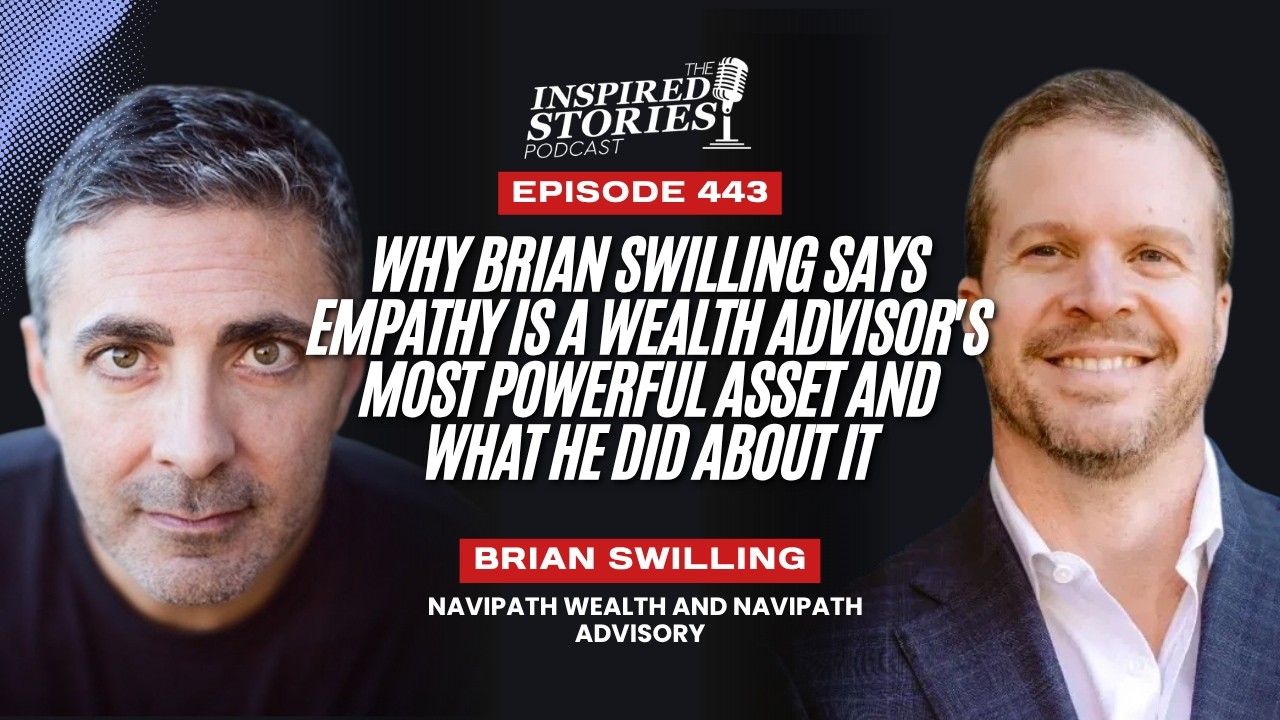
🎙️ From Hedge Fund Derivatives in New York to Behavioral Finance in Charlotte: Brian Swilling's Journey at Navipath
Brian Swilling, co-founder and partner at Navipath Wealth and partner at Navipath Advisory in Charlotte, North Carolina, shares his journey from arriving in New York City fresh out of UNC Charlotte knowing exactly one person, building a leveraged hedge fund lending business at Bank of America and later Credit Suisse that happened to be perfectly positioned when the 2008 financial crisis wiped out its competitors, to walking away from a comfortable corporate career with a three-month-old at home, moving back to Charlotte, and building two practices from scratch over the past decade by learning to put empathy ahead of expertise.
✨ Key Insights You'll Learn:
Spent 11 years in New York building hedge fund derivative lending at BofA and Credit Suisse, positioned perfectly after 2008 when competitors collapsed under Madoff exposure.
Left corporate banking after losing passion, quitting with a newborn at home thanks to his wife’s support.
Founded Navipath Wealth in 2015, targeting dentists—his family background gave him unique insight into their financial challenges.
Launched Navipath Advisory two years ago to provide tax planning, bookkeeping, and outsourced CFO services, filling gaps traditional CPAs couldn’t.
Common tax wins for dentists: 401k/profit sharing, cash balance pensions, paying children into Roth accounts, Augusta Rule, and proper vehicle deductions.
Built the Balanced Wealth Blueprint using behavioral finance certification, aligning client spending/saving with values and joy rather than generic retirement goals.
Uses AI tools: automated note‑taking integrated with CRM, FP Alpha for tax/estate/insurance analysis—freeing time for human judgment and presence.
Learned that Charlotte clients valued trust over his New York pedigree, a humbling reality check.
Defines his superpower as empathy, since numbers are commoditized but relationships endure.
🌟 Brian's Key Mentors:
His Wife: Supported his leap from corporate banking with a newborn, making the business possible.
Father & Sister (Dentists): Provided introductions and firsthand insight into dental finance.
Ryan Whitley (Navipath Wealth Partner): Early collaborator, proving partnership beats building alone.
JB Best (CPA Partner at Navipath Advisory): 30‑year veteran who joined to fill proactive tax gaps.
Team Training for Leukemia Lymphoma Society: Running group in New York where he met his wife, teaching him that showing up uncomfortable builds life‑changing support systems.
👉 Don't miss this conversation about why the numbers are no longer your competitive advantage as a financial advisor, what behavioral finance has to do with helping dentists pay off student loans, and how a guy who knew one person in New York eventually built two businesses in Charlotte by deciding that empathy is the real product.
Transcript
Anthony Codispoti (00:01)
Welcome to another edition of the Inspired Stories podcast, where leaders share their experiences so we can learn from their successes and be inspired by how they've overcome adversity. As you listen today, let one idea shape what you do next. My name is Anthony Codaspodi and today's guest is Brian Swilling, co-founder and partner at Navipath Wealth and partner at Navipath Advisory in Charlotte, North Carolina.
For more than 20 years, he has helped practice owners and high achieving professionals build tax efficient plans that match money with meaning. Navipath Wealth is a boutique advisory firm launched in 2015 that delivers holistic financial planning, investment management, and retirement strategies backed by the digital fetch financial life hub. Its sister company, Navipath Advisory, handles proactive tax planning
bookkeeping, and outsourced CFO work, especially for dentists and practice owners. Brian created the Balanced Wealth Blueprint framework and hosts the Oral Wealth Prosperity in Practice podcast, extending guidance to the dental community nationwide. He also serves on alumni councils for UNC Charlotte and Pi Kappa Phi, showing his commitment to give back. Now, before we get into all that good stuff,
Today's episode is brought to you by my company, Ad Back Benefits Agency. Listen, if you run a business, you are likely stuck in the cycle of rising insurance premiums. You're paying more, but your team, they're getting less. And many people can't afford coverage at all. We do things differently. We offer a solution that provides your employees with unlimited access to doctors, therapists, and prescriptions that's always free for them to use. But here's where you really need to pay attention.
Unlike every other employee benefit out there, our program puts more money into your company's bank account. As an example, we recently helped a client increase net profits by $900 per employee per year. Gains like that can change how a business is valued. Results vary, but the consultation is free. Imagine being the advisor that becomes a hero by introducing this to your clients. See if they qualify today at addbackbenefits.com.
Now back to our guest today, partner of Navipath Wealth and Navipath Advisory, Brian Swilling. Thanks for making the time to share your story today.
Brian Swilling (02:31)
I'm excited to be here. Thanks for having me, Anthony.
Anthony Codispoti (02:35)
Yeah, so you started out at Bank of America and hedge fund derivatives and later moved into something called Structured Alternative Investments. Can you give a layman's explanation for these two things? First, what are hedge fund derivatives?
Brian Swilling (02:53)
Yeah, so it was new to me when I started, because that was my first ⁓ job out of college. But both of those are doing the same thing with different names. The main product we sold was ⁓ lending. So either a line of credit or a leveraged position backed by hedge fund and private equity.
⁓ They were structured as derivatives because that was the easiest way to do it, but it was traditional lending. ⁓ So a lot of our clients were...
Anthony Codispoti (03:34)
do you mean backed by
derivatives? The derivatives were the collateral?
Brian Swilling (03:38)
Yeah, so the hedge funds were the collateral. The hedge fund and private equity LP interest were the collateral. And then we would structure the loan as a swap ⁓ and provide either a line of credit so that if they needed to bridge their investors redemption, so let's say example fund of hedge funds. They have their own investors which are pensions and
large institutions, and then the hedge funds have their own liquidity. So you have to bridge that gap. So that was one product. And prior to kind of the 2008, 2009, a lot of these companies ran leverage on their hedge fund, private equity portfolio to juice up returns. There was a big appetite for that prior to the financial crisis in 2008 and made off.
giving people concern about ⁓ some of that market. So it was a good ⁓ run.
Anthony Codispoti (04:42)
Explain what you
mean there. What was going on prior to 2008 and 2009? How they were using this leverage and how they were using derivatives.
Brian Swilling (04:50)
Yeah, so
the company, like I say, you would set up a company that would fund hedge funds. A lot of the institutions didn't have the capacity to do their own due diligence on what hedge fund is best for their portfolio. So these companies would do the due diligence, build a basket of hedge funds.
or private equity and then give their clients access to that basket. And then we would, usually there was two versions. we're talking about the leveraged version, there would have been the unleveraged version and the leveraged version and returns for most hedge funds in that time were smoother than the market. So less volatile, cause they're hedged. ⁓ So you could,
put leverage on it up to three times and give that enhanced return to the client. ⁓ 2008, there was the financial crisis of the mortgage market, but at the same time, there was Madoff, the Ponzi scheme, which was a hedge fund. lot of our clients had that exposure to Madoff. So once that happened, lot of our clients.
A lot of our competitors had clients. We actually didn't have any exposure to Madoff. ⁓ But at that point, there was just no appetite for a leveraged product. yeah, it out to be...
Anthony Codispoti (06:30)
And when you're saying a leveraged product,
explain that for a lay person.
Brian Swilling (06:34)
Oh,
yeah. So it's kind of like margin on your, if you had margin in a brokerage account or just simple terms, right? You have a, you have a just straight investment. It averages 5 % return a year, right? If you put three times leverage on that, it's a lot more risky, but returns for this example, 15%. Right. So
Obviously, if you're comfortable with that extra risk, you get more return. That's leverage.
Anthony Codispoti (07:08)
you're basically using the same pile of cash or whatever the collateral is.
borrowing money in a sense to make that investment two or three times. And if it gets that 5 % return each year, great. But if it goes down, whoo baby, right? Okay.
Brian Swilling (07:22)
Yeah.
Exactly. that's what
happened. ⁓ That's what happened. ⁓ Some of these funds went down and they lost appetite for that. So that was a start of my career. First, the Bank of America. Then they sold the business to a French bank. And then I was recruited to start with three other my colleagues to start the business at Credit Suisse.
And that's where I spent the first or the last eight years of my time in New York City. So it was an exciting time to grow a business from scratch for sure.
Anthony Codispoti (08:10)
and you were recruited specifically to grow what kind of business?
Brian Swilling (08:14)
the same business that we were just discussing.
Anthony Codispoti (08:17)
even though
people's appetite for this had kind of dried up at the time.
Brian Swilling (08:22)
Yeah, so we started right, we started a year before all the chaos. So what happened was we were positioned with, we were a newer, a newer entrant to the market. So we had a lot less of the bad exposure. So when our competitors had that exposure, they were getting out of the business and shutting down. So clients had the good, the good business had some needed somewhere to go.
And we were positioned ⁓ right there to accept, you know, take over that.
Anthony Codispoti (08:57)
Even though you guys
had very little runway, you had maybe 12 months or so of kind of establishing yourselves, you had the name of this French bank, Credit Suisse, behind you. And so as these other instruments, these competitors kind of fell apart because they were exposed to this risk, people are like, ⁓ here's another option. Pretty safe, pretty sound.
Brian Swilling (09:16)
Yep. At
that point they were like, who can take us? We can't not have this functionality, this ability to borrow. it was...
Anthony Codispoti (09:29)
So the business
just blew up for you at that point, I imagine.
Brian Swilling (09:32)
Yeah,
yeah, it was a very good run. ⁓ And I really enjoyed the growing part, building out the business under the new bank. At first, we were building it out. It was slow on purpose as we were building it up. Then all of sudden the floodgates opened and we were running full steam ahead. It was a good time.
Anthony Codispoti (09:58)
So you did that for eight years, did I that right? And then at some point you decide, ⁓ the comfy confines of a corporate job don't suit me anymore. What was the inspiration for going off to do your own thing?
Brian Swilling (10:00)
Yeah, eight years at Credit Suisse.
Yeah, it was building up over time. So I really enjoyed the growth part. It felt more entrepreneurial. Even though it was a massive bank, we were a smaller group and we were growing fast and I was taking on all these different responsibilities and filling in wherever it needed to make this work. And then as we grew, there was more layers involved. It became more of a...
of what you would think a bank structure would be, right? There's, you know, it was four of us all kind of working at different levels, but all working together. There was no hierarchy. And then the traditional corporate hierarchy came in and I had been doing it for 11 years and I just wasn't enjoying it as much as I was ⁓ and was looking for other opportunities.
they're the, you know, the bank didn't make it very easy on me to find those opportunities. You know, whether it was, well, you get paid too much to learn something new or, you know, or we could take you over here, but we think, you know, we'd have to cut your pay. I don't think you'd be happy. Right. Like, so there was a lot of that for a year for over a year. I was very transparent. I was looking for something different.
It was, you know, we were doing great. I was doing great, but I just fell out of love with the business. And I need, I'm somebody who needs to be inspired to really do my best work. And, and I lost that. So I, I started looking around for what I wanted to do. And the entrepreneurial niche or itch kept coming back.
It's like, do I take another cushy job with a similar salary, doing a similar thing, just to keep going? ⁓ Kind of dabbled in that. But then ultimately I was like, how do I use these skills and my knowledge of finance and financial services to provide, to help more people? And I kept coming back to financial planning and wealth management. So I ended up
Anthony Codispoti (12:37)
so you decided to
hang up your own shingle.
Brian Swilling (12:39)
Yep, I ended up leaving that company and ⁓ moving back to the Charlotte area where I grew up to start the business. So at the time I was married with a three-month-old and just picked up and came back. So, yes.
Anthony Codispoti (12:55)
That's a great time to quit your job and start
a new business, move to a new city.
Brian Swilling (12:59)
Yeah, I always look back on it. I could have done that way more strategically. I could have worked there for years without the inspiration, a couple more years without the inspiration, get more settled, get ready, but I felt like I just felt in my soul that this was the right thing to do.
Anthony Codispoti (13:25)
And so you move back to Charlotte, you start a financial wealth management company, what was the plan? Who were you going to target? How are you going to get customers?
Brian Swilling (13:33)
Yeah, so I grew up.
Yeah, I grew up in a family of dentists, so my dad is a dentist and then my younger sister also went into dentistry. I knew their unique. I knew I knew the uniqueness of that profession. I knew a lot of them want to become owners. I knew it would be a I understood that group and I and there end up being a good client because they.
earn a decent living and a lot of them become owners, which increases complexity.
Anthony Codispoti (14:09)
Okay,
so you had your dad, had your sister's clients out of the gate. Were they able to introduce a lot of their friends?
Brian Swilling (14:18)
Yeah, so that was a big part of it. Early on, was a lot of introductions to, you know, my sister did a great job of introducing me to her friends. They were younger at that point. earlier in your career as a dentist, you know, financial planning should be a top priority, but you have other things going on. So I got most of my success by
connecting with other people who work with dentists. So dental bankers, healthcare bankers, CPAs, commercial real estate people that find. So it was always a referral-based business. ⁓ Early on, I also got opportunities to speak at the dental schools, which got me in front of a lot of dentists ⁓ that
Again, they were younger, so not the ideal full financial planning client, usually ⁓ protection planning. So life insurance disability to get started. ⁓
Early growth was mostly from referrals and that work ⁓ trying to get in front of dentists.
Anthony Codispoti (15:43)
And Brian, what were some things that were specific or unique to dentists when it comes to the financial wealth planning services that you were offering?
Brian Swilling (15:52)
Yeah, the dentists, doctors, lawyers, they have a lot of school, Undergrad, right? Student loans, then you have dental school, then maybe you do a couple years in an internship or a GPR ⁓ at a hospital, and then you get started. So you come out.
with a lot of debt, a lot of schooling, a lot of knowledge on how to be the best dentist, but not a lot of knowledge on money, finances, how to run a business. ⁓ So I saw a lot of opportunity there and that expands. ⁓ Dentists are unique in the fact that they're highly educated and they're ⁓ but owners in general.
Like if you're a owner of a business, need a lot of help. You realize you can't do everything. ⁓ that became something I, know, Dennis is a big part of my marketing, but business owners in general have very, they all have very similar issues. And I realized that I have a unique ability to help them at least get the financial side.
that picture built and give them comfort that they are moving in the right direction. They're not just showing up to earn money.
Anthony Codispoti (17:31)
So we've got two different companies here today, Navipath Wealth and Navipath Advisory. What are the different services that you're providing in each?
Brian Swilling (17:40)
Yeah. So Navapathe Wealth is the financial planning, wealth management, investment management, protection planning. So typical financial advisory firm. ⁓ That was the original company. That was my passion. ⁓ We did a lot of tax planning over the years in Navapathe Wealth. So trying to find ways to mitigate tax bills. And we always needed to coordinate with CPAs.
to agree on the strategy so they could file the taxes, right? So it needed to be a collaborative experience. ⁓ Early on, we had good relationships through a lot of mergers and job changes. We kind of lost that key person to kind of coordinate with. ⁓ So the opportunity fell. A fraternity brother of mine from UNC Charlotte was looking to start up
tax accounting, bookkeeping, CFO business. He was, you know, he's older than me. He'd been doing it for 30 years, but was ready to do it for himself. Didn't want to work for the man anymore. ⁓ And reached out to me and we'd been thinking about how to fill that tax and accounting bookkeeping void and be pro and have a proactive partner there. So we ended up founding Navapathe Advisory to support that.
Anthony Codispoti (19:11)
What was the time frame? You started ⁓ Navopath ⁓ Wealth in what year and then Navopath Advisory in what year?
Brian Swilling (19:18)
Yeah. So
Navopath Wealth was started in 2015 and Navopath Advisory was started two years ago. So 2020-24 at this point. Yeah. So it's a newer company that's operating as a startup. There's three partners there. The CPA partner, ⁓ JB Best,
Anthony Codispoti (19:34)
Okay, so it's still pretty new.
Brian Swilling (19:47)
Brian Whitley and myself are all part of that business. And my main responsibility there is ⁓ business development. So thank God I don't have to do the tax and accounting and bookkeeping work. But it is a great resource to have internally, right? They've already, let's say they're already clients.
on the Nevapath wealth side, they've already built that trust. They have some tax and accounting needs, either their current person is ⁓ not doing a good enough job or they don't have the dental knowledge that we have. So we automatically have that trust and it's automatic. Everybody has to file taxes, right?
You know, so like it's a good resource to have, but it's really that tax planning, that proactive tax planning on both sides of the business that really move the needle for our clients.
Anthony Codispoti (20:57)
So your primary responsibility in Navopath Advisory is business development. Does that mostly look like talking to the Navopath wealth customers and saying, hey, we've got something to offer over here, or are you knocking on brand new doors as well?
Brian Swilling (21:13)
Yeah, it's, you know, obviously we announced it to all our clients, but we were very, if you're happy with your current person, like please stay, we'll work collaboratively with that person, just as we always have. But if you ever have a need, we have this resource. So a lot of the growth has come from introductions, again, referrals from,
other people working with dentists either from their starting, you know, they're only a startup practice or buying a practice or they're just unhappy with the current person. And because tax and accounting is so broad, actually have, you know, we talk a lot of, I talk a lot about dentists because that is a big focus, but we have a broad spectrum of business owners in that business and the NAPATH advisory business and the NAPATH wealth.
⁓ but again, every, everybody has to file taxes. Everybody should do financial planning and wealth management, but a lot of times they're not ready yet. So we actually get a lot of people new to NaviPath on the tax and accounting side. And then a year or two later, or a year later, they realize they need more help. And then we, we get them as a client on the NaviPath.
Well, so.
Anthony Codispoti (22:43)
So I'm glad you said what you just said there because I thought you were exclusively Dennis and you're like, nope, we serve a broad range of clients. So who is a fit for you, Brian?
Brian Swilling (22:56)
Yeah, the generic answer is successful business owners, right? So.
Anthony Codispoti (23:03)
certain
industries, geography, sizes.
Brian Swilling (23:06)
I mean, obviously healthcare, we understand very well. ⁓
It's really a profit for us. It's a profitability bucket, right? When we look at it as a whole, right? The tax and accounting side, if you're willing, if you're at a point in your business where you need to outsource bookkeeping, accounting, tax work, you need a little bit more advice, right? That's why I say successful. You know, it's not, the services are not cheap, right? Because they're, you know, we're proactive and
and engaged and best in class. We feel that we're that way. So it's not cheap. So you need to have at least established enough business to want to outsource that. On the well side, we look at it like if you're making
If you're making about $500,000 a year net, you're going to be a great client on both sides of the business. ⁓ And we do our business a little different than your traditional financial advisory firm. And we do that on purpose to be able to help these younger dentists, medical professionals, business owners. We don't have like a specific asset minimum. We have revenue minimums.
So a lot of these younger business owners, younger dentists, younger medical professionals don't realize they can actually work with a true advisor, not just somebody who is gonna sell them some life insurance or some disability, but like really work with the owner and his family to build a full financial plan. And again, that matches their values to make sure they're their money.
for the purposes that bring them joy and it's not just to save, right? Like there's a bigger purpose there. So we don't have a minimum, we just have a retainer based fee. So we can work with somebody who's just beginning to save.
Anthony Codispoti (25:19)
So what are...
Yeah, you've highlighted that you specialize in
this proactive tax planning, of big picture holistic financial strategies. What are some of the most common tax pitfalls that you've seen and how do you help your clients resolve?
Brian Swilling (25:39)
Yeah, I mean, most of the time it is adding, it's not tax pitfalls, it's just, we say, you know, there's a lot of gray area in tax law, right? And a lot of people just don't know all the ways they can take advantage of tax deductions. you know, the simplest thing is, you know, there's a lot of,
credits and benefits the government has put out to promote companies setting up 401ks, right? So you have a big tax bill, you're not providing a 401k benefit, profit sharing, sometimes cash balance plans. So that's an enhanced retirement strategy. But that's a good, that's an easy one, right? You have money that's taxable to say you have money in your right pocket that's taxable.
let's put it in a tax deferred bucket and reduce your tax bill today. So if you're a high earner, it makes a lot of sense to add that benefit for you and your staff. There's strategies like paying your kids, Make sure, if they have actual office duties, document the duties, right? And you pay your kids.
salary and then if it's under whatever it is now, 15-ish thousand, they don't have to file their own tax return. So you get to deduct that. The kid gets that money. We usually recommend that you set up a custodial Roth if they're underage to start saving for the kids. So they get that money tax-free and then it gets invested tax-free in a Roth. There's a bunch of
There's, it's usually not, a lot of the time it's not, made a huge tax issue. It's more, are you taking advantage of all the tax loop, you know, the tax opportunities? There's the Augusta rule. There's how you, you know, do you have a vehicle that is solely for business purposes? So a lot of that, a lot of that, a lot of adding things that they weren't aware of that have a huge tax benefit.
Anthony Codispoti (28:07)
You know, it strikes me, Brian, that you've now gone through, still going through to some extent, ⁓ two startups in 11 years. What have you learned? What did you learn from the Navipath wealth startup that now you're able to apply those lessons to and kind of add some shortcuts to your own business development with Navipath Advisor?
Brian Swilling (28:30)
Yeah, mean, you know, the early on I realized, like I tell my clients, is it's hard to build it on an island, right? So the first thing I did when I started my own financial planning practice was partner with another advisor who was Ryan Whitley, who was also working.
in that dental field because it's married into a family of dentists. So I was like, why, you know, it looks better as a team, share ideas. So we kind of worked jointly on a lot of things together and then decided to partner. So that was like the first decision ⁓ that we made is to try to build out that team, try to be more robust. ⁓ And partnerships have their ups and downs, differences in opinion.
how to do that. So I learned a lot in that process, which gave me a lot more comfort to start up the NaviPath advisory, the tax and accounting business. I already had that like experience partnering and growing a business. So I felt a lot more comfortable with the structure of how we would start this new business. And I knew it was going to be
You know, that operated, both of them operated as a startup, right? So no revenue day one, not, you know, not paying yourself, but you still got expenses. So I dealt with that on, you know, that growth trajectory on the Navapathe wealth side. So I was very comfortable with that process. Obviously finding partners that are willing to take that risk with you is hard, but we were able to find the right partner.
Anthony Codispoti (30:04)
scary.
Brian Swilling (30:24)
And that has been a very successful business and grown faster than the Wellside did initially.
Anthony Codispoti (30:34)
Well, that's the benefit of experience the second time around. So let's talk about your balanced wealth blueprint. As I understand it, this integrates financial goals with personal values. And I think maybe for our listeners, the best way to kind of wrap their heads around this is if you could share a real life example of how you layered this approach and created a positive outcome for one of your clients.
Brian Swilling (30:38)
Yeah.
Yeah, it's really, the whole idea is instructed in behavioral finance, right? So as the world gets more commoditized, so our world, your world.
The one thing that stands the test of time, even with AI coming in, the one thing that will stand the test of time is that relationship with another human, right? A of the things will, a lot of the old, like I sell a product, it's the best product. Our world is moving away from that to that more comprehensive, like let me really understand you and your family.
I've added like a values exercise. I a, recently got the behavioral financial advisor certification. Yeah. Which is focused on handling your own and client emotions and searching for the best outcomes in those relationships. Money is a very sensitive topic. Emotions.
Anthony Codispoti (31:56)
I didn't even know that was a thing. Okay.
Brian Swilling (32:16)
usually always come into play. We're emotional investors, like a lot of retail investors. Most retail investors, you can look at the statistics, are really bad at making good investment decisions, even if they know that they should buy low, sell high. Emotions get involved. So it starts with understanding the
Like, so you have a client, let's say they favor family giving back in vacation, right, and traveling, right? That's their core values. But they're spending all their time at work and not traveling, you know, not spending time with their family, right? So we need to realign. That financial plan needs to realign.
their money with their actual values. So it goes beyond just, hey, let's start saving for retirement. It's like, let's, how can we structure your business, your personal life to do more traveling, to spend more time with family? And how is money going to be the tool to reach those goals? Obviously, retirement is, you know,
Some form of financial independence is always part of a plan, but again, it's not what drives the plan and not what drives the client. So ⁓ I've had a lot of success with people finally understanding, putting it on paper, like, yes, these are the things I value. So it makes them able to make decisions much better that align with those values.
Anthony Codispoti (34:14)
Is it difficult for you to transition into this way of practicing? You know, we typically think of people in silos, right? We've got these finance guys, they're great with numbers, they can connect the dots there, but they're not generally the people that we think of as being, you know, good at handling people's emotions. That's sort of a different bucket of people.
Brian Swilling (34:35)
Yeah. Yeah. And it's, it's an interesting approach, right? You can't just be like, I'm here to handle your emotions, right? Like, you know, I was nervous about like looking at my clients, which clients would like really be into this, you know, looking at their values, right? Aligning their values with their goals. ⁓ and others ones like, no, just talk to me about the numbers, right? So you still have
a lot of those, but as technology improves, the numbers are the commodity, right? It's again, it's the, if I can really understand my clients and they feel that real, that they know that I understand them better than most and have their best interests at heart, we're able to achieve goals a lot faster than somebody who's just trusting me with the, you know,
the number, the investing, right? The retirement plan, right? So the main success is that building that trust because the technology is gonna keep improving and all that stuff's gonna become easier, right? More commoditized. So the relationship is the key in those, you know. So will it be a good fit for everybody? No. But.
I'm at a point where I want clients that value my services and I want clients that appreciate how I deliver, right? So it has been a transition, it's early in that transition, the Balanced Wealth Blueprint, which is the name I've called my new financial planning process incorporating these behavioral finance aspects, the values, ⁓ but it's...
Clients have really appreciated it. And some of my current clients are like, no, I'm good. I'm good with status quo. We don't need to go all this level. But most of my new clients come in and have that process and have been happy. And I've seen accelerated ⁓ adoption of my recommendations because of it.
Anthony Codispoti (36:53)
Let's talk about technology that you mentioned. AI is at the forefront of everybody's minds. ⁓ How are you guys using it today?
Brian Swilling (37:03)
Using AI specifically? Yeah. the first thing, which has been a game changer, we are in a very regulated field. So random use of AI ⁓ is frowned upon, right? It has to be compliant. But the first thing that we leveraged was using a AI note taker that's connected with our CRM and
financial planning software, ⁓ and our asset allocation tool, right? So it's incorporated with all those tools. So it pulls in information that we already have, and it pushes out information, new information that we get when we talk to them.
That's been a game changer because I don't have to sit and take notes constantly and get distracted from the real client conversation. So I can be more engaged with clients and provides a massive amount of resource that even taking notes wouldn't, I would have missed a few nuances. So it's been a huge game changer. ⁓
used AI to help with marketing, that's always been a hard thing for me to think of ideas. And AI has been a huge resource to kind of move that process forward.
Nya dee.
You know, now we in the meeting app, also does meeting prep. So it looks at old meetings and all the other connected systems and also improves the meeting prep time. So it reduces meeting prep time by a lot. But that's just to start, right? Soon, you know, we're working on how, what other ways can we use AI? Can we use AI to help?
the integration between the different softwares, right? Can we use AI to streamline a financial summary, right? Could we upload a bunch of documents into AI and have it put together a personal balance sheet and throw out ⁓ suggestions or issues? ⁓ We're another software, FP-Alpha that
analyzes tax returns using AI and your estate planning documents. And now they've added insurance, commercial and property casually insurance review. So if you get your declaration page and we upload it and it can, it'll spit out some suggestions, some are not relevant, some are, so you still have, you still need a human
aspect to it. And I think that's the biggest thing I've discovered is like, can't just throw it in AI and trust it. I've got to verify it and use my own knowledge of the situation of the person to see which suggestions are actually valid. ⁓ But I think we're just at the, you know, because we're regulated adoption is slower, like a very regulated industry adoption is slower, but it's, it's just at
You know, it's just getting started. ⁓
Anthony Codispoti (40:46)
So let me kind of peel back layers of the onion there. I want to hear about a couple of these use cases. This AI note taker, obviously this is an approved, secure tool that you can put the information into. And I think if I understand how you're using this, you can take transcripts from client calls. ⁓ It helps to feed that information into a CRM or maybe another tool that you're using to do some of the financial analysis. ⁓
Maybe it's also pulling in email communication with clients. So it's got like a full 360 view of the conversation that's been taking place. ⁓ And then as you're getting ready for the next meeting with the client, it's providing you some sort of talking points or a summary of, hey, here's kind of what we said we were going to do the next time so that you're coming in fully prepared. You get to spend more time face to face with the client, less time sort of behind a computer screen.
doing the data entry on all these notes and going back through everything. So it's sort of like the world's best assistant.
Brian Swilling (41:45)
Yeah,
yeah, I mean, that's exactly what it does, right? It'll join my virtual meetings, which a lot of my clients are virtual, because I have clients all across the US, so I can work with clients anywhere. The phone app, so if you meet in person, you can just turn it on. Obviously, you gotta always disclose, hey, I'm gonna use my AI note taker.
And then it does all those things. You talked about it. It's feeding all that information, saving it in CRMs. The next steps would ideally be like, hey, when we get a new document, automatically save it in this folder. Or if we get this, do that, right? That's the next step, ⁓ I think, in the AI journey for us.
Anthony Codispoti (42:43)
And then ⁓ marketing side of things, less regulated for you, right? You're not putting sensitive client information in there. You're just kind of using a chat function of an LLM and saying, hey, here's my business. What are some ideas you can give me? ⁓
Brian Swilling (42:57)
Yeah,
usually it's directed at, if I have a issue with a client or a question that clients bring up more than once, that's usually how my marketing is, like my ideas come. Like if more than one person has it, or if a client comes with an interesting idea that requires, that would require some kind of more information, and I think other people would have interest.
Those are their ideas. So I keep a list of ideas that come up and ⁓ AI has just accelerated that process. Cause if I have the idea and it understands my business and how I would write, you know, a social post or a blog, it does a really good job of streamlining and making that process a lot less painful for me.
Right, sitting down to write.
Anthony Codispoti (43:55)
Which LLM
have you found preference with?
Brian Swilling (43:58)
Yes, I've tried a lot of them. I've used Google Gemini. I've used ChatGPT. I've used Microsoft Copilot. ⁓ But I found for my purposes ChatGPT has been the best. I actually have a friend coming over tomorrow to show me all the stuff he's done in Claude. ⁓
He, I think for him, it's a lot, do, does a lot more coding. So it just depends on what you're looking for it to do. For me,
asking questions, getting, you and I use it as an enhanced Google. when you first, if you had a question about something, you might Google it. You know, I've used chat GPT in a similar way or to draft.
me draft marketing stuff.
Anthony Codispoti (45:01)
Let's talk about your podcast, Oral Wealth, Prosperity, and Practice. Obviously, given the name, could see this target specifically the part of your business that is working with dental practices. What are some things that you talk about on the show, some unique financial operational hurdles that maybe folks can learn more about and how to resolve?
Brian Swilling (45:22)
Yeah. So first off, oral wealth kind of always gets people like, that's a weird name. Obviously it's play on oral health, So oral health or wealth. So the podcast was designed and originally with a co-host who's an oral surgeon locally. We did a bunch of the first episodes together. He got too busy to keep going. So the later episodes are me and guests, myself and guests.
But we want to talk about the same way as like, what are the biggest issues that dentists are facing? You know, and we open it up to like, you know, dental medical healthcare, ⁓ so adjacent, but it's a heavy, obviously a heavy dental, dental focus, but we want the stories to translate outside to others, you know, professions that have similar issues. But
You know, it's like student loans, right? Understanding all the changes in the student loan market, right? We'll have a podcast on ⁓ how to like when to know when to buy a practice. Like, do you want to be an associate? Like a lifetime associate? Do you want to buy a practice? Do you want to do a startup? What are the differences? What are the hurdles? Like what financially do you need to get together to make that happen? ⁓ We talked about.
I had a guest on about selling a practice. So it's really that life cycle from dental student to ⁓ I'm ready for the next chapter. I'm going to sell my practice or retire or want to reach financial independence. So it's everything in between like hiring, ⁓ hiring staff. So all the it wants to be, the goal there is to have a story.
for all the different stages of what it's like to be a dentist.
from young age where you're working as an associate and it's just a job to paying off student loans, to starting your financial plan, like understanding. I think we have one episode about how to hire a financial, like what to look for in a financial advisor, right? Like early stage stuff to the, okay, now I have a little bit more complex situation, buying a practice, starting a family. There's a whole lot of levels to that.
⁓ that we could talk about at different levels, but it's mainly that life of a dentist from going to dental school to what it's like after you hang up your smock or sell your practice. So ⁓ I think it could relate to all business owners, but we are, and you're probably familiar with this, it's just niche marketing.
works really well, better than I work with everybody. ⁓ So that's still a big focus. I still think that market is underserved because either they're too busy to focus on financial planning or they don't even realize before they have that $500,000 million that they can actually work with a real professional. So ⁓ I still got work to do there.
Anthony Codispoti (48:55)
What, can people find it on all the big podcast platforms or just on your site?
Brian Swilling (48:59)
Yeah. So it's
on, it's everywhere. You can listen to podcasts and on YouTube. So we do video and audio.
Anthony Codispoti (49:03)
OK. Great.
We'll make sure we get a link to that and put it into the show notes for folks. But I want to shift gears for a moment, Brian, and would like to explore a very big, serious challenge that you've had to overcome in your life, how you got through that, and what you learned going through the process.
Brian Swilling (49:22)
Yeah, so I think my first challenge was, I guess my first challenge was moving to New York City for my first job out of college and knowing one person. Like I knew one person that lived there. I'd been in the Charlotte area the whole time before. I grew up in a town called Gastonia right outside of Charlotte, went to UNC Charlotte and then...
got a job in New York City. ⁓ So that was different place. First corporate job, lot of life, ⁓ some lonely times, some like, what am I got myself into times? Like, can I really afford this rent? Like, do I need to get a roommate? ⁓ Then the next big, and that was a struggle for the first year. And then it just became home really.
⁓ But then the next challenge was like, can I really leave this job that's treated me so well and I've done well at it, I'm really good at it? ⁓ Am I being irrational for losing that passion, right? And so that was a big transition is like, am I ready to go from the corporate world to starting my own thing?
And especially when it's adjacent, but it's not the exact same thing I was doing. ⁓ So that was a hurdle and it took talking to my family, the support of my wife with a young kid, she could have been like, absolutely not. We've got to be safe and you're going to be working this corporate job and hate it for as long as you want. But she's like, no, I want you to be happy.
whatever we gotta do. ⁓ So that support system really got me through that. I probably wouldn't, without that support, I probably would still be working in investment banking in New York City and ⁓ probably commuting from the burbs two hours and it wouldn't have been very fun. But when we're talking about practice, like growing a practice,
I, the biggest struggle was I was overconfident in how fast I could grow this because of my, because of my background. like, everybody, you know, like I had to stop talking about, I spent, you know, 11 years in New York city. you know, people want to work with people they know, like, trust. They, you know, I learned very fast that they could really care less.
about my investment banking experience. Yes, it does give me ⁓ more knowledge than somebody who decides to become a financial advisor without that background, but that did not accelerate my growth. I think early on it turned some people off. ⁓ Charlotte is still, Charlotte's a big city, but it's still got the small town vibes. Like people wanna work with.
people they know, and trust. And they're not Googling your background before they decide to work with you, right? ⁓ So that was a big hurdle in realizing how hard it is to grow a business and how hard it is for people to talk about money. that's still a struggle to this day, is just making money a comfortable conversation.
talking to a client in the way they understand, you know, and not trying to be the smartest person in the room, like learn how to understand the client.
Anthony Codispoti (53:27)
So I want to go back to the first challenge that you started with moving to New York. You knew one person lonely, bills are high. What did I do? But within a year, you're like, oh, this is home. you know, like a big shift. What were some of the incremental steps in between that got you from feeling very lonely? And did I make a mistake to now this feels like
Brian Swilling (53:53)
Yeah, when you're in that situation, like early on, luckily I was working with a lot of other young professionals, right? So I got close and we worked very closely together because we were kind of a small group. We were always a smaller group, ⁓ even though the business was pretty big. ⁓ So first, I started off by the support of my coworkers, right?
you know, let's go out and hang out after work. Then I started building, you know, through the one person I knew, he was working 95 hours a week, so I didn't get to see him that often. But when I did, you know, ⁓ you should meet my friend and you just start building out that network of support. And, you know, I say a year, it might not have been that fast, but
It was hard initially, but got much better as I kind of fell into the flow. ⁓ You know, one of the things I did to start meeting other people was I joined ⁓ a group that raised money for Leukemia Lymphoma Society and trained you for like a marathon. So that's where I met my wife. So I had my work, you know, hang out, you know,
drink crew and then I had my, all we do is talk about running crew. So those crews, you know, didn't really mesh very well, but like, just found ways to build, to meet people with, with similar interests. actually wasn't a runner at the point. was like, let's see if I can do this. ⁓ So, you know, it just took, it took effort. It took effort and, and built, you know, put myself out there to find that support. And, you know, and the,
Business was going well. I was getting paid well. It became easier to pay, right? ⁓ My contract that I got out of college, my offer was like, dude, is like, it probably was the same you would get offered to live in Charlotte.
but was in New York City, so it goes a lot farther. So luckily I was, there was growth in the company, in our business, and I found success and I finally, initially it was like, oh, I'll get paid enough to live, and then, oh, I get paid pretty well. So that, obviously, money does help to a certain extent.
Anthony Codispoti (56:37)
And the other part of your story that I really like there is like you, you didn't sit on the couch, right? You were trying things. It's like, okay, like making the extra effort to get to know the folks at work and hey, let's go out for drinks or dinner afterwards. You know, you volunteer this leukemia association, you, Hey, I'm going to try to be a runner. ⁓ you know, you just put yourself in different situations to try to meet people rather than sitting there and feeling sorry for yourself and hoping that the solution to your problem falls in your lap. Right.
Brian Swilling (57:06)
Yeah, and it's hard, especially in a new city. And a big city like that, it's harder to meet people. You have to put yourself out there. You're not gonna meet your neighbors. A lot of them won't even make eye contact with you as you walk down the hall. yeah, if I wanted to live an enjoyable life, I had to put myself out there.
That's every, that never ends, right? Like you got to constantly have to put myself out there to get new clients or to find ways to grow my business or, you know, to how do I serve my clients better? Like, am I giving them the best service? And you got to get uncomfortable to grow, ⁓ whichever, you know, keep having to remind myself over and over again. Cause then you never know.
Anthony Codispoti (58:03)
Yeah, growth comes from being really
uncomfortable at times, doesn't it?
Brian Swilling (58:07)
Yeah, I mean, that's where, you know, if everything comes easy, that's not where the growth, you know, that's not where growth comes, right, personally or professionally.
Anthony Codispoti (58:18)
You know, the other interesting part of your story there, Brian, is when you started the business, you were overconfident about your ability to grow it very quickly. I've been there multiple times, businesses I've started. I hear a lot of that on the show. Like if, you know, if you had known how difficult it would have been, you might not have done it. you know, so in some ways that, that naivete can be a little bit ⁓ powerful for you in the end, right?
Brian Swilling (58:45)
Yeah. I mean, that's why a lot of people don't go into entrepreneurship or starting their own business because...
they think of all the ways that they're gonna fail rather than the ways they're gonna achieve. So you're right, like you have to have a little bit of the same reason I just quit my job and moved a three month old back to Charlotte. And then is the same reason I was just like, let me just do this. I don't wanna work for a bigger company and start my branch that way. I wanna do it on my own. So I've been...
I've been independent, running an independent practice from day one. I've never had to sell a company's products or never had to like meet hurdles that a company provides. Right. So I don't have that support of the company to help me build my business. you know, I had, luckily I had the overconfidence to think I could do it. And I did, you know, it's
It's been a great run and I feel like I'm just now getting started.
Anthony Codispoti (59:59)
Yeah, it sounds like you found your stride and you're getting ready to sprint here. What do you think your superpower is, Brian?
Brian Swilling (1:00:07)
Man, you know, my wife might argue this point, but I think empathy is my superpower. And it doesn't always come easy, but just being genuinely.
empathetic about clients' issues. So non-judgmental. Sometimes you want to jump right to the, oh, this is an easy fix. Here it is, right? But as I've aged, I realize that my ability to truly be empathetic, understand what they're going through, really try to understand how they're feeling.
It has been a big growth engine for me or a way to build that lasting lifetime client, right? Most of my clients are not, again, we're not just selling a product, we're selling any experience around your money. So we want all clients to be with us from the beginning all the way to the end. So you got to really build that trust and you want people to
be able to come and talk to you about, hey, I'm thinking about buying a vacation home or thinking about sending my kids to private school or I didn't want to tell you I have a bunch of, we've been spending too much and I have a bunch of credit card debt. I didn't want to tell you, but you've been a good listener. I want to build that where even if they bring stuff like,
I want them to come with anything money adjacent and be that first resource for them. And the superpower of empathy, I think, has given a lot of my clients that comfort.
Anthony Codispoti (1:02:13)
Yeah, empathy is not the answer you would expect from a wealth planner. But I think this ties in with, you know, your interest in behavioral finance, right? This is you want to go a layer deeper than what most people are doing.
Brian Swilling (1:02:18)
Yeah.
Yeah.
Yeah.
Yeah. I mean, again, I could say, you know, my superpower is, you know, getting the best return, but we can't even say that because we're a regulated industry. You can't even claim return. Like I'm the best at picking your insurance or I'm the best at picking your retirement plans. you know, again, that's commoditized businesses. How do I really grow that balanced wealth blueprint idea? And it is through empathy. And I get that a lot.
was like, why is it numbers related, right? ⁓ It's like, I'm trying to do my daughter's fifth grade math and I'm like, I need Excel to do that. We have systems to do all that stuff now. ⁓ But yeah, I think that's my superpower.
Anthony Codispoti (1:03:12)
Yeah, it's a good one. You know, I've just got one more question for you today, Brian. But before I ask it, I want to do three quick things for the audience. First of all, if you want to get in touch with Brian Swilling, got a few options here. His websites are navipathadvisory.com and navipathwealth.com. We'll have both of those in the show notes. You can find them on LinkedIn, Instagram, Facebook. We'll have all those links too. And his email address, Brian.
b-r-i-a-n, brian at navipathadvisory.com. And if you're enjoying the show today, please take a moment to subscribe wherever you're listening. It sends a signal that helps others discover our show. So thank you for taking a quick moment to do that right now. And as a reminder, you can be the hero advisor that helps clients give their employees access to therapists, doctors, and prescription meds while paradoxically increasing.
their net profits, real gains that can change how a business is valued. Contact us today at addbackbenefits.com. So last question for you, Brian, a year from now, what is one very specific thing that you hope to be celebrated?
Brian Swilling (1:04:21)
I, a year from now, I would like to have a business that I feel fully supports my community, which means growth, right? So ideally from a year from now, know, I've, you know, it's a big goal, but doubled in size, you know, I'm able to hire
more people maybe bring in, you know, people wanting to get into the industry and, you know, teaching them the ropes. So building a true legacy practice, which I've been doing, but like really see that coming.
see that picture actually happening in a year. think I'm easily on the trajectory to get there and be able to help more clients ⁓ and serve the clients that I do have to the best of my ability. think growth is needed to be able to bring in more people into the industry and support my clients to the best of my ability.
Anthony Codispoti (1:05:44)
Do you really think doubling your growth in the next year is achievable?
Brian Swilling (1:05:48)
I think I'm going to shoot for it. I think it's going to be hard. I, again, I'm going to have to get out of my comfort zone. spent, you know, early on, I spent a lot of growth time focused on growth. Then I'm like, you know, I've grown, but am I doing everything the best of my ability in my practice and for my clients? Like, what can I, how can I serve my clients better?
So, you know, and I formed the balanced wealth blueprint. So I've done that, all that legwork. So I have the structure there to be able to accept that growth, right? So I've been refocused on that growth, but it means getting out there, getting uncomfortable and doing the things that get me in front of people who might be interested in working. So doubling.
Doubling will be hard, but I'm gonna shoot for it. Yeah, yeah.
Anthony Codispoti (1:06:50)
going to go for it. Love the confidence. Brian
Swilling from Navipath Wealth. I want to be the first to thank you for sharing both your time and your story with us today. I really appreciate you being here.
Brian Swilling (1:06:59)
Yeah, thank you. I'm
so glad to be on. This has been a great conversation. Hope other people are inspired.
Anthony Codispoti (1:07:07)
I'm sure they will be. Folks, that's a wrap on another episode of the Inspired Stories podcast. Thanks for learning with us. And if one thing stood out, put that into action today.
Connect with Brian Swilling:
Email: brian@navipathadvisory.com