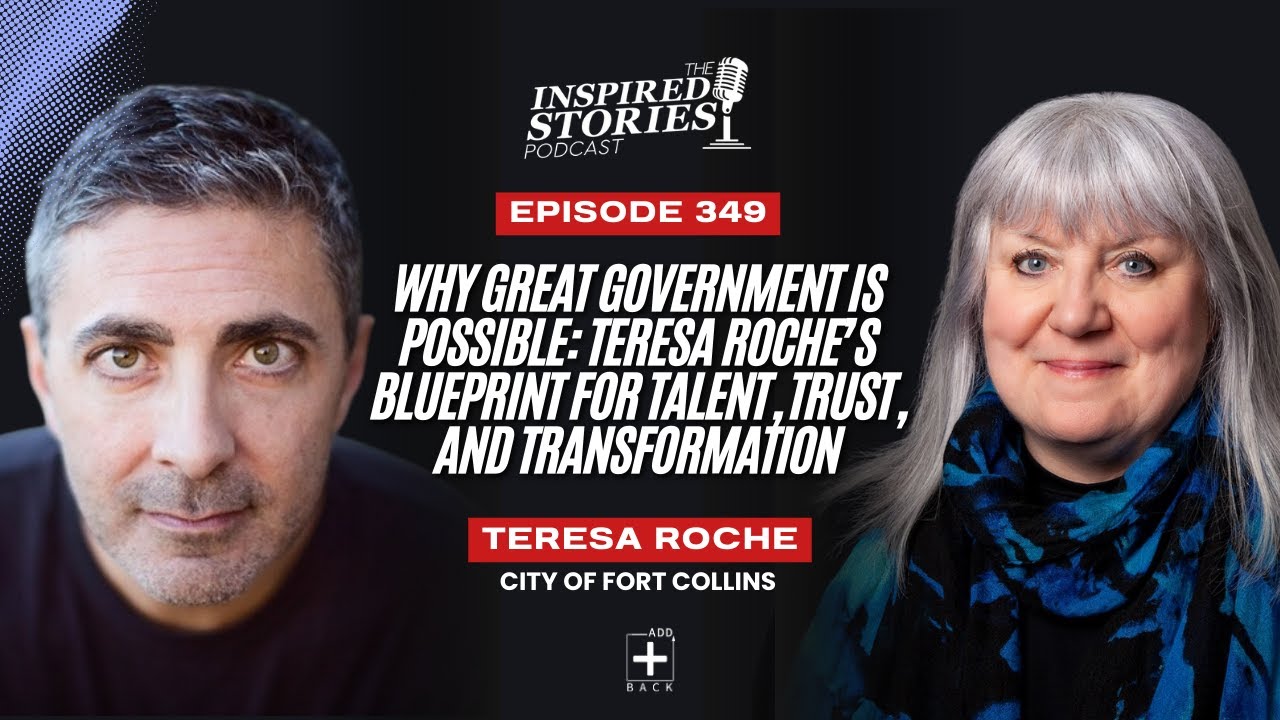
🎙️ From Accidentally Joining HP to Malcolm Baldrige Excellence: Teresa Roche's Public Service Journey
Teresa Roche, Chief Human Resources Officer at City of Fort Collins, shares her journey from accidentally falling into HR at Hewlett-Packard in 1981, to building 90% internal senior leadership bench at Agilent, to leading 2017 Malcolm Baldrige National Quality Award-winning city government discovering "the city broke me and the city made me whole."
✨ Key Insights You'll Learn:
-
Accidentally joined HP 1981: "when you want to save the world it's hard to put it in five-year increments"
-
HP 1984-85: saved 1,500 material handlers from layoffs through community college retraining program
-
Agilent 90% internal bench: filled both 2014 split CEO positions entirely from within
-
Best CEOs are internal hires with outside experience: sent candidates to board programs
-
Fort Collins 2017 Malcolm Baldrige winner after 2016 failure provided improvement feedback
-
Community broadband fiber: 25,000 customers, underground fiber beats private competitors
-
COVID Future of Work: essential workers get three annual flex days for fairness
-
Purdue students: "used to think government workers wore gray, now see innovation"
-
Hogan derailers revealed stress denial: "city broke me and made me whole"
-
Metrics: 90%+ acceptance rate, retention gaps analysis, employee experience surveys
🌟 Teresa's Key Mentors & Influences:
-
Dick Stewart (Purdue Placement Services): Mentor who set up HP interview saying "only company you should work for has values"
-
Bill Sullivan (Agilent CEO): Initially skeptical ("spread rose petals?"), became two-in-box partner caring about development and business results equally
-
Gene Halloran (Agilent): Developed metrics framework with Teresa (acceptance rate, retention, leadership quality)
-
Darren Atterberry (Previous City Manager): Asked hundreds "do you think local government can be great?" (none said yes), charged performance excellence
-
Zach Mercurio (Fort Collins Author): Wrote "Mattering" about discovering purpose, what fulfills you, what gives joy
👉 Don't miss this powerful conversation about accidentally falling into HR speaking from heart versus technical knowledge, building 90% internal senior leadership bench at Agilent through intentional outside-experience preparation, and why "the city broke me and the city made me whole"—because seeing your derailers under stress, being willing to look at shadow side and heal them without getting afraid, creates ongoing life challenge felt most acutely in public service.
Listen to the full episode here
Transcript
Anthony Codispoti (00:00)
Welcome to another edition of the inspired stories podcast where leaders share their experiences so we can learn from their successes and be inspired by how they've overcome adversity. My name is Anthony Cotispodi and today's guest is Teresa Roach, chief human resources officer at the city of Fort Collins. They are known for their innovative public services and strong focus on sustainability.
highlighted by its 2017 US Malcolm Baldrige National Quality Award. Teresa works with a dynamic team to transform the city's workforce through programs that promote inclusion, resilience, and future-oriented thinking. She navigated the challenges of the pandemic and led the Future of Work Initiative, always striving to co-create environments where employees can thrive. Teresa's background includes time in both private and public sectors.
And in the city, she implemented talent management systems, launched employee resource groups, and increased senior leadership hires from within. Now, before we get into all that good stuff, today's episode is brought to you by my company, Advac Benefits Agency, where we offer very specific and unique employee benefits that are both great for your team and fiscally optimized for your bottom line. Imagine being able to give your employees free access to doctors, therapists, and prescription medications.
And here's the fun part. The program actually puts more money into your employees' pockets and the company's too. One recent client was able to increase net profits by $900 per employee per year. Now results vary for each company and some organizations may not be eligible. To find out if your company qualifies, contact us today at addbackbenefits.com. All right, back to our guest today, the Chief Human Resources Officer of the City of Fort Collins, Teresa Roche.
Thanks for making the time to share your story today.
Teresa Roche (01:54)
Of course, I'm honored and humbled to be here, Anthony. Thank you.
Anthony Codispoti (01:57)
So Theresa, what first drew you into human resources? Why were you attracted to it?
Teresa Roche (02:02)
Well, the truth is I wasn't. I had no idea what it was. I didn't have any ⁓ supposedly academic, educational, or work experience. And I was an intern during my masters, and I had a wonderful mentor, Dick Stewart, who headed up the placement services at Purdue. And he came to me one day and he said, Theresa, I really think you should consider the private sector. And I had planned to either be a therapist, go into higher education.
never thought about the private sector. In fact, I had an aversion towards it, which is interesting. That's a long story which we don't need to talk about. ⁓ But I had a black and white view of the world back then. And he said, in the only company I think you should work for is Hewlett Packard, because they have a set of values and their environment as such, you will fall in love. In fact, I have an interview set up for you tomorrow. And I met Jerry Carroll and Anthony
Thank God there was no videos, social media back then because my interview was pathetic. I mean, I didn't know what I was talking about, but I spoke from my heart. Jerry, so trusted dick, I must have made some of an impression on him. And next thing I know, I flew out to HP in the Bay Area and interviewed with people. And this was 1981, the world was so different then. And I walked into the division. I'd read all I could, but none of it made sense to me.
and there was 10 men and one woman, and that division had never done interviews for HR people. They mostly interviewed engineers, so they gave me a technical grill. And, Anthea, I'll stop with this story. They asked me, what do you want to do in five years, Teresa? And because I didn't know any better, I just spoke my truth, which was, well, when you want to save the world,
It's really hard to put it in five year increments. And nobody flinched. I, oh my God, now I'm 69, so a lot's changed since then. I hold both joy and sorrow, Anthony, but many of the people afterwards in my one-on-one detailed interviews said I knew exactly what you meant. They took a chance on me. And I naturally gravitated.
Anthony Codispoti (04:05)
You're a rosy idealist.
Teresa Roche (04:26)
⁓ And again, there are multiple stories I could share, but I fell into it. And it was so long ago, Anthony, was called Personnel, which is what it was called originally in the army. So my friend, let me pause there because that's how I got into human resources. Serendipitous, accidental. Yeah. Hmm.
Anthony Codispoti (04:44)
What kept you in it? Yeah, what kept you in it? Why did you feel once
you understood what it was and you got your feet wet with it, you were doing it for years, like what kept you there?
Teresa Roche (04:52)
Mmm.
So, Anthony, I have the benefit of looking back. I wouldn't have said this during my early years, but I look back and a deep purpose for me is fulfilled because I so love helping people interpret patterns and signals to make meaning and take effective action. And that happens every day, every moment in the field of human resources.
So whether it was compensation, benefits, development, OD, staffing, I mean, there are ways to move and make progress with people. And I think that just was soul work for me. In fact, I would tell people it was spiritual for me.
Anthony Codispoti (05:43)
When you talk about ⁓ interpreting patterns and signals when it pertains to HR, what does that look like?
Teresa Roche (05:47)
Hmm.
Well, I have an innate ability that I notice things, both physically and the emotional energies. Like I feel things, but I also notice things. And I'm a big reader, so I scan. So I take all these data points, emotional, mental, physical, and I make meaning. And I'm able to put it in words to offer it.
to others and so how it's applied in human resources. I'll give you a very specific example when I moved into a corporate role shortly after I joined Hewlett Packard. A phenomenal colleague of mine, Denise Smith-Hammes was doing workforce planning which had never been done before. And she invited me to part of that and we were able to see that the changes of outsourcing to Asia
and just the changes in the world and in the Bay Area that we needed to identify there was going to be more workers in a certain function than the company was going to need given the pattern and signal of moving to Malaysia and Singapore. That became a glorious opportunity to identify alternatives because back then in 1985, Hewlett Packard was unwilling, unless it
absolutely had to, to lay people off through no fault of their own. So we came up with some stunning programs with the executives of HP and other HR colleagues. So that's an example I would share of being attuned, make meaning with others, and then figure out how do you respond to that? Take effective action.
Anthony Codispoti (07:20)
Hmm.
Can you tell us about one of those
programs? We're really gonna pull this off.
Teresa Roche (07:42)
Yeah, I'll tell you one that ⁓ I ended up personally leading just because of what my role in the company was at that time. We had a number of material handlers. In fact, I don't think people today know what a material handler was, but we have material handlers. And we knew that there was a time coming soon when their employment was no longer going to be in that field. fact, anywhere in the Bay Area.
And I worked with the local community college, California in the Bay area has amazing ones. And with faculty and a couple of HP leaders, we designed a curriculum to help people that were material handlers go through a community college curriculum in a very intense focused way to develop skills to be administrative support. And it was amazing.
and people were challenged by it. And yet we knew we had need for administrative support. And so the people went through this development program and they were successfully placed in other positions in the Bay Area. Yeah, it was a big wow. I mean, I could get emotional about that because it was so beautiful to see people struggle and then find new meaning and then know that they could be employed still.
Anthony Codispoti (08:55)
specifically within HP or
Interesting. I wonder ⁓ how you view what's going on with AI now. Is there a similar opportunity there? when we have these new technologies come about, ⁓ people get displaced. And people are like, well, it's going to create new jobs. But is that new job going to be for the 57-year-old person who is almost at the end of their career?
Teresa Roche (09:18)
Hmm. Yeah.
course.
Anthony Codispoti (09:36)
Are they gonna step into, for us now, this new AI function? How do you view that? How do you wrap your head around it?
Teresa Roche (09:41)
Yeah. Well,
Anthony Bloomberg just did this quiz that I had executives and people on my team take. What AI identity do you have? And it just really was a delightful quiz. And I will tell you, I am a both and. AI is definitely disrupting, upending, disorienting. And I read this morning in my scanning,
Amazon's going to lay off, think it's at 30,000 people. AI is...
Anthony Codispoti (10:14)
And those
are 30,000 office workers, which is about 10 % of that side of the workforce. Sorry, go ahead. Yeah.
Teresa Roche (10:19)
Yeah, you read that too then.
So for me to say, AI is wonderful, which I do have part of me saying that, it would be foolish for me not to acknowledge there is pain and difficulty in it. So it's a both and. Now think about it, HP in 1984, 85, it had the wherewithal, the capacity to say, we see this happening.
let's prepare them. Now it wasn't 30,000 people that we had, it was 1,500 in the Bay Area, and it is a different world now. mean, Anthony, just a couple things I'm going to say. One is, um,
There was a great book, I think it was Thomas Friedman, who said, thank you for being late. I think that was the one. And he said, in 2016, I think the book came out then, there are three things happening simultaneously, the three M's, simultaneously and exponentially, Mother Nature, Moore's Law, and ⁓ markets. So internet and the whole way we could sell B2B,
you know, person to person through eBay and others. That's like, totally upended any building structure, middle people to do the selling. ⁓ Mother Nature, I I don't know how you feel about the climate change that's happening, but I think anyone that tries to deny it ⁓ may not have their eyes open. And then of course, Moore's law was going even faster, which is that technology, you know, will be, ⁓ what was the word?
will shift or be disrupted, it becomes obsolete. All three were happening simultaneously. I think people cannot even keep up mentally with all that's happening. And I deeply understand, as frustrating as it is, that CEOs have to think about their shareholders who put demands on them for stock price.
Customers want the lowest price, employees want the highest pay. I it is a tripolarity that they're facing. And I wish we were a world today that we could have more time to say, what would be the dignified loving response here? What could we do to help people? Now, the thing I want you to know is I love AI. I mean, I have three different personal chat apps that I use.
And so I see, and I just learned this from a professor at University of North Carolina, I think that's where he's from, through the Harvard-Lyla cohort that I'm with. And he said we should focus on the hyphen, human AI symbiosis, not the divide. So AI for me is augmenting me. I still need to be human for the prompt that I put in.
AI does all this stuff and then I still need to review it. But Anthony, I'm blessed that I'm at a place where I can do that and I'm not in production or manufacturing or some of these office workers. So it's a both and for me and I'm gonna pause because you've obviously poked at something that I care deeply about.
Anthony Codispoti (13:52)
So I'm going to put you on the spot. Let's spitball this for a second. How would you solve this? Think back to your experience with HP back in 81, and they took this, I don't know what you want to call it, this very forward thinking approach of, hey, know that these folks, their skills are not going to be needed in this area here very soon. Let's come up with some training so we can repurpose them.
Teresa Roche (13:54)
⁓ Okay.
Hmm.
Yeah, it was.
Anthony Codispoti (14:20)
and we'll pick on Amazon for a second because they're easy to pick on. If Amazon were going to take that same mindset, what should they do? Instead of laying off those 30,000 workers, what might be some ways that they could train them and repurpose them?
Teresa Roche (14:23)
Mm-hmm.
Huh.
Anthony, what I'm about to say is so idealistic and people listening will say, oh my God, the woman's a fool. And I don't mind being a fool. I really don't.
Anthony Codispoti (14:41)
Let's hear it.
Teresa Roche (14:49)
I wish people could pause, take a beat, and say, how could we start to implement some things? Because we know we're displacing people, which, affects everybody. I mean, when people are unemployed, the economy suffers. Schools suffer. mean, so people have to take a bigger view of the world and know they're in an ecosystem. And so could people say,
Hey shareholders, we're gonna have our stock go down for a little bit, because we're not gonna have the high prices, because we're gonna take some of that and invest in our people and make ⁓ ways for people who wanna be employed to find it. ⁓ Can you live with that? Because these might be your neighbors and your family members. I have found when people, I'm gonna get emotional when I say it, when people choose,
to co-create a response. I think about when hurricanes, which Melissa right now is unbelievable, communities get devastated, but people come together and they find something new. It's an emergent strategy. So I don't have a magic answer except to wish that we could remember we're all connected. And so short-term thinking is just not good.
Anthony Codispoti (16:14)
Hmm. So if we were to put on our realist hats, you don't really have a specific idea on what could we repurpose these people retrain them to do repurpose sounds cold and you know, like, like, how do I take an old plastic bag and do something else? Like, how do we how do we train these folks to be part of something that's coming?
Teresa Roche (16:26)
Yeah. ⁓
Sure.
Well, Anthony, again, my magic. Look, I've got rose colored glasses on. ⁓ Zach Mercurio, who actually lives here in Fort Collins, has written a book called Mattering. Beautiful book. So where I might first start is to get these 30,000 people and say, let's discover who you are. What fulfills you? What gives you joy? Help them identify purpose.
Anthony Codispoti (16:38)
And I know I'm putting a lot of weight on your shoulders here.
Teresa Roche (17:04)
and then have some paths that people could pursue. Anthony, I fundamentally believe people are creative, resourceful, and whole. And when we call them up and invite them, so, you know, I'm not saying that there would automatically be in the region that these facilities are 30,000 available opportunities, but AI is creating new businesses. I mean,
It's not like AI is the end and nothing else is happening. So I do think by invitation and giving people some opportunity to do some self discovery and then have paths, you who knows what could be possible? Our humanity has continually reinvented itself multiple times.
Anthony Codispoti (17:58)
So let's head back into your career track because one of the things you said, yeah, that was a fun tangent. Maybe we'll come back to it, but I wanna make sure that we get to what you're doing today. ⁓ And so it's interesting to me that you said, initially you had an aversion to the private sector, but that's where you ended up and that's where you spent a good part of your career. And then at some point you ended up.
Teresa Roche (18:02)
Okay, so we're going to go back to reality.
Okay. Okay.
Mm-hmm.
Yep.
Anthony Codispoti (18:24)
in the public sector, city of Fort Collins, how did that opportunity come about?
Teresa Roche (18:26)
Yeah.
Hmm
I'm Anthony Wei. Once you know is in preparation for my interview for the city, they asked me to answer questions. And one of the things I wrote about is that I think there was a DNA strand within me, probably intergenerational. And if I told you stories of my family, you'd be like, oh, I think I see that genetic strand. And the way I talked about it was three Cs. My family of origin was curious.
I watched my brothers and I'm the youngest of seven, I mean my parents and my siblings, I had five brothers and one sister, was the youngest, do things of service to others. So we were curious, we cared about community, and within our household, making a contribution to family harmony matter. My mother went back to work when I was five as the last child, and so we had to do things around the house.
to ensure that the family's harmony happened well. So I say that because I think it was in me. But how it happened practically is ⁓ I left the private sector after a rich, mature, wondrous chapter at Agilent, went into what I called liminal space, and I did some consulting to scare myself. And that's a whole other story.
And then I said, someday I hope to work for the city because years before I was in a program that happens across the nation called Leadership Whatever Your City Is. So I was in Leadership Palo Alto in the 80s and there was a Leadership Fort Collins. And it was a program for a year that exposed you to different aspects of your community with the intention that you would find ways to contribute.
I was in the program in 2008 and there was five city people. And I watched them and I was like, I really liked them. Anthony, Peter Yac... I'm not gonna say his name, but he's written a book called For the Love of Cities. I love Fort Collins. I mean, I couldn't explain it to people. I said, if I die before my husband and daughter, I...
or if they die before me, I want to stay here. So I had such a deep affection and I could tell you story after story of that. So I said, someday I hope to work there. And then the CHRO position opened up. I expressed interest and they didn't want to interview me. I had no public service. And I was in Albany, New York at a Pema show run.
Retreat at the Omega Institute. I was on the tarmac little plane to get back to New York City after the retreat and the recruiter called and said ⁓ They do want to meet you. I'm like, huh? What changed he said? Well, it was a failed search person They made the offer to didn't accept because this wife didn't want to leave Atlanta And so before they started all over again, I told them there's five of you from the private sector. They should meet
And I think they were exhausted. And that's why they chose me. I don't think they had any idea who they were getting. And I just felt it was the universe opening a door that I was keenly interested in. And here I am nine years later.
Anthony Codispoti (21:49)
Hahaha
So explain for our listeners a little bit about what the city government of Fort Collins provides to its residents and how that differs from county government.
Teresa Roche (22:11)
Hmm.
⁓ Well, there's some similarities. The difference is in the elected body. So our county, you elect three commissioners, they're full time. So it's their full time position to be a county commissioner. We're home rule as a city. And so we have what's called a weak mayor form of government, which is a strange word because we have a brilliant, phenomenal mayor, Arndt.
But what it means is that our city manager is the CEO, if you will, of the organization that supports the community. We are guided by the council and they are guided by the community. so Kelly DiMartino, an exceptional person, reports into the council. So there's the difference. ⁓ And what I will tell you as far as the portfolio of services provide, first think of us as an ecosystem
that supports the people that live here, drive into shop, the students that go to school at CSU, visitors, people who come to work at local businesses, we're an enabler, but we provide all the way from bus services, so I have bus operators, protective services, so we have police agency, utilities, we have one of the best waters in the nation, ⁓ electricity.
Our community voted years ago for us to start our own broadband, so we have a connection that we provide, and it's a remarkable service. And mind you, we don't do these things for profit. I mean, like the budget that funds my department is what we call the general fund. It's sales use and taxes. Utilities is paid for through rates. We have policy analysts. We have traffic.
that watches the patterns in the street. have streets operators that take care of the streets. I mean, you name it, we have it. I tell people, and this is the last thing I'll say, Anthony, I thought my role was complex working in the private sector, because I was in global roles. I had a team that was distributed around the world. So Agilent also at HP and other companies I was at, they had to figure out local laws.
and the customer base in those areas, keeping the depth of purpose and values of those companies, I thought my life was complicated. I tell people I'm co-located here with all of the employees and the diversity of what we provide and the talent segments makes my previous life look like a piece of cake.
Anthony Codispoti (25:04)
So two things you said, I want to make sure that I understood them. You provide utilities and broadband.
Teresa Roche (25:06)
Yeah. Yeah, please.
Yeah, which is a type of utility. So we provide wastewater, stormwater, water, electricity, and then we have a broadband service that we ⁓ pulled up. it's an interesting proposition because think about it, there are big players that are in the private sector in an installed base, but we just reached our 25,000 customer who has taken our service.
Anthony Codispoti (25:30)
Yeah.
And so those private sector
companies are also in Fort Collins sort of competing with you. And you say you don't.
Teresa Roche (25:42)
yeah, mm-hmm. But you know what our advantage
is? We have fiber underground. And that is hard to beat. Okay, I'm so sorry.
Anthony Codispoti (25:48)
Yeah. Yeah.
And so are you price competitive with these other services? I think you're saying that you're not doing it for profit, but you know, you're obviously having to cover costs and
Teresa Roche (25:57)
No,
absolutely. And whatever we have, we reinvest in, you know, other parts of the broadband service. But we are able to provide, and I wish I can remember the price, the same level of service. So we have digital equity as a city goal. So we actually provide a service that is a high volume at a really remarkable
so that every community member that has our fiber either already there or still being installed able to have access. I mean think about it, our mission is to serve our community. And it's not just price that's causing us to do better than some of the, you know, private sector competitors. We are remarkable at customer service.
And technology with fiber has been pretty stunning.
Anthony Codispoti (27:00)
That's incredible. I don't know that I've heard of that before. I've heard of some cities that provide ⁓ electric and certainly water is common, but broadband. Have you heard of another municipality in the country? Okay, so this is not first of its kind.
Teresa Roche (27:08)
Yeah, yes.
Yeah,
Chattanooga, Tennessee is often one of the first that people refer to that they had set it up. But our community voted for it and it was years in the making. That's only thing, Anthony, I'll tell you, is you have to really take the long view in the public sector. Things don't happen in a quarter.
Anthony Codispoti (27:22)
Okay.
Tell us about the Malcolm Baldrige National Quality Award. What is this? How do you earn it?
Teresa Roche (27:40)
Hmm, I get no credit for that
at all. And I say that with deep integrity, the city was on a performance excellence journey. Like it mattered how we did things because effectiveness and efficiency is just a healthy way to run an organization. And our previous city manager, Darren Atterberry, another remarkable person, he was mentored by
people that had done the Malcolm Baldrige, our local health system, which back then was Poudre Valley Hospital, now it's part of the ⁓ UC health system, they won the Baldrige Award. And our local credit union won the Baldrige Award. So we're kind of swimming in a environment where people say getting better matters. And so the city was on this journey for quite a while.
The first year I came, 2016, we were chosen for a site interview, which meant a group of Malcolm Baldrids evaluators came and interviewed based on the application that had been turned in. And we did not get the award that year, but man, do you learn a lot by the questions they ask and they give you feedback called opportunities for improvements, nickname OFIs. And then the next year we applied and we received it.
And the Malcolm Baldrige, they've actually updated their questions to be very contemporary. It came out of the Secretary of Commerce years ago, and certainly private sectors companies have applied for it. But you see some, like health systems, our city, we're not the first city and not the last that won this, but it's a way to have an external body say,
these things, almost like an OD model, are done well and they're congruent to turn something out, that's of merit.
Anthony Codispoti (29:46)
So what does that scorecard look like? Give us like maybe the top three things that they're looking for.
Teresa Roche (29:51)
Well, first, they want to know like, what is the purpose and mission of your organization? So you do an organizational profile. But I'll tell you three things out of the many that they look at. They want to know how are you connecting to your customers? And in our case, it's our community. How do you know that you're listening to them? What evidence do you have? And so it's very data-driven, evidence-based.
question had to do with how are you ensuring that your talent is capable to meet the needs and what are you doing to constantly prepare them? That's a brilliant component to have. Another one that they have on there is leadership. And of course one of my favorite quotes, Anthony, is organizations only grow to the level of consciousness of their leaders. And so
for them to focus on leadership was quite beautiful. Just to show you a parallel, for years there was a group of people that were working on having the SEC include human components in their scorecards for stock. And so you've seen over the years where the quality of leadership matters, the investment in the people matters.
It's not anywhere near where it should be, but I have a distinct bias. It all comes down to people and how they work together.
Anthony Codispoti (31:27)
So,
yeah, so tell us about your approach to people. And I'm thinking from both the recruiting standpoint and a retention standpoint. How do you find the right people? What are you looking for? And then once you have them and you're like, yes, these are our people, they fit in, how do you keep them?
Teresa Roche (31:32)
Mm. Mm. ⁓
Mm.
Hmm.
Well, COVID taught us a lot, Anthony, because a lot of people said, hmm, this isn't what I want to keep doing. And of course, we were strained. And so our salaries at that time were not as competitive. But what an opportunity. And there's a famous Paul Romer's quote from Stanford, a crisis is a terrible thing to waste. We actually use COVID for as difficult and challenging as it was.
I told people it was a portal of transformation. So we actually ended up having a talent acquisition team. We used to just post positions and let the managers try to figure it out. But we actually saw that recruitment is an expertise. So we have recruiters assigned to what we call service areas. That's our organizational unit. And they spend time to listen to the hiring manager and what they need and what they're looking for. And is this what they're going to need in the future?
Helping somebody in dialogue really be clear allowed us to write really amazing postings so people knew what they were applying for. Anthony, I personally am hiring people to be on this team. My first question is, do you want to work for a local municipality? Because if you can't answer yes in a full embodied yes to that, this is not a place to be.
Anthony Codispoti (33:14)
Does anybody ever say no?
Teresa Roche (33:16)
I think there's people that ⁓ opt out or decide they don't want to work because people have a lot of biases about the government. mean, people thought when I first came, I was interviewed all the time by people saying, why did you do that? And I was like, how could I not? So the attraction matters. And we look at our sourcing strategies. I have to tell you, Anthony, we get a high number of people who apply for our positions.
Every month the city manager and I do a meet and greet where we meet with our new employees in person for a dialogue. And they tell us stories about how they tried three times to get hired to be a utility locator. And they just really wanted to be here. A lot of people love the community and this is a way to be connected to it. Retention, I can't say there's one way, Anthony, because when you think about
police officers, utility workers, policy analysts, we try to look at what do they need? So some things are one size fits one, and a lot is one size fits all, excuse me, and then a lot is one size fits one. Because the nature of their work is so different. And I'll just close with this. I was definitely influenced by the brilliance of
Gene Halloran and Bill Sullivan, the two people I work closely with at Agilent Technologies. And we said, here's the metrics that we're gonna measure by, acceptance rate. So we actually look at top quartile benchmark and the norm out there is 80%, which means you offer and 80 % accept. And we are over 90%, we set the goal at 90. And we've had...
Anthony Codispoti (35:12)
You're talking about
Agilent or Fort Collins?
Teresa Roche (35:14)
No,
at Fort Collins. It's a metric I learned at Agilent. So it lets you know, are we a place people want to come to? Do we have a competitive offer? The second is retention. So if we hire them, that's great. We have over 90 % acceptance rate. Are they staying? And so we study our retention and look at where we have any particular gaps. And we were seeing, for example,
people not staying within the zero to two year. So we got really curious about that. Like are we explaining what it means to work in the city? And then the third one, which we had to take off for a while just because we stopped doing our survey, but we just resurrected it, is quality of leadership. And we just literally implemented an employee experience survey. And so we're looking at
what is the quality of the experience of employees? And leaders have a lot to do with that. And if I can look at those three organizational health metrics, are people wanting to come, are they staying, and is there experience of meaning, then I can feel pretty confident that we're gonna do well.
Anthony Codispoti (36:32)
Yeah, this is a little bit of a different stat, but also something impressive from your time at Agilent. You built a leadership bench that filled 90 % of senior openings from within the company. How did you do that?
Teresa Roche (36:41)
Mmm.
Yep. ⁓
I was incredibly blessed to have a CEO that was two in the box with me when I was the chief learning officer. He cared as much about development as I did, and I cared as much about business results as he did. We were a great partnership, and he was actually Anthony, the first line leader I was assigned to in 1981. And as a fun story, he didn't think I should be hired. He was the only one that said,
What is she going to do, spread rose petals in the manufacturing floor? I was scared of him. I'll just say, when I first had to work with him, which they told me I wasn't going to have to, but then two weeks in they said, oh, I'm sorry, you're going to have to. I remember walking down with my high heels and Farrah Fawcett hair. And I sat down and I literally was shaking. And I said, Bill, I know that you think I don't know what I'm doing. And you know what? You're right. But I am such a curious learner.
and I care deeply and I'm afraid of you." And that melted him, Anthony. And we just formed such a partnership. So he's the one that brought me back to Agilent, HP became Agilent and HP in 1989 when I wasn't there. And so what happened, just to be quick about this.
Ashland missed nine consecutive quarters of commitments to the shareholders. Nine quarters. Bill was chosen from within, which was pretty dicey because the board's like, hey, is there anybody that knows how to do this? And Bill was chosen and what he did is he realigned the company to go back to its origin, which was pure play measurement. And there's such a story to this. I'm trying to be...
quick to get to your question. And in 2005, 40 % of people that were general managers, P &L, of various businesses either went to a different role or left the company. And where we started is we got very clear about what the role was. We actually used an outside firm to assess were the leaders in their seats the best we possibly could have in our industry.
Anthony Codispoti (38:52)
Yeah.
Teresa Roche (39:08)
And then Bill and the team I was blessed to lead with a partner called Tricor developed a program. And so we thematically developed leaders starting with the executives, senior, middle, all the way to individual contributors in a thematic integrated way. And so it was a game changer. And when Agilent split,
In 2014, because we became so big in the life sciences market, we were able to fill both CEO positions and their entire executive teams from within. Because Bill would ask me questions. And so he said to me, years before he knew he was going to leave, Teresa, could you find out, like, is it better to hire CEOs from within or outside? What's the track record? And Anthony, there was so much data out there. So I wrote a paper.
And clearly the conclusion I came to was the best hires that sustain your company, customers, employees, shareholders, are those from within that have had outside experience. So Bill and I were like, well, how are we going to do that? We don't want some best leaders to leave. And we embarked on this remarkable program of having them meet with our board members, a number of our candidates. We sent them to programs to learn how do you work with the board.
Anthony Codispoti (40:19)
and
Teresa Roche (40:37)
So we acted as if, and so it was intentionality, Anthony, and a deep commitment to our people. And I love telling that story. And of course, a lot of people would interview myself in the CHRO and say, how did you do that, really? It was with purpose, intentionality, and a deep commitment.
Anthony Codispoti (40:57)
So when you're talking about that outside experience, are you talking about they worked somewhere else before or you're sending them someplace to work before they come back?
Teresa Roche (40:59)
Yeah.
Mm-hmm.
Well, what it was was
internal people who left their company at some point in time and came back. And we actually had a couple of executives that I was somebody who left. I was an executive that left and came back. And so we believe that outside experience and the evidence was there in all the data that I reviewed. And we said, well, we don't want people to leave, but we got people on boards.
There's ways to give people outside experience with them still remaining as your employee. And we found ways to do that.
Anthony Codispoti (41:41)
⁓ You mentioned something a few minutes ago, talking about sort of the stigma of working in government, like people who knew you that so that you were going to the public sector, like, what are you doing? Like, why would you go there? And I'm going to guess it was like, you know, governments where lazy people work, right? It's slow, and it's not innovative. And it's, you know, people just standing around all day, dispel that myth for us.
Teresa Roche (41:48)
Yeah.
Mm.
Yeah. Darren Atterbury, the previous city manager, was speaking in front of a group, lots of people, hundreds of people, and they were not government people. And he asked them, do you think local government can be great? Not one person said yes. Anthony, people should not let go of having high standards for the people that provide for your community. I mean, that's like,
bad thinking. And so that's what helped him charge his whole orientation towards performance excellence. And so I have given many presentations to help people understand how government is like the private sector. Anthony, you don't know until you do it. mean, what it takes is really something because you're up close and personal with the people you serve.
I don't have all the ways I could acknowledge people as I did in the private sector. I don't have stock. I don't have bonuses. I mean, so it's a challenge that, it's a worthy one to take. And I'll just say one last thing. I'm very involved with Purdue because Purdue has been home. Purdue has mentored Purdue University in Indiana. Yeah.
Anthony Codispoti (43:31)
Purdue University in Indiana. Yep.
Teresa Roche (43:36)
And I was involved in a program called Executive in Residence. And they asked me because I came back and I would talk about my love of public service and why it mattered. So they asked if Colorado could be where they would take their spring break because they really want to come to Fort Collins. And then they went on to Montrose and some other places with other Purdue alums. And so I had some of the
best and brightest Purdue students that applied to come on this spring break trip. And I designed a program to expose them. And throughout the time, I would say, I don't know if you'll ever choose to be a public servant, but I'm going to ask you to care so deeply and demand that your local government is great. There's also an interesting Gallup report that I read recently that people's impression of the state and federal government is formed by their local experience.
And I sent that to my colleagues and I said, it all rests on us people. We've gotta do that. And ⁓ the students at the end, had somebody who is a facilitator that did this pro bono. I wanted her to ask them, I used to think and now I think, which is a thinking routine question I learned through Lila. Anthony, it was so funny. And I had a graphic facilitator that was.
doing a whole picture of this. These students, and they were from around the world, they said, I used to think that government workers all wore gray and just sat there doing nothing at their computers. And now I realize local government is innovative and there's all kinds of things you can do. I used to think that local government people didn't care. And so I was like laughing because they walked in with this impression.
And through meeting my colleagues and hearing what we did, and I took them on some experiential ⁓ things that they were able to do, they were like, my God, this is amazing. And so one person at a time, Anthony, I try to help understand you should absolutely expect your local government to be great.
Anthony Codispoti (45:54)
I love that. I'm going to take a little bit of a turn here. And this ends up being my favorite question in the interview, Teresa. I'd like to hear about maybe explore a big serious challenge that you've had to overcome in your life. You might pick something personal here. might be professional. Whatever it is, walk us through how you got through it and what you learned in that process.
Teresa Roche (45:55)
Me too.
Yeah.
Hmm.
Hmm.
So.
Let me give a little bit of context. Do you know Noltishi? He was a professor, I think, at Michigan State. I actually got to hear him when I worked at Agilent at West Point ⁓ at a leadership development program that I was invited to do. And he talked about the concept of TPOV, teachable point of view. And it's what's your edge and what's your energy? And I thought, well, I want to explore mine.
So Anthony, need to understand, I think all leadership at home, with your friends, with your family, at work, begins within. My leadership, T-Pov, is self-insight, is fundamental for leading one's life.
So I come to the city at the age of 60 and I thought I was pretty mature, pretty conscious, pretty together. You know, I've gone through multiple challenges since I was a child and I've always been so grateful that I've had people that have helped me through it. And Anthony, I'm a big believer in having a partner that's either a therapist or a coach and I've been with a phenomenal person.
for 17 years here in Fort Collins. And she is my person to make meaning. And for me to see like, ⁓ so that shadow part of me has come again. But I will tell you, at the city, I could write a book that would say the city broke me and the city made me whole.
It's hard.
⁓ And I have had so many times where I would say to people, I don't know who I've become. I'm out of integrity with myself. You know, because I was like, like, I had a lot of like, ⁓ passionate anger, I would get frustrated. And ⁓ these are things that can happen everywhere. And so what I'm learning from seeing myself be derailed is the same
way that I could get derailed in home or with friends or just in society. And because I cared deeply about living my intentions and I felt there were days when I didn't,
You know, I went deep into that and I recently brought in the Hogan as another way for the leaders to understand themselves and we were using it, we're using it in recruitment. And I had not done it for years and I saw my derailers. It's called the dark side. It's a HDS where they look at what are things that under stress show up. And I was like, holy mother of God.
I see exactly. I was denying how stressed I was here. I mean, I, and I didn't want to give up because people have asked me, why do I stay? Yes, I love serving my community deeply, but I think the challenge is that I've seen my cracks and I get a chance to keep filling them. And so I love
continuing to evolve to become a whole conscious person and I see all the times that I haven't been and I know what's going to happen again and so that challenge of seeing the parts of myself that are not very pretty the shadow side and being willing to look at those and heal them and not get afraid of them
You know, that's been my ongoing life challenge, but I've never felt it so acutely as coming here and being a public servant. One of the hokum chests actually said to me, you really should not be in public service. And I said, I knew that my first week. You know, there's part of me that misses the private sector, because I have an engine of activation. I like to get things done. And it's different here.
Anthony Codispoti (50:34)
What is it?
Teresa Roche (50:53)
different here and I'm grateful.
Anthony Codispoti (50:55)
And so you think
that friction is kind of what brought out more of what you call your shadow side. You know that it's always been there, but coming to an environment where maybe you can't affect change as quickly as you want. You don't have sort of the same power and control as you once did that's created more friction. It's allowed more of the unpretty sides of you to surface.
Teresa Roche (51:03)
⁓
Yeah,
you know, and Anthony, funny story. The first mayor I got to work with, I brought all of my orientation of, should be acting like a board and you should look at your employees and how do you blah, blah, blah. And I remember I said to the mayor, well, and he's like, Trisha, I really love this. I've never heard this kind of thinking before. So I said, okay, so here's what you need to do. I worked out the agenda and he said, I can't do that. And I said to him, well, what good's being the mayor if you can't tell people what to do?
Well, that was like a stupid comment. He laughed, but I came from a world where a CEO could declare this is where we're going. You do not get to do that in the city. You listen to the people you serve and they don't all agree. And then there was another time where I was like, should be able to do this with our organization and not be so blah, blah, And, ⁓ see manager. And at that time, the deputy just looked at me like, Trisha, it's in the charter.
And I'm like, well, who decides the charter? And they said, the people. And I was like, oh, the people. Our community votes for things in our charter. And so I would kid people, I'd say, I think I liked a kind monarchy, which a private sector can kind of be. But gosh, Anthony.
Today's world, just watching my life with my family, being up close and personal, and when things get tough, not making it easy or running away, I wouldn't trade it for anything even though at times it has so sucked and it's been hard and I don't like it and I want to run. I won't. I won't.
Anthony Codispoti (53:00)
Mm.
What's the project there that you've spearheaded? What's your most proud, Teresa?
Teresa Roche (53:16)
My most proud, you say? Hmm. I never did anything alone. But I do think the work we did during COVID was we named and normalized what it meant to be human. We named and normalized grief and anxiety.
Anthony Codispoti (53:19)
Yeah.
Teresa Roche (53:37)
And I think the whole body of work that we did that we called Future of Work, we had five different work streams. And we did some brilliant work around how to maintain the flexibility that was quite profound during COVID.
And a challenge that we had, Anthony, is I have brilliant colleagues whose work does not allow them to work from a place other than where they are. Police officers can't do their work from home. Utility operators can't do their work from home. And so the concept of fairness, like the people that could work from home and how do we balance that from the people that can't? ⁓
We did a lot of focus groups and I worked with some of our line leaders in the utilities operation to understand the workers that came in. They said to me, Trisha, we don't wanna work from home. We love what we do, but we don't think the people working from home are working, you know, because there's a perception. And so one of the things we did is we said, what can we do?
to have some way so there's the concept of fairness as a principle but through different practices. And what we came up with with the employees was people that could not work from home were given three days every year of flex time. So they could go to a child's soccer game, they could leave early and go volunteer, and they of course have to work out with their manager. And so...
The employees gave us this idea and we're in our, wow, it's gonna be 2026, we're in our fourth year and we've evaluated this and I look at the utilization and it may not be enough, you know, cause it's a lot to drive in every day and find a place to park. But ⁓ we really tried to see how to hold the polarity of those that can work from home and those that can't and how to find principles.
to make it feel more fair. I didn't have to think about those things when I worked in the private sector. And what happened Anthony at the start of COVID, everybody talked about work from home. And I would say to people, is anybody studying the people that can't work from home? No, they weren't at first. But a majority of people that serve the world are people that are out there in the community, food service providers, know, your city government people.
teachers. It was fascinating to work on that. That's just one thing and a lot of people worked on that, Anthony, and we still have what we call our flexible work policy.
Anthony Codispoti (56:32)
even though aren't most people now working in office or is there still some work from home?
Teresa Roche (56:36)
No, most of our people are hybrid. Like I used to have this whole floor, the team that I am honored to lead had this whole floor in the city building. And at first people are like, I don't want to work from home. This is hard, Teresa. And I had worked globally and was a virtual executive for 15 years. So I knew how you connect with people. So the minute COVID, I was like, ⁓ I know this. Other people struggled. And then they're like,
I save time because I'm not driving. I'm not getting stressed being on the road. And actually, isn't that better for the environment? So my own team who went from, no, we hate this. Now, ⁓ I don't want to give this up. No, I found a way so that there's enough of us that are here that want to be. And as the executive, I feel like it's incumbent for my role. ⁓ And yet we still serve our people. So I have a hybrid workforce.
And I have shrunk what space I use. And through ARPA dollars, we designed a collaborative workspace. So people come into what we call the Grove and they either use a hot desk or a hotel cube. The big area that we made is where we do our meet and greet. So it was a way to reimagine the space, but no. And I track, we have a tracking for how many people are essential on site, how many people are hybrid.
Very few people work full time at home.
Anthony Codispoti (58:08)
Do you feel like you miss out on anything but not having everybody together?
Teresa Roche (58:13)
Well, I ask my whole team once a month to come together. And Anthony, you know, you have to ask yourself, well, why do people get together? And so I think about times that we need to collaborate and we'll come in, work together for that. ⁓ I started a chat on Teams the minute COVID started just for fun things. So it's our channel as if you're seeing people and saying, how was your vacation? here's my pictures. How was your son's graduation? I mean, it's
a personal life channel that people come on and tell stories, post pictures. ⁓ So it makes you have to think of new ways to form community and ask yourself, are there ways to collaborate that don't always have to be in person? Now I'm gonna tell you, there's still a loss there. And so I feel like every day I live in a polarity, Anthony.
joy and sorrow, there's tension in everything. And so is it perfect? No. Are we missing some aspects of community? You bet. But you hold that as a polarity. So if you look at, you know, on-site, remote, you know, how do you navigate that energy every day and make good decisions on that?
Anthony Codispoti (59:35)
Teresa, I've just got one more question for you. But before I ask it, I want to do three things. First of all, anybody who wants to get in touch with Teresa, you can visit her LinkedIn page. And her name is spelled T-E-R-E-S-A and the last name Roche is R-O-C-H-E. And we'll include a link to that in the show notes. And you can also email her directly, trocheatfcgov.com.
Teresa Roche (59:38)
Yeah.
Okay.
Anthony Codispoti (1:00:03)
Also, as a reminder, if you want to get more employees access to benefits that won't hurt them financially and carries a financial upside for the company, reach out to us at addbackbenefits.com. Finally, if you will take just a moment to leave us a comment or review on your favorite podcast app, you will hold a special place in our hearts forever.
So last question for you, Theresa, you and I reconnect one year from today and you're celebrating something big. What is that?
Teresa Roche (1:00:29)
You and I connect one year from day and we're celebrating. Both of us get to.
Anthony Codispoti (1:00:34)
Something big, what
is something big that you hope to be celebrating one year from today?
Teresa Roche (1:00:45)
Hmm, well I'm gonna couple. That I continue to grow in being a loving, intentional human being. That I continue to evolve in my consciousness and that I continue to find ways to serve the community by creating the most amazing, sustainable, as good financial stewards, employee experience.
because I do believe that employee experience directly correlates to customer experience. And so I hope that I grow and I'm able to help the organization grow because those are kind of a virtual virtuous cycle for me.
Anthony Codispoti (1:01:28)
Theresa Roche from the city of Fort Collins city government. I wanna be the first to thank you for sharing both your time and your story with us today. I really appreciate it.
Teresa Roche (1:01:36)
You're welcome. Thank you for the honor.
Anthony Codispoti (1:01:39)
Folks, that's a wrap on another episode of the Inspired Stories podcast. Thanks for learning with us today.
REFERENCES
Email: troche@fcgov.com
LinkedIn: Teresa Roche
Website: fcgov.com