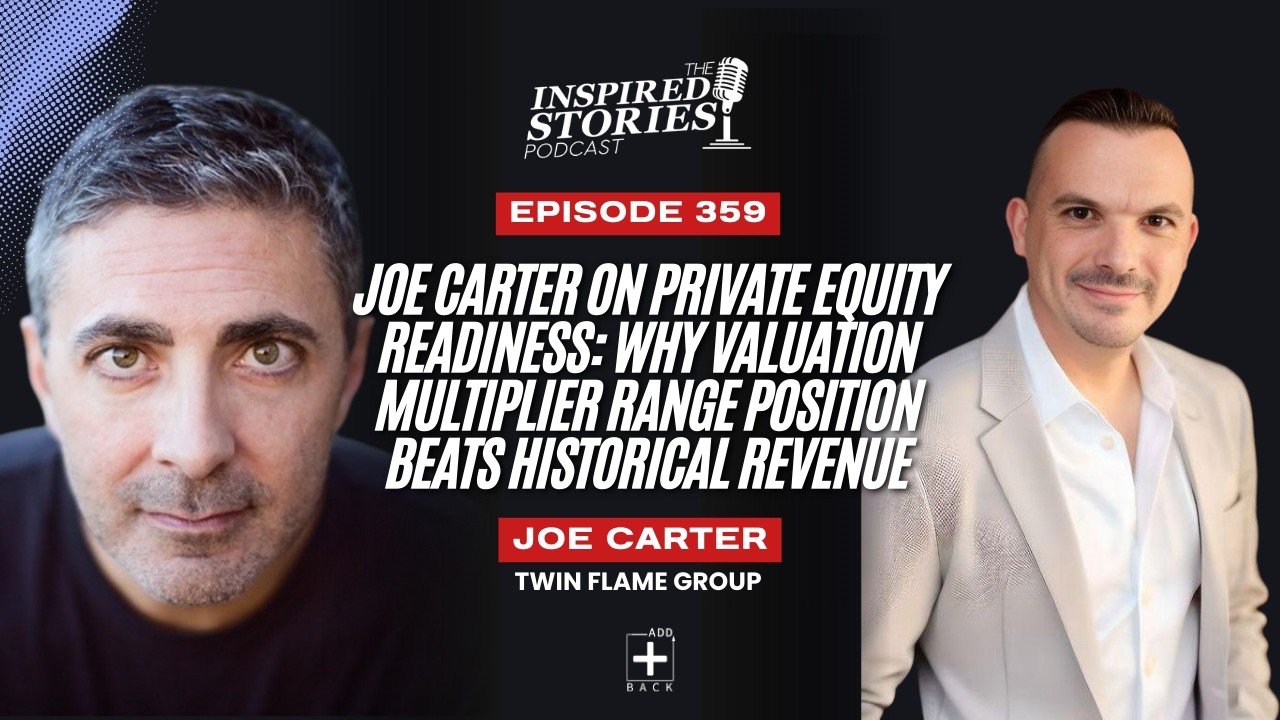
🎙️ From $2 Million Mistake and Son's Suicide to Helping 100+ Businesses 10X Revenue: Joe Carter's Journey Through Private Equity Due Diligence, Landscaping Exit, and Building Consulting Firm Focused on Owner Independence
In this inspiring episode, Joe Carter, Founder and CEO of Twin Flame Group, shares his remarkable journey from starting first Dallas-Fort Worth business scaling to 12 retail locations plus 10 mobile service ventures in three years selling to franchisor—later discovering left $2 million on table due to owner dependency and systemization gaps, then buying mom-and-pop landscapers across nine territories six states creating commercial-residential hybrid earning private equity acquisition just 18 months versus planned five years working inside PE due diligence seeing 400 deals totaling $14 billion. Through candid stories about son passing away seven years ago from suicide requiring leaning on Lord and wife through dark moments then channeling grief into Suicide Awareness Foundation helping hundreds understand third-party vantage point (how actions affect family five years forward) creates purpose beyond self, operating with ADHD requiring three simultaneous thoughts to maintain focus (Christmas decorations, client due diligence documents, podcast conversation), and oil field services client nearly doubling revenue from $7.5M adding $6M in 100 days through estimating platform systemization, Joe reveals how business valuation multiplier range (1.5X to 4.5X) matters more than historical revenue—owner independence, accrual accounting, forecasting, geographical footprint determine where you fall in range, private equity overpays for one company having all systems to copy-paste underpaying others bundling together, and consistency differentiates good from great because helping someone else achieve your level success gives double win confidence lift.
✨ Key Insights You'll Learn:
- First business Dallas-Fort Worth: 12 retail locations plus 10 mobile service ventures in three years, sold to franchisor but later discovered left $2 million on table due to owner dependency gaps—created webinar teaching others avoid same mistake
- Landscaping hybrid model 18-month exit: bought mom-and-pop residential landscapers nine territories six states, implemented estimating platforms landing commercial/governmental contracts, private equity came knocking versus planned five-year timeline
- Private equity due diligence experience: stayed nine months post-acquisition working inside PE firm seeing 400 deals totaling $14B+ providing unique 360-degree buyer-seller lens
- Son's suicide seven years ago: leaning on Lord and wife through dark moments, channeling grief into Suicide Awareness Foundation helping hundreds—conversation framework showing third-party vantage point (how actions affect loved ones five years forward) creates purpose beyond self
- ADHD management without medication: needs three simultaneous thoughts to maintain focus (Christmas decorations peripheral vision, client due diligence documents screen, podcast conversation)—discipline recognizing brain needs multiple stimuli or accomplishes zero
- Oil field services $6M lift 100 days: Vernal Utah client nearly doubled revenue from $7.5M implementing estimating platform replacing handshake gut-reaction with data-driven systematic margin protection
- Business valuation multiplier range: industries have 1.5X to 4.5X range, historical revenue less important than where you fall in range—owner independence, accrual vs cash accounting, geographical footprint, marketing strength, forecasting drive position
- Private equity acquisition strategy: buy one company having all systems (overpaying) to copy-paste onto 7-10 underpaid similar businesses lacking infrastructure, bundle together reselling—goal is help clients become overpaid company
- Owner dependency most common pitfall: entrepreneurs wore every hat building business, bottleneck organization continuing same approach, buyers understand replacement cost—blank paper two-week exercise listing only-I-do tasks creates delegation SOP accountability path
- Accrual accounting valuation driver: most small businesses cash-based QuickBooks, CPAs don't volunteer accrual transition (big lift), government thresholds $7-10M service-based or $4-6M restaurant vary by state, switching before required improves exit multiple
- AI leveraging: created internal GPTs feeding private equity experience plus client data for faster business valuation analysis, built sales roleplay app where AI customer overcomes objections improving skill development replacing disappearing traditional roleplay
- Twin Flame Group mission: help entrepreneurs systematically position businesses for exit (selling, passing next generation, whatever strategy), 45% franchise space but not exclusive, scaling with purpose means protecting margin while revenue grows
- Goal by end 2030: helped 1,000+ clients increase EBITDA valuation minimum double (goal triple) within six months contract initiation, helped 100th individual become entrepreneur through franchise ownership by end 2025
- Faith-based approach: 30 minutes reading Bible nightly before bed (Jobs and Psalms favorites, sometimes opening randomly trusting Holy Spirit guidance) helps ADHD brain slow down achieving proper rest for next day performance
- Community partnerships: 1% every client contract goes Goodwill of America (helped Joe during struggling period, wants payback 10X), $250K+ community donations supporting causes, clothing/food donation pickups, sponsoring walks/telethons
🌟 Joe's Key Mentors & Influences:
- First Business Partner (Dallas-Fort Worth): Partnered launching initial venture scaling 12 retail locations plus 10 mobile services three years, sold to franchisor providing capital for next venture
- Franchisor Buyer: Approached after scaling Dallas-Fort Worth business, paid fairly high multiple for industry enabling landscaping venture launch
- Landscaping Partnership Group: Raised significant capital for mom-and-pop acquisition strategy across nine territories six states
- Private Equity Firm Leadership: Kept Joe nine months post-acquisition working due diligence department, exposed to 400 deals totaling $14B+ teaching buyer lens strategies
- Wife and Family: Supported through son's suicide grief seven years ago, leaned on each other through dark moments, drove decision stopping nationwide travel to attend kids/grandkids soccer/gymnastics events
- Lord/Faith Foundation: Christian faith-based individual leaning heavily on God through grief, nightly Bible reading (Jobs, Psalms, random Holy Spirit guidance) centers and prepares for next day
- Son (Deceased): Passing away catalyzed reshaping world, still connects through 1994 Chevy Corvette drives with wife (their shared project car), drives suicide awareness advocacy
- Suicide Awareness Foundation Network: Provided platform helping hundreds navigate mental health challenges through empathetic third-party vantage conversations
- Oil Field Services Client (Vernal, Utah): Second generation taking over from dad's 20+ years, wanted outside perspective identifying estimating bottleneck teaching $6M lift lesson
- Photography Studio Retail Pivot Client: Taught pivoting from wardrobe rental model into children's apparel brand launching online retail eliminating costs creating new revenue stream
- Goodwill of America: Helped Joe during struggling younger years, now receives 1% every client contract plus donations/sponsorships demonstrating pay-forward 10X philosophy
👉 Don't miss this powerful conversation about discovering left $2 million on table due to owner dependency learning to teach others same lesson, channeling son's suicide grief into helping hundreds find purpose beyond self through third-party vantage point, and why business valuation multiplier range position matters more than historical revenue—because private equity overpays one company having all systems to copy-paste onto underpaid others bundling together.
Listen to the full episode here
Transcript
Anthony Codispoti (00:01)
Welcome to another edition of the Inspired Stories podcast, where leaders share their experiences so we can learn from their successes and be inspired by how they overcome adversity. My name is Anthony Cotaspodi and today's guest is Joe Carter, founder and CEO of Twin Flame Group. This franchise and business consulting firm helps entrepreneurs and businesses scale with purpose. They specialize in leadership development and strategic growth solutions.
aiming to unlock unseen opportunities and achieve sustainable success. Now, Joe's organization has guided over 100 businesses to 10x their revenue. Thanks to a focus on operational efficiency, franchise consulting, and data-driven strategies. Under his leadership, they built partnerships that generated over $250,000 in community donations, supporting causes like Goodwill of America.
Joe has many years of experience in business development, helping organizations reach new levels of profitability and social impact. His background includes designing tailored solutions that ease complex franchising hurdles. Twin Flame Group also publishes tools and resources to empower leaders. Now, before we get into all that good stuff, today's episode is brought to you by my company, Ad Back Benefits Agency.
If you run a business, you're likely stuck in the cycle of rising insurance premiums and soaring deductibles. You're paying more, but your team is getting less. And many people can't even afford coverage at all. We do things differently. Add Back allows you to provide your team with unlimited access to doctors, therapists, and prescriptions that's always free for them to access. But here's where you really need to pay attention because our program is structured to actually put more money back into your company's pockets.
We recently helped a client increase net profits by $900 per employee per year. Results vary, but the consultation is free. See if you qualify today at addbackbenefits.com. All right, back to our guest today, the founder and CEO of Twin Flame Group, Joe Carter. Thanks for making the time to share your story today.
Joe Carter (02:18)
Thanks Anthony, I appreciate you having me on. I've been super excited about this for a while. I can't wait to jump into it.
Anthony Codispoti (02:23)
Let's do it. Roll up our sleeves here. So Joe, you've helped over 100 businesses achieve, we said it in the intro, but it's almost hard to believe, 10 X their revenue. Can you walk us through just one example, specific example, something that you did, something that you changed, strategic shift, operational tweak that helped to yield that kind of a dramatic result?
Joe Carter (02:46)
Yes, definitely. So one particular client of ours was in the oil field services industry in the Vernal, Utah area. And what they were doing previously before coming on board with us was all around estimating. And it was exceptionally like handshake driven. And it was, you know, kind of put your finger in the air and come up with some kind of a number. There was really no systemization around it. So we were able to look at all of the different specific parameters that they previously did that were just kind of gut.
reaction versus data-driven analysis on creating estimates and created a consistent way for them to be able to do those estimates going forward. After implementation of that estimating platform, they were able to increase not only the number of estimates that they were able to perform, but actually ensure a specific margin ⁓ for that. So they saw a $6 million lift in about a three and a half month timeline simply through the execution of that estimating platform.
Anthony Codispoti (03:44)
Wow. Six million dollars is significant. Can you give us an idea of from what to what was this like from six million to 12 million or 100 million to 106 million?
Joe Carter (03:55)
Yeah, definitely. So they were doing about seven and a half million dollars previously. So was almost 100 % increase in growth, almost doubled. But yeah, that's a little over 90 days, about 100 days probably, time frame from beginning to end, they nearly doubled their revenue.
Anthony Codispoti (04:08)
Wow, and this was oil and gas, the industry, right? And did you have prior experience in that industry or was that not necessary for you?
Joe Carter (04:11)
Correct, yes sir.
A little bit of experience, but really not necessarily in this particular regard. Any kind of service-based industries, there's a lot of very specific consistencies that you see from one thing to a next. You're just providing a different service. So it's just taking some logic that is around that particular service driven industry and applying it to what they already had in place.
Anthony Codispoti (04:36)
And so in this case, with this specific client, did they come to you knowing that this estimation process was their bottleneck, that this was their problem, or did they come to you and just say, we need help, we don't know where?
Joe Carter (04:51)
It was pretty much the second, the latter that they knew that they needed assistance, they needed help. The business had been around for a very long period of time. was in the second generation within a family. And so the son took it over from the dad. The son had been running it for the last like four to five years, but the 20 plus years of the entirety of the company was driven by dad and dad's retired now. And so while there's a little bit of understanding and knowledge.
there wasn't as significant as what the company had previously established. So they wanted some outside perspective on how do we actually take this to the next level? Because the goal was they wanted to exit that particular business at some point in the near future to be able to retire themselves. So they didn't know where to start. And we were able to identify that as one of the bottlenecks. were several others, but that was one from a revenue standpoint that they had.
Anthony Codispoti (05:39)
So how long did it take you to get your fingers dirty and understand? And there were other changes. I know we're just focusing on one to understand that, here is a significant area of opportunity.
Joe Carter (05:54)
So to be able to identify specifically the estimating was an opportunity was really within just a couple of days. Getting to watch how they did two different estimates was...
like a light bulb moment for myself and when I started asking questions certainly for the owner as well. But in terms of everything that we were looking to improve with the net particular company, it was roughly about a three and a half to four week timeline for us to be able to fully see what they're doing that had the opportunity for improvement or growth and improvement in efficiency and be able to identify which ones are we going to go tackle first, second, third and so on.
Anthony Codispoti (06:28)
Interesting. Okay. I want to dive more into the specific examples if we can in a moment, but I want to rewind first and let's sort of lay the groundwork. What were you doing before you started Twin Flame Group? Let's lay sort of the foundation for why Joe Carter has the experience and the qualifications to help companies through these kinds of issues.
Joe Carter (06:50)
Yeah, definitely. So my ⁓ career began kind of in a traditional corporate footprint. I worked for a lot of Fortune 100 companies and very high level leadership roles, but I had this urge to become an entrepreneur.
Thankfully, I had the opportunity to partner up with a friend of mine and started a business in the Dallas-Fort Worth Metro. We were able to pretty quickly scale that particular brand. In about two and a half to three years, we were able to get to 12 retail locations and 10 mobile service ventures as well. We were approached by a franchisor who wanted to make the Dallas-Fort Worth area their home base. They were able to pay us a fairly high multiple for the industry at the time, took that money, and went and started my next venture.
which was a completely different industry and landscaping. Also got in with kind of a partnership group so we were able to raise a significant amount of capital, get that going. But our goal was to scale it and exit it to a private equity firm within about a five-year timeline. We actually did it in 18 months. I got to stay on with the private equity firm for nine months post-acquisition as part of the transition. But within that, I got to work inside of their due diligence department.
and see over 400 due diligence deals totaling more than $14 billion that that private equity firm ran through. So I got to see the buyer's lens and I had certainly been on the seller lens a couple of times. So I have this like unique 360 degree view when it comes to selling a business, what they're going to subtract and ultimately what they're going to add as well. And I can apply that logic and that framework to any business, regardless of industry. So that's what took me to want to be able to take my past experience, create the Twin Flame Group,
and help the next generation of entrepreneurs either scale and exit or just scale to improve.
Anthony Codispoti (08:37)
That's really cool. Take me back to the ⁓ landscape example there. guys, the plan was five years, pretty typical, right? You know, kind of like a four to seven year timeline is what, when, you know, you've got venture money involved where they want to see like a return on their capital. But you guys did it in 18 months. What happened? What were the big levers that you pulled that allow for you guys to accelerate that time?
Joe Carter (09:02)
So when we did some analysis in the landscaping industry space, what we saw was a dramatic difference between kind of your smaller mom and pop landscaper that are doing mainly residential and the very big, very well known companies that are doing almost exclusively commercial. And we saw an opportunity for a hybrid between the two where we can provide that one-on-one care to a residential customer, but also be able to land those larger consumer customers as well. So how do we leverage those two ends of the
spectrum and be able to create something in the middle. And we did so by
buying out a handful of the smaller mom and pops and instituting and implementing several things that would allow us to go after those commercial accounts. We were able to do that across nine different services, service territories, excuse me, in six different states. So we were able to acquire some smaller mom and pops, put some institutions in place specifically around estimating in order to gain those commercial clients, land several large con...
consumer, commercial, industrial, and even governmental customers and clients in that 18 month timeline, and PE came knocking.
Anthony Codispoti (10:11)
So a big part of the unlock there is recognizing that the big money is to be made on the commercial accounts. You can get a better valuation when you're acquiring sort of these small mom and pop shops that are doing the residential. Their margins aren't there, so the valuations aren't there. But knowing what you knew about how to go out and get those commercial accounts, now you can leverage that with your new acquisitions in those geographic markets where they already have a presence and some staff, et cetera.
Joe Carter (10:38)
Exactly, you're able to pretty quickly identify.
how many potential customer personas commercial are going to be in a particular territory. You already have at least some of the infrastructure in place for the team and equipment to be able to perform it. You just got to go after it. And in most cases, those larger commercial clients, you have to wait until their current contract is coming up to end for you to be able to bid against them. being able to identify those individuals 90 days plus in advance so that you can be fully prepped and ready to go for when it's bidding time for their contract to be renewed.
take the contract from whoever the current provider is and institute it for yourself.
Anthony Codispoti (11:16)
And how do you determine that? How do you find out who's got contracts that are coming up for renewal?
Joe Carter (11:22)
A lot of it, truthfully, is kind of what I would call grassroots marketing, just going and talking to people. Whoever the specific individual is that is running or leading that particular commercial account or governmental facility. A lot of times it took a lot of door knocks, a lot of phone calls, a lot of follow-up and emails. Sometimes you can do some Google searches and at figure out who you need to speak to, but you still have to go speak to that individual to be able to find out, do they have a current provider? When does that current contract come up for renewal? And what can we do
to be able to bid against them in the future. And nine out 10 times, they were coming up for renewal within the next three months or so. And so that gave us plenty of opportunity to be able to understand what is a current provider doing that they like, as well as what they're doing that they don't like. And how do we close the gap and also be able to at least come in close.
if not a discount over the current providers so that we can gain their business. And then the next year, once we've proven the concept to them, if we need to do a price increase to improve margin, we certainly could.
Anthony Codispoti (12:24)
Interesting. So this is the second example where there's something in that estimating that bidding process that was a big unlock. Were there commonalities between landscaping and the oil and gas client that we just talked about?
Joe Carter (12:40)
Yes, there's a ton of consistency there. While you're providing a different service ultimately to your customer, your client, how you perform them is exceptionally similar. You're going to have labor and you're going to have equipment.
for the most part, in both of those particular things. There's going to be materials and people. So being able to identify what is your labor margin, what's your labor burden, more importantly, and what materials, if any, and or equipment do you need in order to execute on that particular service. Provided that you have a specific margin that you're looking to acquire in mind, you can add that in at the top end, and you understand within a fairly reasonable scale what your price point needs to be for you to achieve your margin. And then all you have to do is go and execute.
Labor burden, specifically in the estimating world, is an estimate, you're guessing. So the better you do with that based on past performance, the more likely that your estimate will actually come through fulfillment.
Anthony Codispoti (13:37)
So this is all fascinating stuff, really interesting, the levers that you're pulling. Why go and start a consulting firm? Is it more profitable for you to continue to do the private equity, venture capital space yourself? But there was something that drew you to starting your own firm to help other folks out. What was that?
Joe Carter (13:54)
So what happened and it's kind of a personal story if that's okay. But roughly seven years ago, ⁓ my son passed away. And ⁓ certainly as anyone who's ever had to go through something similar to that can understand it completely reshapes your world.
⁓ I was doing a lot of nationwide travel. I was gone fairly consistently as a result of that. And I wanted to be able to help other people navigate through the mistakes that I had made myself personally within business, but be able to do so in a framework that allows me to be there for my family and be able to go to the soccer matches and the gymnastics competitions and things like that for my kids and my grandkids. ⁓ That was only one of the biggest reasons for me want to start a
consulting firm so I could help others but more importantly be able to help myself and my family.
Anthony Codispoti (14:49)
Wow. I'm sorry to hear about your son. How did you get through that time?
Joe Carter (14:57)
That's a difficult question to answer. It's a lot of leaning on the Lord above. I'm a very Christian-based, faith-based individual, so there's a lot of that, certainly a lot of tears. My wife certainly took it much harder than I did as well.
Anthony Codispoti (14:59)
It's a big question.
Joe Carter (15:17)
leaning on each other when we're having those kind of dark moments or those dark days ⁓ so that you're a support mechanism built into that. But ultimately, after at least the initial grief period exalted, we wanted to be able to find a way to, how do we help someone else not have to go through that scenario? So we've been exceptionally involved in suicide awareness and suicide prevention and doing a variety of different walks and charity related things to be able to bring awareness.
That's a buzzword that has a negative connotation to it. It's the S word. It's the new bad S word that's going around there. You're almost not allowed to say it in certain networks. ⁓ But if we don't say it, we don't talk about it. If we don't talk about it, there's somebody else out there that's struggling with it. So I'm perfectly fine talking about it, talking about my experience, because I want to help someone else not have to feel like that is their only way out. There are always things that you can do differently, and there's always a way to fix anything.
Anthony Codispoti (16:19)
So give me an example of one of the conversations that you have with folks where you're providing this type of encouragement to them. What kinds of things can you say?
Joe Carter (16:30)
Well, certainly I can empathize.
There's sympathy and there's empathy, right? And I can never fully sympathize because I'm not necessarily in their shoes, but I can pretty strongly empathize with what thoughts they may be feeling, what might be going on. But more importantly, I want to encourage an individual who may be having that type of mental thought or framework inside of the brain going on, understand what the people around them, the individuals that actually care about them and what the impact would be to their life if they chose that route to go.
What's gonna happen to your friends? What's gonna happen to your brother, your sister, your mom, your dad, your kids, et cetera? How is their life gonna be impacted? Fast forward in your brain, you're not here. Five years from now, what is your kids doing? What are they thinking about? How's it impacted and shaped their life over the next five years because you're no longer present? And when you are able to bring them out of their just kind of...
constants, internal self-driven negativity and place it in a framework that's more third party where they're looking at the vantage point of someone else. Then a lot of times you can at least help them to get the starting point of what I would call growth, but in reality it's more heal than anything else.
Anthony Codispoti (17:46)
So that's interesting. The way to kind of get them to take that first step in your experience oftentimes is to frame it as if you did this, here's how it's going to affect the people around you. And that many times you've seen has been a little bit of an awakening for them to be like, okay, I don't want those things. I don't want to put that pain and that situation on those people around me. And then once you...
I don't know, sort of got their attention. Maybe there's a better way to put that. What have you seen as sort of the next steps?
Joe Carter (18:22)
So the next steps are, truthfully, it can go one of a couple of different ways. There's time periods in which that can almost to a degree backfire, where you already have negative thoughts about yourself and...
I'm forcing you to think about others and what your actions gonna do to someone else. And it can make you feel even worse that, my God, I can't even believe that I'm potentially gonna put my family through this. How bad am I? And it can almost be a spiral downward if we're not careful. But what the ultimate real goal would be is what is the goal? What is the thing that you want your...
children, your mom, your dad, your brother, your sister, whoever it is that is important in your life, where do you want them to be within five years and how can you help to support them and give them a goal, give them something to go after that is beyond themselves, where they have to have attachment, they have to help someone else achieve and in doing so it lifts them up, it provides them with a need, a want, a goal, an aspiration, something that they have to do.
for someone other than themself. And what I see more often than not is that is a humongous lift in self-confidence because you're helping somebody else and it raises your confidence at the same time. So it's almost like you're getting a double win in that result.
Anthony Codispoti (19:29)
you
You're helping them find a purpose outside of themselves. Powerful. Joe, what is it that you think? Because I've known people who have experienced the loss of a child, pain that I hope I never have to experience. For some folks, they find a way to work through it. They come out the other side and they're able to lead a happy, functioning, productive life, never forgetting about.
Joe Carter (19:44)
100%.
Anthony Codispoti (20:09)
You know, never fully losing the sense of grief, but they have the ability to move on and other folks don't seem to have that ability. They stay stuck in grief and anger. Sort of the two emotions that I've traditionally witnessed. What is it that you think was different for you and your wife that you guys didn't stay stuck in those emotions?
Joe Carter (20:32)
Yeah, that's a fantastic question. And I truthfully don't think that there's a one size fits all answer for that because everybody's different and every situation was different. But for us personally, we were able to lean on each other and help each other through those moments. I know many people who have lost a child and it destroys the marriage. It ultimately creates the path or what likely becomes divorce in most cases because they don't know how to help or support their partner.
through the grief-stricken things that you're going to go through when that happens in your life. So I'm exceptionally blessed that my wife was able to help me and that I was able to help her. And I believe more than anything else, that and God are the reasons we got out on the other side. We still have plenty of moments where we get sad, but it's not like we forget or those feelings disappear in any way, shape or form. But you do find, to use your words, a purpose to continue to go on.
And if you can find a purpose that's not you, my purpose was my life. I need to help my life through this. Almost ignoring the fact that I needed help myself, but through that process I was able to get help from her. But my goal, my purpose was to help her. And when that purpose is beyond you, you're more likely to just want to get through the tough times so that you can deliver upon your purpose.
Anthony Codispoti (21:56)
Have you kept count of how many conversations you've had with people where you think maybe you've helped?
Joe Carter (22:03)
⁓ I don't think I could give you a number. ⁓ It's been a lot. To be honest with you, hundreds ⁓ through ⁓ the Suicide Awareness Foundation that we've dealt with and things like that, there's been many people that I've had the opportunity to speak to. How many have I helped is probably a smaller number because truthfully, I can't help everybody.
I wish I could, that would be amazing, but I don't have that reach. But if I can help one person, that's one person more than would have been helped without me. So I can tell you there's at least 20 plus individuals who have told me personally that as a result of conversations that I've had with you, I feel better about XYZ. So that alone is great in my personal opinion. If the number was anything north of one, I would be super excited and the number is way north of one.
Anthony Codispoti (22:56)
That's amazing. ⁓ On behalf of those folks and their families and their friends, thank you. mean, how amazing that, you know, you and your wife were able to turn your own grief into, ⁓ like you said, like an opportunity for purpose outside of yourselves and to help other folks. think that's tremendous. So this this helps to explain why you wanted to get off the road, stop traveling.
Joe Carter (23:03)
Yeah, absolutely.
Definitely.
Anthony Codispoti (23:25)
be home more and help other folks with the knowledge that ⁓ you've acquired through all the different business opportunities that you've been a part of. When you decide that you're gonna start Twin Flame Group, how did you go and get that first client?
Joe Carter (23:43)
So I wouldn't get that first client, truthfully, through a referral. So someone that I worked with in the past knew someone else that was running a small business and had the opportunity or want to try to grow that and prepare for an exit one day. And having recently exited the private equity space and had conversations with that friend, that was a pretty easy kind of transition moment of, just literally did this 400 times. I can do it for you pretty, simplistically.
apply models and concepts and valuation methods, et cetera. So first client came from referral. And if I'm honest with you, vast majority of our clients today come from referrals. Yes, we do marketing. Yes, we do reach out to webinars and all these sorts of things. But I would say about 70 % of our clients come from someone else that we've worked with previously and been able to help that they gave us testimony to someone else that they know. A lot of times entrepreneurs run in entrepreneur circles. It's crazy. So as long as you take care of the ones you have today, you're probably going to get some
more later as a result.
Anthony Codispoti (24:44)
Okay. So we've kind of talked around what some of the services that you offer are and the big sort of overarching theme here seems to be we help you increase your revenue and there can be lots of ways to do that. I'm going to assume some of these are cost reductions. Some of these are sales and marketing techniques. Some of them are just finding bottlenecks and breaking through inefficiencies, but I'm putting words into your mouth. Let's hear from Joe Carter himself, what you guys do.
Joe Carter (25:15)
For sure. So revenue is definitely a piece of the pie. However, our real niche, if you will, is improving the valuation of your company.
Again, a piece of that is revenue. I don't want to ignore that. We got to increase revenue for the value of your business to go up. But there's a lot of other strategies that goes into a business valuation beyond just what your revenue is. What type of revenue is it? Is it recurring or one-off? Is a significant valuation driver. But beyond that, to your point, there's a lot of other things that have nothing to do with revenue that ultimately will improve your valuation. Certainly, expense reduction is a big piece of that. But optimization, efficiency, operations, that kind of thing,
is a humongous step forward. If you can reduce your labor costs by 2 % and you're a million dollar company, you just increased your valuation by 20 % times whatever the even a multiplier is for your industry. So we apply that sales, marketing, operations, people development. We look at the entire gambit of everything that would be evaluated on your business and identify where your opportunities are. Sometimes that's a hundred or more things that you could do better.
We can't fix 100 or more things today. What can we fix that's going to give you the biggest return on investment? And that's the stuff that we're going to go out.
Anthony Codispoti (26:31)
So what does a typical engagement look like in terms of time period?
Joe Carter (26:36)
Our typical engagement is between 90 days and six months. Just totally depends upon what the particular customer client is looking to achieve. If they're looking to sell, AKA they've already been engaged with a buyer, whether it's a P firm, VC firm, or an extra individual buyer investment group.
They're looking to exit fairly quickly. That certainly is one, and that's going to be a shorter engagement because we're trying to accomplish something because we already have somebody kind of on the hook, so to speak. If it is more operational efficiency so that you can improve future operations, it's typically a slightly longer engagement, closer to that six-month timeline. But we do have many clients that we were working with into the multiple years now because we were able to achieve several of the beginning stages and stuff. They saw how we work with them, and they wanted to continue to.
in the other areas as well as scale outside of the current geographical footprint for growth.
Anthony Codispoti (27:31)
So let's talk about that first scenario where the sale is coming up very quickly, right? They're already talking with a buyer and they want to boost, your client wants to boost that valuation before they close that transaction. correct me if I'm wrong, traditionally a valuation is looking, you know, not just at the last, call it three months of revenue, it's looking at X number of years going backwards and taking an average of that going forward.
my right in this generally.
Joe Carter (28:03)
Generally speaking, traditionally you're looking at a list of three-year kind of past looking perspective into financials to understand history and then you're applying some similar logic to forward forecast out three, five or 10 years depending on the type of model or method that you're leveraging. But yes, you're going to certainly look backwards.
Anthony Codispoti (28:23)
Okay, and so that forward forecasting in those shorter timeframe scenarios, I'm guessing is where the recent work that you've helped with is really coming into play, right? Because let's say that they engage you three months, six months before a transaction closes, they'll have some months of showing improved performance, but it's not going to have the impact as if they had worked with you a couple of years prior. Am I thinking about this all wrong or?
Joe Carter (28:53)
No, you're definitely thinking about it right. If you're going to prepare for an exit, the sooner you start, better. And the longer that you have to fix it, certainly the better. However, there is a lot of things that come into valuation that has nothing to do with what your financial said they were six months ago. I can't fix anything that happened six months ago. What I can do is fix current state. And also what I can fix is how you're evaluated in the future state.
So traditionally, almost all industries are going to have even a range. So that range could be whatever, one and a half to four and a half X. Well, if that's the industry, your valuation is going to fall somewhere in that range. Our goal is to get you to the highest possible portion of that range. And that has very little, if any, to do with historical data. It has portions of it, but it's more forecasting related data as to where you're going to fall within that range.
So what is your geographical footprint? How strong is your marketing? How good are you at being owner independent? Meaning if I buy your business from you today and you leave, does the business fall apart before I replace you? If it does, I'm less likely to want to pay you an extreme amount of money or a higher end of that range because I have to figure out how to replace you. If you're already replaced, you could step away and the business does not.
go down in any way, shape or form, that is a owner independent business and you're going to get higher into the range. That's just one example.
Anthony Codispoti (30:21)
That's the really important piece that I was just missing there in my explanation. It's because let's say you've averaged a million dollars in EBITDA over each of the last three years. Your work here today in these three to six months may not move that million dollars a whole lot. It may, but what it's really going to do in that short period of time is increase that multiple rather than getting that one and a half times a million dollars.
Joe Carter (30:41)
Do it.
Anthony Codispoti (30:50)
Maybe now I'm at three, three and a half, four, because people look at it and they're like, ⁓ man, they've got all the systems in place. The owner can step out really easily and we can just step right in. And they're like, yeah, you know, now we'll pay a higher multiple on that million dollars. That's really smart.
Joe Carter (31:07)
Bingo.
And all of that comes from working inside of private equity. When private equity goes after an industry, typically they're going to want to acquire somewhere between seven and 10 businesses within the same industry across the country. And ideally what they like to do is buy one of them that's got everything that they want. All the systems, all the trainings, all the marketing, all the sales techniques, and the other ones that don't have any of it. And they want to take the one that's really good and apply it to all the other ones.
What they do more often than not is the one that's got everything they'll overpay for. So they can get all that stuff and not have to replicate it themselves. And then they basically just copy and paste and underpay all the rest and then bundle them together and resell and repurpose it. My goal is to help a business become the one that gets overpaid because they have all the stuff that PE is going to need or want to copy and paste to the other companies that are similar to them elsewhere in the country.
Anthony Codispoti (32:01)
That's really cool. Now, a big thing that you guys emphasize is scaling with purpose. Can you say more about that?
Joe Carter (32:10)
Absolutely. So people chase revenue. We've talked about revenue a lot because a lot of times in business, think revenue is the fix hole. Like if I just grow revenue, it's better. Well, that's true to a degree. But if you scale your revenue, but you lose margin as a result, you're scaling, but you're not necessarily scaling with purpose. You're going to ultimately scale yourself out. At some point, there was a kind of...
point of no return where you've spent so much more money to gain this revenue that you've actually gone backwards and your valuation is less than it was before your revenue went up because now you're spending more money in marketing or more in labor or more in systems or whatever it may be. Scaling with purpose where you can protect your margin while your business grows in revenue. That is the way to have systematic growth that someone else is going to pay a premium.
Anthony Codispoti (33:04)
I also know that corporate social responsibility plays a big part in your work. We talked about the nearly quarter million or over a quarter million dollars in donations that your work has been able to contribute to some organizations like Goodwill of America. Can you talk about how these community partnerships work and why they're mutually beneficial?
Joe Carter (33:28)
100%. So Goodwill is one of the larger partners that we have. Obviously, Goodwill is a very nationwide and reputable brand. much anybody knows who Goodwill is. Well, Goodwill helped me out in a time period of my life, many, many, years ago when I was struggling through something and needed assistance. And I never forgot that and always wanted to pay it back. And I, again, I'm a face-driven individual. I believe you pay back 10 volt.
So that's exactly what I set out to do was how do I pay back 10 times what I was able to receive and Goodwill was one of those that I wanted to help. I wanted our firm to be able to assist. So how do we do that? We do that in a variety of different ways. Certainly we take donations, clothing, food, ⁓ anything really within the household. We will accept donations. We will go pick them up for you and deliver them to the local Goodwill Center so that we can ensure that those things are helping someone else. That is one way in which
we do it, we also sponsor a variety of different charitable organizations like walks and telethons and things like that that Goodwill puts on. So we will sponsor those in a variety of different ways. And a percentage of all of the contracts that we have with every single one of our clients, 1 % of that goes to Goodwill. So there's several different ways in which we give back to them as well as a few other organizations. And we just try to do it with the framework that if we help.
If they helped us, we want to help them times 10 with the ultimate goal that the next person is going to do the same thing and want to pay them back tenfold. And it ultimately is a multiplying effect that we're able to help so many other people.
Anthony Codispoti (34:59)
I like that. Who's your ideal client, ⁓ Geography, industry, size, whatever other descriptors help.
Joe Carter (35:09)
Yeah, geographically, there really can be anywhere in the continental United States or Canada. We've had clients in virtually every single state to this point. Industry also ⁓ exceptionally not as important because through my work with the private equity firm, I got the opportunity to see a variety of different industries. And really, there's more similarities than there are differences. In terms of revenue, traditionally, $3 to $10 million in annual revenue is kind of a prototypical client because that is where your business is small enough that you need
external help.
but also big enough that if we move a couple of needles, it makes a substantial impact in terms of your able to multipliers. So kind of $3 $10 million, traditionally, you're looking at somewhere between 20 to 100 employees based upon what type of service or product they're offering to their customer. ⁓ And ideally, it's someone that's either wanting to grow and improve their business, whether they keep it or not, or looking to exit. And exit can be a lot of different things. We've talked a lot about selling a business. That is certainly an exit.
But I also help a lot of clients as well navigate an exit where they're passing that business on to their next generation, their kids, someone within their family. And there's a way to do that. So you set them up for success and so that they can continue to drive home the legacy that you created.
Anthony Codispoti (36:29)
When you're advising business owners, entrepreneurs, what are maybe one or two of the more common pitfalls that you've seen that you're able to come in and help folks repair pretty quick?
Joe Carter (36:43)
Truthfully, owner dependency is the most common thing that I see in almost every small business. And if you think about it, because I've been that individual before, it's almost natural. You created a business, and it's successful.
And more than likely, you did wear almost every, if not every single hat through that entire time period. You were the sales guy, you were the payroll guy, you were the janitor at some point because the business was small enough, you had to do it. And so you almost get to a place where you feel like, have to keep doing it.
And without realizing that certain points, if you don't allow someone else to do all those things, you're bottlenecking your organization and someone else who wants to buy or wants to take over your business understands they have to replace you. And there's a cost impact to that time, effort and energy. So owner dependency is the most common theme. Firstly, every single one of my clients has got that in some way, or form, especially the kind of celebrity clients, if you will, where they are the salesperson, they feel like they
they have to go make the sales and everything's a handshake deal with them. Getting them over that personality quirk where their personality is tied to the business is a big piece of it. But secondarily is, truthfully, there's a lot of mess when it comes to the financials. ⁓ It's a big thing to be an accrual-based accounting versus cash-based accounting that drives your invatoration multiplier substantially. Most small businesses are in a cash-based accounting system versus an accrual-based accounting system.
Anthony Codispoti (38:12)
that's interesting. A lot of the businesses that you first come in and consult with are on a cash based accounting system. Just the way that it started, it was easy and it made sense and they stuck with it. Okay. Yeah.
Joe Carter (38:18)
Correct.
Yeah, they might have a CPA or most of them are running through QuickBooks, right? But they never really made that leap into accrual-based accounting. And there are several different governmental factors depending upon your industry when you have to go accrual, and then your CPA will navigate you through that. But if you haven't hit that threshold yet, it's really up to you as to whether or not you want to be cash or accrual. And truthfully, it's easier.
to be cash than it is to be accrual. So there's a little bit more stuff you have to do within the accounting system if it's accrual based. And no CBA likes to do that transition. It's kind of a big lift. So they're not going to volunteer that unless you ask them for it, right? But understanding what the benefits are.
specifically in evaluation if you're trying to exit, then maybe we can have a conversation with your CPA and be like, I know you don't like to do this and don't want to do this, but we really need to do this and here's the why, so let's work together to make it happen.
Anthony Codispoti (39:15)
I wasn't aware of the thresholds. What are the thresholds like? Do you know off the top of your head?
Joe Carter (39:19)
Yeah,
so in service-based industries, traditionally somewhere between seven and ten million dollars is where the government will require you to be a pro-based accountant when you submit your tax returns for the business. ⁓
restaurants, food, et cetera, are a little bit shy of that. I believe it's been 4 and 6, depending on the state, whether or not they have state income taxes as a result of it. So there are some specific time periods in which it has to occur. More often than not, you can request extensions, and your CPA probably does that without you even knowing about it because they don't want to do it. So they'll just submit the extensions and try to the can as far down the road as possible. But there are some governmental influences as to when you need to do it, but don't wait for when you have to do it. Do it before
beforehand because truthfully you'll get paid more on the back end.
Anthony Codispoti (40:05)
Now that owner dependency issue that you're talking about. Yep. I hear about it all the time. I've been in that position myself before for those folks who enjoy being in that position. Cause there's different types of entrepreneurs, right? Some are, you know, the core of the business and it's hard to remove themselves. They want to, they know they need to. It's just difficult to do. And then there are some folks it sounds like you're running into, and I've certainly seen this before where they don't even want to do
Right? How did you put it? Sort of the celebrity salesperson. Like, you know, they enjoy sort of that that role that they play. How do you approach these two personas and and coach them along?
Joe Carter (40:49)
Yeah, so depending on which side of the spectrum we're talking about there, if it's somebody that wants to, but doesn't know how to do it, that's slightly easier. So we traditionally will just start with them having a blank sheet of paper and a pen, and they got to carry it with them for the next two weeks. And everything that they do, and they're the only one that does it, they write it down. And we will go back to that list and understand what do we, ⁓ who do we have, excuse me, that we can hand those things off to, create some kind of an SOP around it.
delegate it to an individual and then create some accountability steps to follow up and ensure it was done correctly. So it's a little bit easier if they want to make the change than if it's something that they just thoroughly enjoy. And in those instances in which you got the celebrity persona, they like being the salesperson, they like being the person that closes all the deals. What I found that works the best is have them look at the perspective of your next sale is the next salesperson in your organization.
Make that sell. Make that close. Make that person be able to close just as much as you do. And guess what? You just doubled your sales efforts. And if they can get that same kind of rise internally because they're able to help someone else become that same level of success, it gives them that kind of same juice that they saw. And slowly but surely, we can back them away from it because we have somebody who's doing well. But they still have a way to be a celebrity within their organization. We just have to...
change the mindset to become a celebrity for your team versus a celebrity to your customers.
Anthony Codispoti (42:20)
That's interesting. Very clever. ⁓ Do you have experience in the retail industries? Yeah. Talk to me about some of the curated experiences that you've been able to help develop there that have really driven this kind of growth for your customers.
Joe Carter (42:27)
Absolutely. Yes.
Yeah, definitely. One of the clients that we had was initially, wasn't what we call a traditional retail. It was a photography studio that had model shoots and things of that nature that they were working on. What they were doing initially was renting out a lot of their wardrobes.
for the models to wear during the shoots. And the goal was for them to be able to drive more models and they were ultimately trying to sell those to larger agencies. That's how they were gaining their revenue. What I helped them to see was not only from a cost reduction perspective, is it pretty costly for you to go rent or buy and then donate or whatever all of this stuff every single season? What if we created a clothing brand?
for you and we find some manufacturers and we find some ways for you to be able to have your own clothes to be able to not only market the models, but market your actual clothes themselves as well. And we were able to make that transition. They now have multiple studios in the Dallas, Texas area and they have officially launched their online retail shop as well where they're selling specifically to children. ⁓
from a children's apparel perspective through all four seasons of the year. So they've got everything from spring and summer to fall and winter, that they've been able to launch and leverage over almost the last year. I think they're on month 10 now since they officially launched. So we pivoted them from what probably is not traditional retail into a more retail driven space. So they were able to save money and now they're generating a whole new revenue stream that they never had before.
Anthony Codispoti (44:11)
So
10 months in, is it too early to tell if this is gonna work?
Joe Carter (44:16)
Maybe to a degree. You could say it's maybe too early to tell. However, you can also kind of project out what have we seen. We haven't seen all four seasons necessarily complete themselves, but we have seen what type of customers are buying our particular product, what type of marketing is working versus not working, and apply some logic around that to be able to forecast in the future. In my personal opinion, I think it's going to explode.
But that is my personal opinion based on multiple different amount of data sets that I have and my understanding on what they're going to be doing in the near future. So it might be a little early, but I also think we have enough trends to be able to say within a reasonable level of certainty, there's a lot of growth coming.
Anthony Codispoti (45:00)
indicators are positive is what you're saying. And those data sets that you have access to is this data like the that clients sales data like what you're seeing and how it's increasing or is there another layer of data that you're kind of putting on top of this.
Joe Carter (45:16)
So yes, that's certainly one of them. What their customer data lead generation is coming through the different marketing efforts that they're doing. But also we look at heat mapping on the website as well. So we can understand when somebody goes to the website, what areas are they spending the most amount of time on? Where's the cursor going? What's being clicked within it? And we can apply logic behind that to understand that there's a way that we can keep them on the website for an extra five seconds. It increases your conversion rate by 3.5%. What can we do to keep them on there for that extra three seconds?
get there, what else can we do to keep on there for another three seconds and increase our conversion rate even more? So it's just applying logic really more than anything else to the data that you have to be able to tweak it just a little bit to improve it a little bit more. And then you just repeat that over and over again until you get to a degree of optimization.
Anthony Codispoti (46:06)
So that specific example there, the website optimization that you're talking about, Joe, that is a very specific skill set. ⁓ People who spend all day, every day kind of working and knowing how to turn those dials. Is that a skill set that you guys have internally, or do you acknowledge that this is something really important, and so we're gonna bring in our partner who's an expert in that area.
Joe Carter (46:34)
Love that question. So while I would love to say I'm great at everything, that's not necessarily true. There's a lot of stuff that I believe we are very, very good at here, but we also understand that there's some people out there that do even better than us. So we have a variety of different partners, both from a marketing perspective, a sales perspective, a finance perspective, and specifically in the legal world. So attorneys, cetera, to be able to assist and we can tap into within our network and say, we're gonna bring this partner in to help with a specific thing because A, they can do it better than us
to be that you do it faster than us. And it's gonna help you achieve it all faster.
Anthony Codispoti (47:08)
Hmm, well, that makes a lot of sense. What's some other low-hanging fruit that we haven't already covered, that people listening who are thinking, I've got a business. I kind of want to start getting it ready for exit. I don't know that I'm quite ready to engage with Joe, but what are some of those pieces of framework that they should start putting in place sooner rather than
Joe Carter (47:34)
Well, AI is a pretty big topic that's going on right now. It seems to be taking over the world, right? But ⁓ understanding the ways in which AI can help your business versus replace people within your business is a very big differentiator that I see with a lot of small business owners. They go to like chat GBT and just say, create me my next 30 days marketing calendar. And it's back out and whatever chat GBT says is what they go do. Well, that's great.
but you're completely eliminating the human element and there's not a whole lot of data analysis of past performance in there either. So being able to pull your social media accounts and see number of viewers, number of subscribers, of comments, forwards, likes, reposts, et cetera, and leveraging that into an AI tool such as Chat, GBT or others, and give it the data to be able to give you an even more informed response. That's how you leverage AI versus just allow AI to take a.
Anthony Codispoti (48:31)
Yeah, I'm glad that you brought up AI. Can you talk more about how you're seeing this come into play in your line of work? Whether it's how you guys are using it inside of Twin Flame or how it is that you're seeing your clients use it in an intelligent way that actually contributes to their overall valuation.
Joe Carter (48:55)
Yeah, definitely. So ways that we use it and leverage it within the Twin Flame Group, we definitely leverage a lot for data analysis, specifically in business valuation. So we've been able to create several different GBTs internally that we have put in all of our private equity experience and all the other clients that we've had so that we can then throw in a new client's information and have it apply that same logic back to us faster than we would be able to do on our own. So that's one way in which we're utilizing or leveraging it, but we're setting it up.
to be successful first and certainly testing it to ensure that it's done accurately or correctly. And then in terms of my clients, what I've seen the biggest level of improvement in is kind of in the sales aspect of several of my service-based clients where they have leveraged a AI tool to be able to generate an improvement around sales techniques, ⁓ how they overcome objections, be able to role-plays with their salespeople. We actually created an app where it's a
So you're talking to a computer, right? But you're pretending that it's a customer and you're asking it questions or an offer and that's responding back to you. And it's giving a large role play. Role play is the biggest thing that will improve a salesperson. And role play is something that in today's world is almost completely going away. And yet it's the thing that's going to help skill set development more than anything else. So if we can utilize or leverage AI to replace or at least kind of
fill in the gap, so to speak, of the role pay aspect for sales development, then we're able to continue to grow where we can leverage marketing to bring in more leads, but we have that salesperson be able to close.
Anthony Codispoti (50:33)
That's really interesting. So this GPT that you guys have built sounds like what happens is you're feeding the client data into it. Here's what the client does. Maybe here's even the sales script that they use. And then there's another piece of data that's coming in that says, here are some, you know, FAQs, some common objections, et cetera. So the AI has some understanding of kind of the typical back and forth that takes place. And then.
What is the actual interaction with that GPT look like from a training perspective? somebody like, is this the audio version where like I'm talking and then it talks back to me or is it giving me a text version and then I'm sort of typing my response.
Joe Carter (51:19)
So one point I was kind of the text version, which could either be on a mobile device or on a laptop. So you're pretending like you're calling, you know, a potential lead, right? But you're just doing it via.
quote unquote, text versus a physical number. Once we are able to vet through that that's functioned correctly, then we do clone particular AI voices so that you can actually have sales or live sales role play calls with a computer based AI model. So you're able to get a little bit more of a verbal dialogue back and forth, but at least the 1.0 version when we create for our clients is kind of a text based system.
Anthony Codispoti (51:54)
That's a great place to start. Yeah. And then you already have visions of where this is going to move to next and just continues to become even more powerful. Hmm. Joe, how would you characterize your superpower?
Joe Carter (52:03)
100%.
That's a good question. My superpower is what I would call the ability to see the future. I'm able, thanks to a lot of experience and having done this a lot of times, understand how to properly forecast a business of where it will be not tomorrow, but where it will be three years, five years, and 10 years from now, based on demographical data.
historical performance, the understanding of what's happening within the economy and what is going on within that particular business, and applying growth patterns and strategies to be able to predict the future. So that's my superpower, the ability to predict the future.
Anthony Codispoti (52:50)
I like it. So let's tap into that superpower. What does the future hold for Twin Flame Group? What's coming next?
Joe Carter (52:58)
So the future for the Twin Flame Group is we're going to have helped over 1,000 clients by the end of 2030 be able to successfully increase their EBITDA by a minimum of double. So the goal is triple, but a minimum of double their EBITDA valuation within six months of contract initiation.
Anthony Codispoti (53:19)
That's quite a goal. I mean, that's a quick time period. You gave us one example where you were able to do that for the oil and gas company. I presume that was a bit more of an outlier. To get double growth in that time frame, I don't know. That's pretty aggressive.
Joe Carter (53:39)
You would think it's aggressive and from the outside looking in, it certainly sounds aggressive. However, when you understand that all industries have got a range and almost every one of our clients, when we meet them, on the lower end of that range because they don't have many of the things in place that a private equity or venture capitalist firm is going to want to look for to pay the higher premium multipliers. And if we just close those gaps, double is actually a small goal. It's a small increase. If I'm honest with you.
Anthony Codispoti (54:09)
And you know where I'm tripping up again is in your state double evaluation. In my mind, I'm thinking double the revenue. And I made that mistake earlier in our conversation. Certainly you're looking to increase the revenue, but that's not the only thing that goes into the valuation. It's improving all those other systems and processes so that you can go from the one and a half X to the three X, right?
Joe Carter (54:21)
Sure.
Correct. Correct.
Anthony Codispoti (54:33)
good lesson for me to be reminded of within the past 30 minutes of my own interview. love it. Hopefully other people are embracing that lesson as well. So if you had to recommend one resource for folks who are interested in improving their business valuations, a book, a course, a podcast, where would you direct?
Joe Carter (54:44)
Definitely.
So I would direct them through a couple of different places. First and foremost, within our website, you can fill out ⁓ basic information and get a free private equity readiness checklist and 90 day scale plan. So it's free resource. You can just put in some basic level information and download it. And then you can apply it and do it yourself. And that is a great starting point for a lot of people to just understand where is my business at today and what could it be later. Then if you want help, cool, we're here.
and you want to just kind of run with it or throw them in trash. That's ultimately up to you. And then terms of a podcast, I have two. So I have the Franchise Bro Show, which specifically focuses in the franchise space, and the Lead, Manage, Thrive podcast, which is non-franchise entrepreneurship. So check those two out. They're all about founders who have created businesses that are scaling value, not just scaling revenue.
Anthony Codispoti (55:53)
Okay, so the website, TwinFlameTX.com, TX is for Texas, yes? Okay, TwinFlameTX.com where you can get that ⁓ business valuation assistance there. And then the other resources, how do folks find those? The podcast that you're referencing.
Joe Carter (56:11)
The podcast, so we are on YouTube, Apple, Spotify, and then we also put them on our website as well. So check your local podcast platform, we're probably there.
Anthony Codispoti (56:19)
Okay.
And if they go to the twin flame T X.com website, they'll see the podcasts on there as well. So if you're going to remember one thing from today's conversation, one resource, you're going to go to twin flame T X.com. and I see it right there in the main menu. Podcast is one of the options services about, yep. Everything's there folks. Twin flame T X.com. ⁓
Joe Carter (56:27)
Correct.
Anthony Codispoti (56:46)
Okay, what's something fun that you like to do outside?
Joe Carter (56:52)
Ooh, that's a good one. So I got a 1994 Chevy Corvette. It was my son and I's car. We like to tinker with it. So when I'm not working, one of my favorite things to do unwind and get away is my wife and I go on a drive. So we're in Texas. I-35 is the main interstate. We will drive it all the way up to the Oklahoma border, turn around and come on back. So it's typically about an hour, hour and a half to bring in traffic, but it's getting away from it all.
I'll have my phone with me, but it's awful hard to hear it when the top is down and you're going 90 miles an hour. It's a way to just get away from it, be able to reconnect a little bit with our son who's no longer with us, but do so in a way that puts a smile on our face versus a way that maybe brings us down and makes us sad.
Anthony Codispoti (57:41)
How about some daily practices or habits, Joe, that either help you get your day started or keep you on track and keep you centered?
Joe Carter (57:51)
Yeah, so I'm probably a different personality than most. I know a lot of people out there like to get up and either read, stretch, workout, or something like that in the morning. I'm like the opposite of that. I need to kind of unwind at the end of the day, just because I'm naturally ADHD. So what I will do personally for myself is I spend about 30 minutes reading every night before bed. So I have a very specific time in the morning to go to bed every night, rewind 30 minutes, and I spend that time reading. And my favorite book to read is the Bible.
I will find a different chapter and read a handful of scriptures, make some notes around it. And that helps my brain to slow down, unwind, get a proper amount of rest for that evening so that the next day I'm ready to be the best person that I can be for myself, my family, and my clients.
Anthony Codispoti (58:39)
When you open up the Bible, are there a handful of chapters that are your favorites, are kind of your go-tos? ⁓ Or do you just kind of flip it open and wherever the thumb stops the page, that's where you feel called to jump in?
Joe Carter (58:53)
Yeah, well, I mean, there's certainly chapters that I like to go to, or my go-to is more than anything else. Joe's and Psalm's are definitely probably the top two, but there's many times that I'll open it up, like just kind of just actually physically open it and see what page it falls to, because I believe there's a reason for everything. And that if my finger just happened to touch a particular page when I open that, that's probably the page that God wants me read today.
reason. So there's more often than not a time period where I'm going to a book that I didn't walk in the room anticipating to read but just allowed you know the Holy Spirit to guide me on what I do need to be reading for that particular day.
Anthony Codispoti (59:38)
Joe, in my experience, sometimes our mistakes end up becoming our greatest teachers. Is there an early career moment for you that seemed like a setback, but actually propelled you forward?
Joe Carter (59:53)
Yes, so my first business that we started, there was a lot of success. I referenced that earlier on in the podcast, but when we sold, I thought it was a win. We sold for what I thought was a pretty good amount of money to the franchisor. I found out later, it wasn't, I found out later that I left $2 million on the table.
So how did that, how did that happen? Well, there's a lot of stuff from a systemization and operations and an owner replacement perspective. I was the guy running everything and doing everything. So I got dinged a little bit for that. And so it's a $2 million mistake. There's a webinar that I put on earlier in the year called the $2 million mistake where I walked through step by step all of those things that.
identified and ultimately created a $2 million gap and what I do to help my clients not have the same $2 million mistake.
Anthony Codispoti (1:00:47)
You know, and I'm glad that you mentioned franchise because you work with all kinds of businesses, but you've done a lot of work in the franchise space. Can you talk more specifically about that?
Joe Carter (1:00:59)
Yeah, definitely. my first business was ultimately got sold and became a franchise. But I've worked with several different franchise brands, either as a franchisee, franchisee or side, right? I did sales, marketing and operations support as a consultant for them. And then today I help individuals who want to become an entrepreneur explore the path of entrepreneurship through the lens of franchising. So within our network, we have almost a thousand different franchise brands that we represent and support throughout the U.S., Canada,
at Mexico and several countries in Europe as well. So a plethora is the short way to answer that question. But as franchise, there's a lot of positives to it. Truthfully, there's a lot of negatives too. And not every franchise, even the ones you know about, Chick-fil-A, Starbucks, whatever, like they're great brands, but that doesn't mean it's a great fit for one specific individual. And my goal is to help find the right fit.
Whether that fit is Starbucks or Chick-fil-A or someone else that just has a better alignment with what they're attempting to accomplish from a financial perspective, an involvement perspective, geographical perspective, whatever it may be, and help them navigate and find the right fit for them.
Anthony Codispoti (1:02:13)
I think that ⁓ Joe, I've just got one more question for you today. But before I ask it, I want to knock out three quick things. First of all, we touched on this before, but anybody who wants to get in touch with Joe Carter from Twin Flame Group, go to Twin Flame TX dot com. The TX is for Texas. You can. We're also going to put his LinkedIn profile in the show notes for folks so you can check that out. But if you look up Joseph Carter, Twin Flame Group on LinkedIn, you'll find him. Twin Flame TX dot com.
Also, as a reminder, if you want to get more employees access to therapists, doctors, and prescription meds that, as paradoxical as it seems, actually puts more money into the company's pocket, reach out to us at addbackbenefits.com. Finally, if you're enjoying the show, a quick comment or review on your favorite podcast app goes a long way towards helping others discover our show. So thank you in advance. So last question, Joe Carter.
A year from now, you and I reconnect and you're celebrating something big. What's that big thing, that specific thing that you hope to be celebrating one year from today?
Joe Carter (1:03:18)
So I don't hope for anything because I believe hope is just a replacement of something that you wish for and I don't wish for anything. I set goals and I execute and achieve goals. So a year from now when we do reconnect, the thing that we will be celebrating is we will have helped our 100th individual become an entrepreneur through franchise ownership and we will also be celebrating our 350th
small business that we helped to increase their valuation by at least double if not triple.
Anthony Codispoti (1:03:52)
Love it. Thank you for reframing that. Joe Carter from Twin Flame Group. I want to be the first to thank you for sharing both your time and your story with us today. I really appreciate you.
Joe Carter (1:03:55)
Of course.
Thank you, Anthony. This was a pleasure. I love being on.
Anthony Codispoti (1:04:06)
Folks, that's a wrap on another episode of the Inspired Stories podcast. Thanks for learning with us today.
REFERENCES
Website: TwinFlameTX.com (TX for Texas)
LinkedIn: Joseph Carter, Twin Flame Group
Company: Twin Flame Group (Dallas, Texas based)