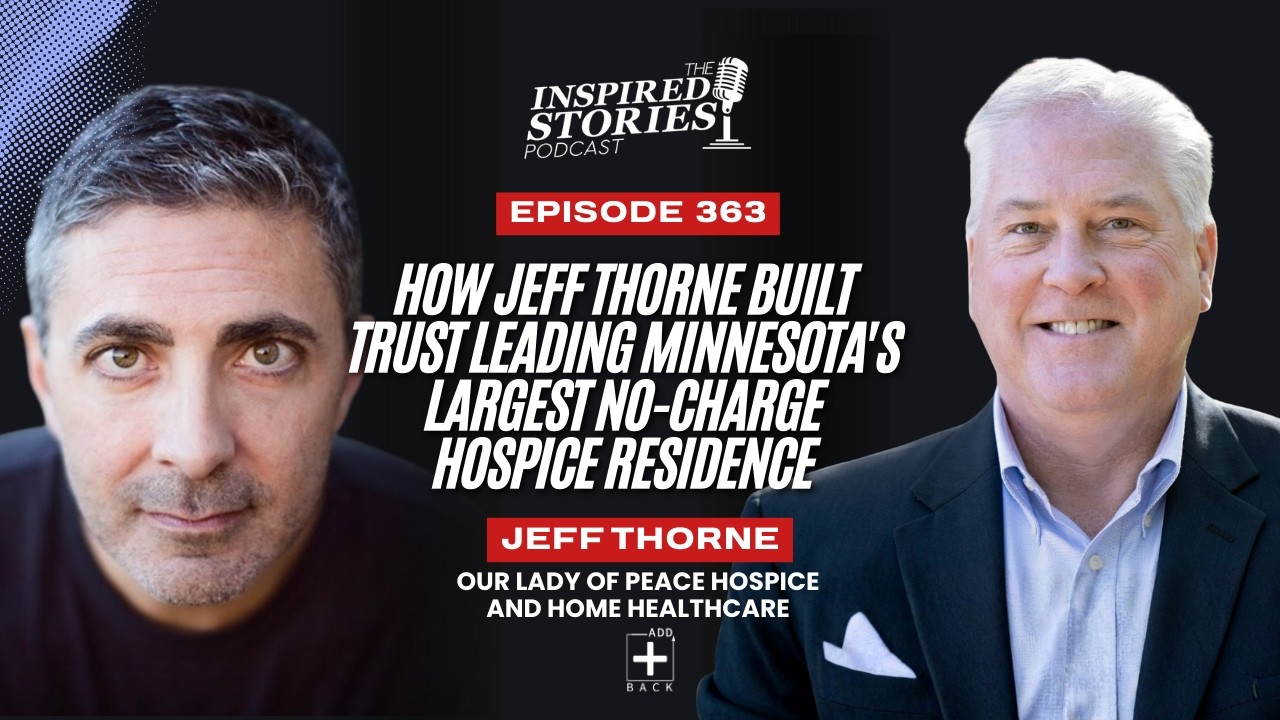
🎙️ From COVID Layoff to Leading 84-Year Hospice Legacy: Jeff Thorne's 30-Year Networking Journey
Jeff Thorne, President and CEO of Our Lady of Peace Hospice and Home Healthcare, shares his journey from discovering healthcare leadership through college career center informational interviews to COVID layoff recovery in three months, culminating in leading Minnesota's largest no-charge hospice residence—an 84-year mission founded by Dominican sisters where no patient receives a bill and every fundraising dollar stretches further than industry standard.
✨ Key Insights You'll Learn:
- Veterinary medicine pivot to healthcare leadership discovered through college career center informational interviews with executives
- Nonprofit versus for-profit decision: chose strong mission and servant leadership over financial emphasis after intentional internships
- 30-year networking arc: lunch invitation at 23 led to CEO opportunity decades later through persistent relationship building
- 84-year Catholic mission founded 1941 serving everyone regardless of faith—less than half patients Catholic
- 21-bed no-charge model: largest in Minnesota with special legislation covering costs sisters never billed for
- Fundraising efficiency: 15-18 cents per dollar raised versus industry standard 24-25 cents through lean operations
- COVID layoff recovery in three months through wife's support and 30-year professional network checking in
- Hire for mission fit over technical skills—culture alignment first, teachable skills second
- Employee wellness priority: bereavement programs, EAP support, donor-funded break room remodel for caregiver sustainability
- Collaboration over expertise: surround yourself with people smarter than you, practice active listening
🌟 Jeff's Key Mentors:
Dad and Grandfather: Taught collaborative leadership, rolling up sleeves to help people, and including key stakeholders in decisions
30-Year Lunch Contact: 23-year-old received phone call welcoming him to area—relationship took 30 years to fruition as CEO opportunity
Early Career Mentor: Advised during informational interview to surround yourself with really good people smarter than you
Wife and Kids: Provided assurance during COVID layoff while professional network reached out checking in
👉 Don't miss this conversation about how one lunch invitation at 23 became a 30-year relationship arc leading to CEO role at mission-driven hospice where sisters never charged patients and fundraising efficiency sets industry standard.
Listen to the full episode here
Transcript
Anthony Codispoti (00:00)
Welcome to another edition of the inspired stories podcast where leaders share their experiences so we can learn from their successes and be inspired by how they've overcome adversity. My name is Anthony Cotus Bodie and today's guest is Jeff Thorne, president and CEO of Our Lady of Peace Hospice and Home Healthcare. They are a nonprofit in St. Paul, Minnesota, dedicated to delivering compassionate end of life care.
Their mission is to address the physical, emotional, and spiritual needs of patients through in-home hospice, home health services, and a 21-bed residential hospice that operates free of charge thanks to generous donors. Jeff has served in senior leadership roles across nonprofit healthcare, senior housing, and rehabilitation for roughly 25 years. Before joining Our Lady of Peace in 2022,
He held positions at Volunteers of America, St. Teresa and Serenity Marion of St. Paul, building a reputation for guiding teams with both empathy and expertise. Now, before we get into all that good stuff, today's episode is brought to you by my company, Adback Benefits Agency, where we offer very specific and unique employee benefits that are both great for your team and fiscally optimized for your bottom line.
Imagine being able to give your hospice employees free access to doctors, therapists, and prescription medications. And here's the fun part. The program actually puts more money into your employees' pockets and the companies too. One recent client was able to increase net profits by $900 per employee per year. Results vary for each company and some organizations may not be eligible. To find out if your company qualifies,
Contact us today at addbackbenefits.com. All right, back to our guest today, President and CEO of Our Lady of Peace Hospice and Home Care, Jeff Thorne. Thanks for making the time to share your story today.
Jeff Thorne (02:05)
Hi Anthony, great to be here. Great to meet you in person. virtually, yeah.
Anthony Codispoti (02:08)
Yeah, virtually in person.
Best we can do today being in two different states. So Jeff, what first attracted you into the healthcare space?
Jeff Thorne (02:14)
Right.
Well, actually, I go back to my days in college. ⁓ In growing up, I always thought I wanted to be a veterinarian. Started my college ⁓ life with a pre-veterinary medicine track. And ⁓ midway through my sophomore year, kind of figured out maybe it wasn't the best track for me. So I actually started working quite a bit with the college's.
Career Center and, and, you know, this is back in the mid late eighties, so long time ago, but they had a lot of different tools to use to help me kind of figure out where my personality was the best fit, where my skills might be the best fit. Healthcare leadership came out very, very high. So I took that and started doing some informational interviews, ⁓ with, ⁓ executives and different healthcare organizations, both.
on the acute care side, hospital side, as well as long-term care side. And I will be forever grateful for those individuals and just their willingness to spend 30 minutes with this college kid at that time. And then, you know, how it works at the end of each interview, I'd ask, is there anybody else you might suggest I talk to? And they kept referring me to somebody else. So just really learned a lot more about long-term care, about acute care.
leadership management and really felt it was a good fit. So made a change with my degrees and ended up with a business degree. And then I actually did a couple of internships, you know, just to try to really explore further. I determined I wanted to be more on the long-term care side and that kind of brought out a little bit more of.
Anthony Codispoti (04:09)
Did you determine that before you got
into the field just from some of those conversations that you were having?
Jeff Thorne (04:14)
I did,
yeah, through the informational interviews. And what in hindsight, looking back on it, I think what it did is it brought out a little bit more of that entrepreneurial spirit that I have in that in the long-term care side, organizations are much, much flatter. So as an administrator, ⁓ I had responsibility as well as insight and opportunities to work in finance-related things, marketing.
care delivery, I all of these different aspects as opposed to a more vertical organization where you kind of have a department. ⁓ So that really fit well. I did a couple of different internships, one towards the end of my college career, one post-graduate in the long-term care field, post-acute care field, and really did that intentionally where one was with a for-profit.
organization and one was with a not-for-profit or non-profit organization. Both organizations, very, very good organizations. But I just kind of felt and learned that the non-profit side was a much better fit for myself.
Anthony Codispoti (05:25)
How so? What really attracted you to that?
Jeff Thorne (05:27)
Yeah, I think it's a sense of a strong mission, a sense of ⁓ even at that point without being able to label it, kind of a little bit more of a servant leader in ⁓ focused on certainly doing what's right, providing excellent care for people in times of need, but doing that without having
as strong of an emphasis maybe on financial outcomes. Now nonprofits, you know, we still need to try to have a bottom line, but it gets reinvested right back into the organization.
Anthony Codispoti (06:06)
⁓ And so you took this test at, know, when you were going through the vet track, right, going to vet med, and that wasn't a fit for you. So you took this test and you know, it says, hey, you know, healthcare administration, good fit. And so you rolled up your sleeves, you had a whole bunch of informational interviews, you heard things that you liked. And then you got started in some internships. And through some of these internships, different work experiences, you figure out that the nonprofit track, that is a better fit for you.
Jeff Thorne (06:12)
Yes.
Anthony Codispoti (06:35)
right? And, and so you kind of move your way through some different stops as you kind of think back to some of the previous career stops for you, Jeff, prior to getting to Our Lady of Peace Hospice. Can you recall maybe one big like learning moment in terms of like operational challenges and how that influences or informs how you approach leadership today?
Jeff Thorne (06:35)
Right.
Sure. I think one ⁓ was when I became, ⁓ went from a position of operating a single site to overseeing multiple sites. ⁓ That was a job change to do that. So more of a, what was called a regional director of operations. So having multiple locations under my responsibility. And with that organization, we were building
So not only multiple sites, but multiple sites in different states. So then we were going to build a new facility, a rehab facility. And half of it was rehab and half of it was a geriatric psychiatric hospital. And ⁓ steep learning curve with the hospital part. We had a partner that was gonna manage that facility for us, but I was.
kind of one of the primary contacts in operationally working with them. But going through the process of learning how to operate in another state, learning how to oversee people in these buildings remotely and not being there all the time, ⁓ learned a lot. And my person that I reported to was great. He was very supportive, but he was very hands-off as well. So it was an opportunity for me to really stretch myself. ⁓ Had to learn a lot.
relatively quickly. And then with building a building, ⁓ you know, with three, four states away, ⁓ took some effort and took a lot of quick learning to figure out how to do that. And yet still, you know, know all the details, be overseeing progress, be making sure we're hitting the timelines. There's a whole lot of regulatory requirements, joint commission types of requirements, and just really working through all of those.
Anthony Codispoti (08:54)
So, you know, it's one thing to be taking on all of these new responsibilities and challenges when you're on site. It's a whole other thing when, like you said, you're four states away and you're trying to level up on something completely new. Who did you go to? Where was the support for you? Who was kind of a mentor during this time?
Jeff Thorne (09:04)
Hmm.
Yeah.
My boss was certainly, you know, I'd check in with him and he would, you know, want to make sure things were on track. In that organization, we had a great team of what we call consultants, but they were internal people that had specialty in different areas. ⁓ So I'd certainly be leaning on them ⁓ as we were going through it. We had a ⁓ development company that was helping working through, you know, even helped.
a little bit with the financing, but the pro forma's help with the project management. So leaning on them ⁓ as well ⁓ to just keep track and learn. I had to though, I felt like really learn a lot about that market quickly. ⁓ I probably had responsibilities overseeing other buildings in that market for about a year before we started building. Not only to understand
know, kind of the laws and the building requirements, but certainly just understanding the market and what those individuals want in a rehabilitation facility. And we were trying to do something that was a little bit different, not looking like a nursing home, but truly be a rehab facility that could, physical rehab, that could attract maybe a little bit younger population as well.
Anthony Codispoti (10:35)
You made a comment earlier about, you know, in the nonprofit space, you were attracted to the idea of servant leadership, even though that was a term that you didn't really have a word for then. Explain how your attraction to that or your belief in that approach unfolded.
Jeff Thorne (10:58)
Probably honestly that approach from my dad and even my grandfather. I mean, it's that ⁓ you roll up your sleeves and you get in the weeds and you help people and you do what's right in society basically. ⁓ But from a leadership standpoint, for me, it's one that believes very strongly that a collaborative approach is a better approach. ⁓
identifying your key leaders and working with them and growing with them, including them in key decisions where you can, and getting their feedback to make those decisions. I feel like those decisions are better if we involve the right people in them rather than me in my office doing it by myself. ⁓ So I think it goes back at the way I was raised, you know, to a large extent that, you know, you never...
too good to do something, don't ask someone to do something you wouldn't do yourself. I just those age old ⁓ types of values that were instilled in me.
Anthony Codispoti (12:03)
So let's talk about how you came to join Our Lady of Peace Hospice. I understand there is, even though you've only been there a few years, was sort of a 30 year arc of how this all unfolded.
Jeff Thorne (12:15)
Yeah,
yeah. Very interesting and, and just kind of a testament, I think, to networking in the value of professional relationships. So I'm literally a 23 year old kid, you know, a year out of college. And I, start my first position as a care center administrator and I'm in a small rural community. I grew up in the suburbs. So a little bit of a culture shock, but
I get there at 23 years old. One day out of the blue, I get this phone call from someone who's about a half hour away in another community, larger community, but still rural. And he just welcomed me to the, to the area and said, Hey, let's go have lunch. Get a chance for you to meet me. And I can meet you. Took him up on it. It was great. Over a 30 year time period, we'd see each other at conferences. We once in a while might chat on the phone or something.
⁓ but then fast forward to what now was probably about five years ago. He reached out to me, reached out to me, ⁓ out of the blue and said he was starting to think about retirement. And would I be interested in throwing my hat in the ring for his position at our lady of peace? And, you know, at that point I said, no, thank you. I'm very happy what I'm doing and, and where I am. And, it was, ⁓
somewhat relatively new to that organization at the time. And I said, the timing's not right for me. ⁓ It's too soon for me to leave. I just got here. Thankfully, he called me a couple more times over about a 12, 18 month period. And finally, I said, OK, let's go have lunch again. So we had lunch. And I learned a lot more about Our Lady of Peace and the organization. ⁓
And I came for a couple visits with him just to learn more. And then finally, after a lot of conversation with my wife, I called him and said, hey, I think I want to throw my hat in the ring when your board is ready. And when they put together their search process, let me know if you don't mind, and I'll throw my hat in the ring. ⁓ So it was great. Now, you know, another layer to that is once ⁓
There's a person, part of our leadership here at Our Lady of Peace that I used to work with probably about 14 years ago, we worked together and I found out kind after the fact that ⁓ she encouraged or threw my name in as well as someone that might be good, a good fit for this organization. it took over a 30 year period for that to kind of come to fruition, but, and took me... ⁓
a little bit of time to finally say, let me learn more. But thankfully I did. But I think things happen for a reason. And thank goodness my predecessor was persistent with trying to reach out to
Anthony Codispoti (15:22)
You know, I love this story. It highlights the importance of your network, right? And for some people, networking is kind of a, I don't know, an uncomfortable kind of almost sticky word. Cause I think, you know, I won't speak for everybody. know early in my life, I went to networking events and it felt like, you know, everybody's just sort of like, you know, can you give me something like, you know, that kind of a thing. And that's not what you're describing here. Like you were developing like genuine.
Jeff Thorne (15:45)
Hmm.
Anthony Codispoti (15:50)
Friendships right there was no Transactional value in mind as you got to know these people these were just nice people that were in the same field and you'd stay in touch and it Confirmed for me. Is this the way that you kind of think about networking Jeff?
Jeff Thorne (15:51)
Mm-hmm.
Yeah,
absolutely. Absolutely. I think, you know, I don't know about other industries or professions necessarily, but for mine in, in healthcare, ⁓ it gets to be a pretty small little net, you know, community of, of healthcare people throughout the state. I'm located in Minnesota and ⁓ people know each, people know people. And certainly later in my career, you know, after that first or second,
position that I had, it becomes pretty clear pretty quickly that a lot of times the positions you get are based on kind of who knows you, who knows your integrity, who knows your successes that you've built throughout your career. And that ⁓ is a lot of times more valuable for people than sitting in an interview with someone they don't know.
Anthony Codispoti (16:55)
I can tell you every, maybe every opportunity that, you know, door that it's open for me in my life has come through a relationship that I had that was not of a transactional nature before. Somebody I knew, you know, just somebody I had a good relationship with and they, right, just like you're saying, they come to understand what your personality is like, what your experiences are like, what you're good at. ⁓ And then those are the people that come knocking on your door. So yeah.
Jeff Thorne (17:00)
Hmm.
Yeah. Yeah.
Anthony Codispoti (17:24)
I
think it is just a good moment to kind of do a sidestep and highlight that for folks, the importance of doing that. Start building your network now. ⁓ Invest in it. Invest in people. And I think that's really the way to sort of couch that. So, okay, now I want to talk about what are the services that you guys provide? What is it that you guys do at RLATOP's hospice?
Jeff Thorne (17:44)
Sure.
So our Lady of Peace, we've been around as of this month, 84 years here in St. Paul. And, you know, a little bit of our history, we were founded by Catholic nuns that came from Hawthorne, New York, Dominican sisters, and they came to St. Paul and they started providing end of life care in 1941. Grand opening.
for their building, which was an old telephone company building that they renovated into being able to provide care. Their grand opening was on December 7th, 1941. So on Pearl Harbor Day is when they opened the doors and started caring for people, which to me kind of goes partly to their perseverance ⁓ of providing great care, even as Pearl Harbor Day was occurring.
Fast forward today, excuse me, today, we are a Catholic organization, but we care for everyone. But based on those foundations that those sisters built for us, we provide home health care out in the community. So a 25 mile radius from St. Paul, where we're located. And that's rehabilitative home health care, PTOT, speech, kind of wound care management, those types of things.
nothing to do with end of life care. Other part of our organization provides end of life care and hospice care. So we do that out in our community, meaning we go, our staff go out into individuals' private homes, into assisted living, into nursing homes and provide hospice care. Again, 25 mile radius from here in St. Paul. And then a part that makes us pretty unique is we've got this, you mentioned 21 bed hospice residence building.
here in St. Paul. In Minnesota, 21 beds is the largest in the state. We have some special legislation allowing us to exceed the state maximum for that. And the other very unique thing about us is, as you mentioned, no one gets a bill for being here. So we do not charge patients or family members for the care we give them here in the hospice residence.
Now we do bill Medicare, which is a primary payer for hospice care, but there's no copays, there's no deductibles, there's absolutely no bill for people. So that leaves an enormous hole in our budget each year.
Anthony Codispoti (20:30)
Medicare doesn't reimburse nearly enough to keep the operation running.
Jeff Thorne (20:33)
No, it doesn't. And the Medicare payment is really focused or based on kind of a community-based hospice approach like we do 25 miles out. So the Medicare payment rate does not cover the costs of a building. The cost of 24 hours, seven day a week staff of, you know, a maintenance department, a food service department, housekeeping, all those other services that come with a building are not covered.
Anthony Codispoti (21:00)
So you're
saying that really the Medicare model is set up to reimburse for just home hospice care. Okay, sorry, go ahead, Chuck.
Jeff Thorne (21:07)
Correct, yes, yep,
no, yes, that's correct. So other hospice residences will charge a private pay fee typically to cover that building expense, that 24 hour staffing models that they need. And the sisters never did that. And we've been able to carry through their mission for 84 years. So we do a substantial amount of fundraising and we've got a very large group of just
incredibly committed donors that help support our mission and more donors every day, every week that support our mission.
Anthony Codispoti (21:48)
What does the fundraising look like? Are you guys holding like an annual gala? You've got people on the phone dialing and smiling.
Jeff Thorne (21:50)
Ahem.
It's ⁓ most impactful with people that we've cared for in their family. We don't do a lot of events. ⁓ We did have an event recently, which is an annual celebration of life. We do a butterfly release in the summer months, and we have a spring luncheon. Those are really our events. Every five years or so, we'll do a gala.
Those events take, especially a real large gala, they take a lot of staff time, a lot of energy. There's a lot of expense associated with them. As an organization, we are extremely lean with our fundraising. So for every dollar we raise, we're spending about 15 to maybe 18 cents to raise that dollar. The standard out there is closer to 24, 25 cents. So we're very lean on what we do.
Anthony Codispoti (22:50)
very efficient.
Jeff Thorne (22:52)
but it's all about donor relationships and just making that contact and making sure communicating why we're doing what we're doing. And to be honest with you, I don't think you could write a better story than what has unfolded for our Lady of Peace.
Anthony Codispoti (23:12)
more about that, that story.
Jeff Thorne (23:13)
Well, just, yeah,
our story just founded by Catholic nuns, caring for everybody. ⁓ Those nuns used to teach, you know, our staff that it doesn't matter if you're the bishop or if you're homeless, you're welcome here and you're going to get excellent care. So we still do that today. ⁓ Yes, we're a Catholic organization, but because of our Catholic social teaching that we care for everyone. Less than half of the patients we care for are Catholic.
our chaplain team, know, we have Catholic, have Lutheran, Jewish, Protestant. ⁓ We really try to meet the patient where they are. ⁓ And, you know, we are able to do that through the generous donors at no charge for someone. ⁓ that, that providing excellent care is one thing that takes a whole lot of energy and time and reputation, but to be able to do that at no charge to people.
Anthony Codispoti (24:14)
That's incredible. Yeah. You said that you guys at 21-BEDGE are the largest facility ⁓ of the kind in the state of Minnesota and that even you needed to get some sort of a state exemption to do that. Why are the state laws requiring that facilities be so small?
Jeff Thorne (24:14)
Yeah, it's just an incredible story.
Yeah, I think that law was based in, and that law I think goes back to the 80s or 90s. It goes back a little ways, I think. But I think it was based on trying to keep a hospice building more residential feeling. Now we take a little bit different approach too than some other hospice residences do in that we focus on patients.
that are assessed to be within about the last 30 days of their life. So it's a very much a medical model. On average, a patient is with us here in this building for about 12 days before they pass away. But the most common length of stay is literally one or two days. So people are coming to us very frail.
And we have, you know, with our staff, they are absolutely incredible and they've developed expertise in end of life care and just surrounding not only the patient, but the family with support, with education about the process and just love. I mean, our staff are absolutely incredible for what they do. And sometimes at the very, very literally very short
period of time we have to make an impact on them and provide that care when they most need it at the end of their life.
Anthony Codispoti (26:09)
So putting myself in my own shoes, but I'm sure a lot of listeners are wondering this kind of thing as well. When we've got a loved one who approaches that point in their lives, what can we expect? Help walk us through what that process might look and feel.
Jeff Thorne (26:11)
you
Well, typically, at least with the hospice residents, about 70 % of the patients that come to us are coming directly from a hospital. So ⁓ some of our patients may be getting hospice care from another hospice organization or our own hospice organization out in the community, but many are not. it's a very difficult time of a family member hearing about a terminal diagnosis many times for the first time.
or hearing that there are no longer valid treatment options for someone. So it's a lot for a family to deal with. And many times if they are in the hospital, it's we need to help you find a place of where your loved one can go and need to try to make that decision in the next couple of days. So it's a lot of burden on a family very quickly. And for most people, unless they've had other loved ones go through it, they don't.
know the process, that it's difficult to navigate. So the hospital staff are very helpful. ⁓ Other community types of groups are helpful. Word of mouth is very important. We're kind of like that networking. mean, people reach out to family members, to friends that have gone through it to try to learn how to navigate. But ⁓ for us, that hospital discharge planner, that physician in a clinic, whatever it might be,
you know, is encouraging hospice care and there's a social worker or someone that's helping, you know, reach out. Many times, you know, families don't even know where to start. So they may have, well, here's a few options of organizations to look at, but, you know, it's patient choice. They need to decide where they'd like their loved one to go to get hospice care. And a part of that decision-making is determining whether or not their loved one can be at home and get hospice or whether they need.
more of a 24 hour a day care support around their person depending on how they're doing. So it's a whole lot of factors, decisions that happen very quickly. What we do is when they make contact with us is we try to answer all those questions. We really try to help as best we can. And even if they don't come to us, we're still going to try to really help that person make the right decisions for themselves.
And then we have to then work directly with the physician, the hospital to get, you know, copies of medical records and things to make sure we can provide care for that person ⁓ and get it set up. then whether the person comes here to the hospice residence, our team, you know, is ready and waiting for their arrival. And typically it's by ambulance that they come to us and then we get them into bed and we start working with the family.
Anthony Codispoti (29:26)
start working with the family, start working to make the patient comfortable. ⁓ In your experience, having done this for a long time, what's the thing that surprises the loved ones the most about the process?
Jeff Thorne (29:28)
Right.
The complexities around it. know, hospice care is a little bit easier from a payment standpoint in that it's typically Medicare. But if you've got someone that doesn't have Medicare under the age of 65, it can be more complicated just trying to figure out if you've got a health insurance plan that might cover some of the costs. So that can be extremely complicated. I talked to friends. I talked to someone earlier this week.
just trying to navigate that, that their mom has a Medicare Advantage plan. Do I need that? Is that the right thing? Should I have straight Medicare? It's a very complicated system.
Anthony Codispoti (30:24)
So when you stepped into the CEO role here at Our Lady of Peace Hospice back in late 2022, so about three years ago, what were some of the immediate priorities that you wanted to address there?
Jeff Thorne (30:37)
You know, I, ⁓ in working with our board's search committee and going through that process, one of the things that the search committee asked for was, I'm assuming for all of the candidates or the final candidates was, what's your one-year plan? And I remember when I was putting that together, I wanted it to be very thoughtful, but I wanted hopefully to be able to utilize it. So I put a lot of energy into it and hung onto it and...
The approach I took is even during the search process and then talking to my predecessor, I did a lot of research to understand the organization. I didn't see any immediate red flags, but I told the board as well, I felt it was very important that I do my own assessment so that I can really dig into things quickly and try to make sure or find out if there were ⁓ immediate needs that I needed to deal with very quickly.
to get on that right away. So I did, you know, a financial assessment, kind of a care-related assessment, you know, what liabilities did we have, what, you know, types of things might be going on, and thankfully, things were very good, as I expected, but wanted to assure myself of that. And then I started spending a lot of time talking to our staff, one-on-one, small groups.
And I don't just mean leaders. mean, people delivering care at the bedside. Why they were here. ⁓ What do they think is really going well? What might we do a little bit better? I met one-on-one with each one of our board members. I started making contact with some of our key donors and having similar conversations with them. And just understanding better why people have chosen to be connected with Our Lady of Peace.
and those questions around what do we do really, really well and maybe what could we do a little bit better. That started forming for me kind of what turned into a strategic plan or kind of identifying those key objectives in that first year of what was most critical that we start working on.
Anthony Codispoti (32:56)
And what was that?
Jeff Thorne (32:58)
You know, it was, for me, was primarily because things were going well. There weren't immediate crises. It was building trust as quickly as I could. I was following someone that had been with the organization and kind of through a merger for 30 years. So some big shoes to fill. And people that had a whole lot of comfort working with him. So I wanted to not have any kind of a...
mass exodus, you know, some key leaders or other staff, we're not that large of an organization. Couldn't afford that. So, and even with board members, it was just trying to advance as quickly as I could to build that trust, to get that relationship deep as quickly as I could. And then really, again, working, starting to work on a strategic plan and what we should be kind of most focused on.
Anthony Codispoti (33:55)
So, you know,
84 year history of RLAD piece, know, undoubtedly things have evolved and changed over time. Are there any current or even upcoming innovations that you're working on, excited about, technologies, staff training, community outreach, anything that really gets you excited?
Jeff Thorne (34:16)
Yeah, there are. know, the 84 history is wonderful. I mean, I'll tell people, you know, I could list organizations that would pay just about anything to have our reputation and have the foundation that we've built. It's our greatest asset, but there's always things we can improve on and there's always better ways we can do things. So, you know, technology is always something that's easy to, you know, maybe just not quite stay up to date. Our electronic medical record system.
was outdated, very outdated. So just a couple months ago, we implemented a new system, which took a lot of effort, collaborative effort, working through that with our folks. And, you know, so far good results, but we're what now probably two months in with that new system. But there's new opportunities with that new system that we haven't even uncovered yet. It's just better processes, ⁓ more efficiency with staff.
There's things still upcoming. Could be some things kind of built into the system that we just haven't uncovered yet around AI opportunities and how that might streamline some things we do. But that's been very good for us, very exciting. But I think it opens the door for other opportunities going forward too related to technology.
Anthony Codispoti (35:40)
⁓ Either,
well, two-fold question here. How are you guys using AI today, if at all? And two, as you think about other ways to use this new platform and leverage AI there, what are some things that you're excited about going?
Jeff Thorne (35:54)
Sure. We've kind of just dipped our toe a little bit into some AI things now. Not across the organization. There's a handful of people that have some access to some AI things. And so right now, it's more about summarizing documents, ⁓ summarizing different regulations, summarizing ⁓ emails, helping us just work through that, helping us with some communication types of things. So pretty entry level, in my opinion.
I think with our new EMR, there's some opportunity there already just built into the system with how it analyzes things. There's going to be a future for that as well. I've had some of our caregivers talk to me quite a while ago even about wanting to use AI to help with patient charting, being able to customize it obviously and making it very patient-centered, but just helping with some of that.
that it takes to do that documentation. We're not there yet. ⁓ And one of the things that I'm very cautious of and we are as an organization is the protection of any patient information. So we don't use AI for anything patient related at this time, ⁓ just because we haven't worked through to make sure it's all HIPAA compliant and privacy protected appropriately. But I think there's a lot of opportunity there.
Anthony Codispoti (37:22)
What do you think the execution of that patient charting looks like? Is it sort of like a voice to text kind of ⁓ a thing so that, you know, they're not spending time writing. It's just like, you know, Hey, they got five minutes in the hallway and they're making a little voice note and that kind of gets inserted into the chart.
Jeff Thorne (37:26)
Thank
I think it absolutely could be voice to text. There's some softwares out there that do some of that. But I think there's also opportunities around ⁓ reviewing, could be different types of ⁓ blood pressure, temperature, all of those different types of measurements and things that we do. And there's other things that happen around end of life care that ⁓
you know, ⁓ AI device could summarize that much quicker, but also could maybe even make, you know, some recommendations about based on this, this and this, you know, it's go this route. You know, we've got some pretty prescribed ⁓ methodologies for care delivery and medication use and what types of things like that, but there could be opportunities there as well. I think with
with AI and it's just my hope. It's not to ever for us replace staff, but it's to make staff more efficient and maybe a little bit less time in front of a computer and more time with the patient. That's our focus.
Anthony Codispoti (38:54)
That's amazing, right? Because it's that human-to-human connection in any field, but particularly in the type of work that you guys do that's so important,
Jeff Thorne (39:03)
Right, yeah. Yeah, I've had ⁓ some of our nurses, we did a renovation a few years ago of our building in addition of a couple more wings that created all private patient rooms, which is critical, I feel, in end of life care. But we put in computers in every room, much like many hospitals do in each patient room. So staff could document right there. Well, a couple years in, we've actually removed those because they just weren't being used by staff.
And many of our staff just did not want that computer between themselves and their patient. It needs to be much more of a human interaction. ⁓
Anthony Codispoti (39:43)
So the time spent in the
room, they are with the patient. They're 100 % fully present.
Jeff Thorne (39:48)
Exactly.
Yeah. Yeah.
Anthony Codispoti (39:52)
And yet to talk about staff, like again, in any industry, your frontline staff is so critically important. That's the face of the company, right? That's how people relate to who you are and make judgments about the service that's being provided. But man, so critically important in the kind of work that you guys do. It's such a sensitive, you know, time of somebody's life. How do you guys approach the hiring, the interviewing process and then
you know, when you've got good folks, how do you hold on to them?
Jeff Thorne (40:24)
Yeah. You know, going back to when I first came to our Lady of Peace and spending some time visiting with our staff and our frontline caregiving staff, one of the things I heard over and over from our folks, and I'm talking about folks that have 20, 30 years with us, is that it's not a job. This is a calling. I'm called to do this work. So they have very personal, deep personal reasons why they want.
to care for people at end of life. But for us, and this, our work here at Our Lady of Peace really emphasize this, I've heard it a lot throughout my career, you you hire for fit, hire for the culture, you know, those kinds of things, it is paramount for us. So we absolutely do want to hire people that are all in with our mission, that fit our culture, and we want technical expertise. But if there's some things,
that maybe they're not quite there yet, we can teach that if they have the right fit and the right culture. So we spend a lot of time in an interview talking about our history, talking about who we are, what we do, and why we do it, and really try to gauge their level of commitment to that mission. Again, depending on the position, this health care community is a small community. So many times,
Someone knows someone that knows someone. We are blessed that we have some ⁓ staff that come and work for us on an on-call or casual basis. So no ⁓ position or schedule in the hopes of getting one when one comes open. So we've got folks that are working with us, you know, with the hopes of getting a more regular position. And obviously we get to know them very well during that time period too.
Anthony Codispoti (42:19)
Almost like a substitute teacher kind of a setup, right? Yeah. They prove themselves and when that door opens. Yeah. And, you know, the kind of work that they're doing, your frontline folks, very stressful, right? You your, your job is to help people pass on, you know, and make them comfortable. What kinds of emotional support exists for your team? ⁓ you know, just to kind of help them through what they're dealing with.
Jeff Thorne (42:21)
Kind of, yeah, yeah, right, right.
Yeah.
Yeah, yeah, it's very important, very insightful question for what we do ⁓ because it is so important. Our staff, you know, to be at their best, we need to really support them and take care of them. ⁓ And we're blessed with our board of directors is very interested, you know, on an ongoing basis. What are we doing to take care of our people? You know, how do we take care of our staff? So throughout the organization, there's a lot of support for that. But some things we do.
⁓ you know, and sometimes there can be times where an experience with someone is, difficult. And many times for us, cause we do care for adults. We don't do pediatric care, but even if it's someone in their thirties and forties, sometimes that's more challenging on the staff. That's more difficult. There could be young children that are losing a parent, know, those kinds of scenarios. Most of the people we care for in, you know, 65.
So we ⁓ will do some support groups with our chaplaincy group. Another part of our organization is our bereavement team. So anytime a patient passes away in our care, we will offer and provide bereavement support for their family members for up to 13 months after their loved one passed away. Now that's directed by the individual.
Some people, I just want resources. Some people want one-on-one conversation. Some people want a small support group. We kind of have all of those types of options for individuals. So we might do a little bit of that with our staff too, who will pull together a support group. We have had recently a very difficult death of a patient, a very unexpected death. And we brought in kind of an expert.
from outside our organization to just meet with the staff that were involved and really try to support them. And that was just an area we didn't have the expertise internally. And sometimes we also understand and respect some of our staff may not want to share with colleagues. They need that external person they feel a little more comfortable opening up to them. So we'll do that. We have an employee assistance program.
certainly that our employees are aware of and we encourage them with that. ⁓ We are hopefully getting soon to finishing a completely remodeled, relocated break room for our staff. And that was 100 % funded by donors because they want to take care of our staff. So that new break room is going to have much updated, but a coffee bar is going to be broken up into kind of three
subsections because we know people need different things during their break and they need to be able to. Some people want a conversation area with a cup of coffee. Some people want a more private space. I just need to be alone and think. ⁓ We've got one of those real large massage chairs that you might see that will be available for staff. So we're just trying
Anthony Codispoti (46:10)
a little
self care support there. Yeah.
Jeff Thorne (46:10)
Yeah, yeah, we are doing
a lot around employee wellness because it is so different for each person and just trying to meet them with different options. So we'll offer a variety of different things. Massages, we'll offer ⁓ different types of wellness programming that's focused on employees. And we know not every employee is going to partake in every one.
But hopefully we're hitting the mark on some of them that helped them.
Anthony Codispoti (46:42)
know, Jeff, in my experience, ⁓ personal growth, ⁓ professional growth, oftentimes comes through going through our own huge challenges, right? What's a big challenge that you've gone through in your life, whether it was on the personal or professional side? How did you get through it? And what did you learn getting through the other side of it?
Jeff Thorne (46:53)
you
Yeah, that's really good question. ⁓ The one that really stands out for me, I I think I'm like probably most people where throughout your career, there's a variety of different types of bumps and hurdles or left turns that you maybe didn't anticipate. One that really kind of hit me blindsided was I was one of those victims ⁓ of the COVID time as far as losing my position. ⁓
and being laid off, ⁓ didn't see it coming. Didn't, didn't expect that. was working ridiculous hours, trying to support, you know, my teams and multiple buildings during that time. And, ⁓ first time ever I've had that in my life. and that was something, you know, that set me back quite a bit. It was a lot of self-reflection. was, did I do something wrong? What did I do wrong? How do I bounce back?
I took a few days, and it was kind of right by the holidays. And I just thought, you know what, I need to start talking to my peers. I need to start talking to networking groups. And that word kind of spreads and had, again, people more than willing to talk, to give me advice, to just help work through it. And I'm old school of, have a wife and two kids of
My role is to provide for my family. My wife works, job. It's not who makes more, but it's just old fashioned me. So I got to get back in the game here. And big part of those conversations with people was trying to figure out what game I wanted. I didn't know for sure I wanted to get back into healthcare management. ⁓ Far too young to retire and just hang it up completely. ⁓
really set me back mentally, know, emotionally for a little bit and then just started talking and ⁓ started hearing about some opportunities and it was just a matter of working through those. And I'm, you know, grateful. An organization that I worked for previously called me and wanted me to, you know, first kind of help on this consulting project. And then that developed into a new
⁓ vice president role with them. So, you know, I was very grateful and ⁓ appreciative, you know, kind of of getting back in the game, so to speak.
Anthony Codispoti (49:44)
How long was that gap
between ⁓ being let go during COVID and starting the new role?
Jeff Thorne (49:53)
felt like forever, but it was, yeah, it was just shy of three months. So, not too bad, you know, ⁓ and we were, you know, our family was blessed enough that it wasn't a situation where we're gonna have food on the table, but it certainly was going to change us and our lifestyle a bit depending on how long it lasted. ⁓ no, and then that part in hindsight,
Anthony Codispoti (49:54)
huh.
Jeff Thorne (50:22)
wasn't a concern, but when you're in the middle of it, everything was a concern.
Anthony Codispoti (50:27)
Because it's the unknown, right? If you went into it knowing, in three months I'm going to have a new role, you'd be a lot more relaxed. OK, look at my finances. OK, we can make that work. But when you're in the midst of it, you don't know if it's three months or three years. And so how do you get through that uncertainty? Who were you able to rely on? What were your sources of strength?
Jeff Thorne (50:28)
Yeah.
Exactly. Right. Yeah, exactly.
My wife, first and foremost, you know, ⁓ and just assuring me and my kids, but, ⁓ it's, you know, I keep, and even, appreciate this doing this podcast with you, Anthony, because it's kind of bringing back things to me of the importance of that network that I built over, you know, now 30 years, ⁓ in this field, ⁓ relying on people. had, I had a couple of, of good colleagues that
would reach out to me every couple of weeks, just checking in, how you doing? That meant a lot to me. I didn't, maybe didn't realize how valuable that was in the moment because I was just so concerned about so many different things. But just, you know, starting again, doing those little, you know, one-on-one lunch, one-on-one, whatever ⁓ type of get togethers or phone calls just to see what else was happening. It was a tough time in healthcare because
Nobody was hiring new positions, especially more ⁓ leadership type senior leaders.
Anthony Codispoti (51:57)
Was that just because
they were so focused on trying to get through the day to day? No.
Jeff Thorne (52:01)
Yeah, yeah. You
know, and in the long-term care world, I mean, it was just such an unfortunate time, but, you know, many, many of the residents living in those buildings were catching COVID. In the early, early days, ⁓ you know, all of a sudden, occupancy and census was bottoming out and, you know, organizations were just scurrying, trying to, you know, save their organizations and make sure they could continue beyond that
public health emergency. Those were tough times. ⁓ But again, I absolutely relied on those colleagues to just help talk it through. And like I said, it wound up with an organization that I worked for previously, actually had a new leader, but she must've heard enough about me that she called me in and offered to kind of get started again. Yeah.
Anthony Codispoti (52:53)
That's great.
What's your superpower, Jeff?
Jeff Thorne (52:58)
Boy, ⁓ do think it is collaboration. You know, so I'm not the smartest person in the room and I don't feel like I need to be. I had a mentor back in those early days of those informational interviews that said if there's one thing you should take away is surround yourself with really good people that are smarter than you.
And I've taken that to heart. So, you know, I would tell people, you know, stories of I could sit in my office by myself and I could develop a probably a pretty impressive looking strategic plan as an example. I could have charts, I could have data, I could lay it all out, but I don't think it's going to be nearly as effective if I, then if I included some key leaders.
So we've gone through our first strategic plan here that I came. We worked with a great facilitator that helped us, but we developed key goals from our board, from our leadership, but then we took it out to the organization and we put together ⁓ eight different, we called them strategic imperative teams. Each one of those teams had one of the goals.
When we put that out, had 55 employees involved in our developing objectives of how we're going to meet those goals. That's out of about 175 employees total. And that's including casual everybody. So we have a big part of the organization that's involved in that process. We've got a lot more work to do around that. But getting the insights from the people that are literally with the patient every day.
That's insight that I don't have and yet I need, I think, in order to lead the organization in the right way. So I'm just a real firm believer in the collaboration piece. And to me, what comes with the collaboration is active listening, is being able to sit there quietly and listen to people and let them give you feedback and insights. Don't lead the conversation too much, but really listen to them and what they're telling them.
Anthony Codispoti (55:23)
How did you arrive at this approach, Jeff? Was it just sort of years of trying different things and noticing what works and what doesn't? Was there a management course that kind of put you on the right track, a good mentor?
Jeff Thorne (55:28)
Thank
mentors, but you know, I learned it kind of through the school of hard knocks in a way. You know, I learned it by in the long-term care field. I came into it as the administrator of a building back in my early days and I have a business major. Well, I'm leading a maintenance department. I don't know boilers or how they function.
I'm leading a food service department where, I can cook for myself, but I can't cook for 150 people three times a day. I'm leading a nursing department with nurse leaders, providing care, working with a medical director. So, I mean, I used to tell when I, of times I'd work with students ⁓ that ⁓ I take on as interns and. ⁓
I mean, I'd always tell them, again, don't be the smartest person in the room. I'd copy that message. But I'd also say, one of the things I love most about this job is I've never bored. Because I literally, in the morning, could be meeting with a maintenance person and maybe a vendor and I'm working through the issues of a boiler system and I'm learning about it. And then I go in the afternoon and meet with maybe medical director and my nurse leader and I'm learning things about clinical care that I had no idea.
So I'm always learning, ⁓ which I appreciate and love. ⁓ But I learned that I need that expertise of those different people. So that's what I love about this field too, is I'm not operating a department with a bunch of people that have the same background I do. I'm not running a marketing department or a finance department. all kind of related. ⁓ Sometimes it's a lot more complex when there's different disciplines in the room. But.
In the end, if we can get there, I think we can get much better outcomes having that expertise around the table.
Anthony Codispoti (57:34)
I like that. ⁓ Being able to shift your brain into different types of tasks sometimes can be really exhausting. But like you said, it keeps you sharp, keeps you on your toes and ensures that you're never bored. It's it's, you know, different problems that you need to figure out solutions to every day. Now, we got a favorite podcast, favorite book, something resource that you might like to recommend to our listeners.
Jeff Thorne (57:35)
you
Right.
Right. Yes.
You know, one I keep going back to, a book, ⁓ and it's been out for a long time, ⁓ but it's Hard Wiring Excellence and written by Quint Studer, a consultant. ⁓ But it's a book that years ago that an organization and our quality director gave me. And healthcare related, more specifically probably acute care related, but it's got elements of
strategic planning, it's got elements of customer service, and just practical applications of how you create an environment, a culture of excellence, but then how do you hardwire that into people so that it's sustainable over long period of time. And like I said, I probably read the book three different times just because I kind of keep going back to it and have given copies to other leaders. ⁓ It's been out there for a long time, but... ⁓
I feel it's got some real good practical applications. Yeah.
Anthony Codispoti (59:00)
It's a good one. How
about something fun you like to do outside of work, Jeff?
Jeff Thorne (59:07)
well, I love to golf. ⁓ Minnesota is a short golf season. ⁓ but I do love it. I honestly too, spending a lot of time with family, you know, I have a hard time, ⁓ on weekends, especially giving up time to go play golf when I can, can I, you know, hang out with our family or we're doing different things. I love to travel. ⁓ we get to do that a little bit now, especially with our kids, a little bit older, a little bit easier sometimes to break away and do some traveling.
Anthony Codispoti (59:36)
where are some of your favorite places to go? Or better yet, what's a place that's on the list you haven't hit yet?
Jeff Thorne (59:43)
⁓ Probably a place we haven't been yet. There's some other islands in the Caribbean we haven't been to that I would love to. Ocean, beach, re-energizes me. I also love, we had an opportunity to go to, you know, throughout Italy and Paris and ⁓ just to learn the totally different perspective than the...
Anthony Codispoti (59:57)
That's your style.
Jeff Thorne (1:00:11)
United States perspective on things. appreciate it. So I'd love to go back to other parts of Europe too.
Anthony Codispoti (1:00:17)
Nice. I've just got one more question for you today, Jeff. But before I ask it, I want to do three quick things. First of all, anybody who wants to get in touch with Jeff Thorne, you can find him at LinkedIn. Last name is spelled T H O R N E Jeff Thorne with an E on the end of it. And if you can, if you want to email him, he's given us his work email address to share with you, which will include the show notes. But for anybody listening, it's Jeff at our lady of peace. ⁓ N
So MN is in Minnesota. So Jeff at OurLadyOfPeaceMN.org. Also as a reminder, if you want to get your hospice employees access to benefits that won't hurt them financially and carries a financial upside for the company, reach out to us at addbackbenefits.com. Finally, if you'll take just a moment to leave us a comment or review on your favorite podcast app, you'll hold a special place in my heart forever. Thank you.
So last question for you, Jeff, you and I reconnect one year from today and you're celebrating something big. What's that big thing that you hope to be celebrating one year from today?
Jeff Thorne (1:01:21)
Well, you know, we didn't talk about it, but one of our primary ⁓ strategic initiatives for us over the next probably multiple years though, but one year from now, if we could be celebrating a huge kickoff and good start is we've got a fund of money ⁓ that we operate and use some of the investment income to help us support that care that we're not billing anybody for.
So we have an initiative that we're going to do a comprehensive fundraising campaign and try to raise a substantial amount of money to double the size of that fund. So if a year from now, ⁓ if we can be celebrating a great kickoff, a handful of key donors that have committed to us their willingness to continue and help us continue this mission, that would be a huge success for us.
Anthony Codispoti (1:02:18)
Well, we'll have to make a note to check back on that because that's a noble goal. All right, Jeff Thorne from Our Lady of Peace Hospice in Minnesota. I want to be the first to thank you for sharing both your time and your story with us today. I really appreciate it.
Jeff Thorne (1:02:21)
Yeah, I'd love to.
Thank you, Anthony, very much. I enjoyed it.
Anthony Codispoti (1:02:35)
Folks, that's a wrap on another episode of the Inspired Stories podcast. Thanks for learning with us today.
REFERENCES
Email: jefft@ourladyofpeacemn.org
LinkedIn: Jeff Thorne
Company: Our Lady of Peace Hospice and Home Healthcare
Website: ourladyofpeacemn.org