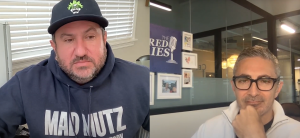
🎙️ From Concrete Cutting Crews to President of an 85-Year Deli Brand: Deric Rosenbaum’s Journey at Groucho’s
Deric Rosenbaum, President and resident CTO of Groucho’s Deli, shares his journey from running commercial construction crews in his 20s, to living across the street from the third-generation owner of an 85-year-old South Carolina deli institution, to building its entire franchise infrastructure, distribution company, and technology platform over 26 years. Through candid stories about borrowing $20,000 from his dad to open his first franchise and paying for everything else in cash, building and selling a multimillion dollar distribution company to Sysco just to learn how that side of the business worked, spending five years as his youngest daughter’s medical advocate after a mysterious encephalopathic event at seven months old, and building AI agents and internal podcasts via Notebook LM to help franchisees learn on their commute, Deric reveals what it looks like when a builder who is either all in or all out applies that same mentality to every problem he touches.
✨ Key Insights You’ll Learn:
Founded in 1941 in Columbia, SC by Harold “Groucho” Miller, nicknamed for his humor and mustache.
Franchising began only 25 years ago; three generations knew just one location before expansion.
First franchise funded with $20,000 loan from his father; built and paid cash for three more.
Created a central distribution company for eight stores, sold to Sysco after scaling to multimillion revenue.
Migrated brand to Square for Franchises with a universal omnichannel menu, streamlining updates.
Developed Groucho’s OS, an AI-powered dashboard for operations and allergen data.
Uses Notebook LM to produce short internal training podcasts for managers and franchisees.
Advocated for youngest daughter through years of medical challenges; now a thriving student-athlete.
Caps growth at one location per quarter—30 stores in 26 years—to prioritize sustainable expansion.
Maintained marriage despite challenges; divorce rates among special needs families are double the national average.
🌟 Deric’s Key Mentors:
Bruce Miller (Business Partner, Third Generation Owner): The neighbor and best friend who recognized that Deric knew how to build restaurants and he knew how to run them, a combination that has powered the partnership for 26 years
His Father: Lent him the first $20,000 that made the original franchise possible, which Deric considers the only debt he did not generate himself
His Oldest Daughter: Introduced him to Notebook LM while using it in graduate school for study guides and Quizlets, which he immediately recognized as an internal training podcast tool for Groucho’s franchisees
Harold Groucho Miller (Founder): Set the template for community involvement from day one as a champion fundraiser for what is now Easter Seals, establishing that Groucho’s is a neighborhood institution before it is a sandwich brand
The Medical Community He Navigated for Five Years
👉 Don’t miss this conversation about building franchise infrastructure that actually works, why a deli brand with 31 locations has a more sophisticated tech stack than chains 10 times its size, and what five years of medical advocacy taught a fixer about the limits of fixing.
LISTEN TO THE FULL EPISODE HERE
Transcript
Anthony Codispoti (00:00)
Welcome to another edition of the inspired stories podcast where leaders share their experiences so we can learn from their successes and be inspired by how they’ve overcome adversity. As you listen today, let one idea shape what you do next. My name is Anthony Codaspodi and today’s guest is Derek Rosenbaum, president and resident CTO of Groucho’s Deli, a quick service restaurant brand known across the Carolinas and Georgia as your neighborhood deli.
Founded in 1941 by Harold Broucho Miller, the company built its reputation on fresh sandwiches, signature salads, and the famous Formula 45 sauce. Today, Broucho’s operates more than 30 neighborhood locations and a growing catering arm, all driven by the simple promise that quality is the most important ingredient in a sandwich. Under Derrick’s leadership, the brand has modernized its entire tech stack, rolled out online ordering and
boosted repeat guest visits by more than 20%. The company’s longevity has earned dozens of local best deli awards and its 80 plus year story was recently featured in Southern Living. Before joining the family business full time, Derek helped launch its first franchises in the early 2000s and is active with the family connection of South Carolina. But before we get into all that good stuff,
Today’s episode is brought to you by my company, Ad Back Benefits Agency. If you run a business, you are likely stuck in the cycle of rising insurance premiums. You’re paying more with your team, they’re getting less, and many people can’t afford coverage at all. We do things differently. We offer a solution that provides your quick service restaurant employees with unlimited access to doctors, therapists, and prescriptions that’s always free for them to use. But here’s where you really need to pay attention.
Unlike every other employee benefit out there, our program puts more money into your company’s bank account. As an example, we recently helped the client increase net profits by $900 per employee per year. Gains like that can change how a business is valued. Results vary, but the consultation is free. See if you qualify today at addbackbenefits.com. All right, back to our guest today, President of Groucho’s Deli, Derek Rosenbaum. Thanks for making the time to share your story today.
Deric Rosenbaum (02:25)
Absolutely. Thanks for having me on Anthony. It’s exciting to have the conversation.
Anthony Codispoti (02:28)
Let’s do it. So before we talk about your 20 plus years with Grouchos, what kind of work were you doing before that?
Deric Rosenbaum (02:35)
So complete departure from the hospitality industry. I was in commercial construction. ⁓ So the first, I don’t know, I was in college. I was running concrete cutting coring crews ⁓ and then kind of morphed over into the commercial space as a project manager superintendent. So doctor’s offices, school renovations, restaurants, catering halls, kind of a mixed bag of all sorts of general construction. So I am actually a trained carpenter.
Anthony Codispoti (03:03)
Okay, so how did you get from the trades into quick service restaurant industry?
Deric Rosenbaum (03:09)
So my business partner is Bruce Miller, third generation family owner of Groucho’s Deli. We lived across the street from each other. We were best friends hanging out buddies, drinking buddies, doing all the things that dudes do in their 20s, And at the time Groucho’s had one, two locations. It was a satellite location in Lexington. They were just kind of testing the waters on franchising.
And he’s like, you know how to build restaurants. I know how to run restaurants. So we got together. We opened up our first franchise on the other side of town and it was very successful and did both for about six months. And then quickly realized, okay, I need to pick a career path. And then kind of went full, full tilt and learned the business from within the four walls. And then it evolved from there.
Anthony Codispoti (03:57)
So in that first franchise location that you guys opened together, you were literally building the walls, hiring subs to come in and do all the physical labor to put the physical structure together.
Deric Rosenbaum (04:09)
I
did everything from drawing the space to turnkey, the whole process, start to finish. And then obviously had subs because I’m not like an electrician or a plumber, but yes.
Anthony Codispoti (04:15)
Okay.
Yeah.
And so when that location opened up, were you continuing to be involved? Were you like right out of the gate?
Deric Rosenbaum (04:25)
I was there,
I was there nights and weekends trying to learn the business. Cause like I’m not a person of half measures. I’m in or I’m out. So I wanted to understand everything about the business. So I was doing both. then I was, cause at the time I didn’t know, is this going to be successful? Is this going to, you know, provide for my family? I had a very young family and actually I didn’t have a child at that point, but I’m still newly married and trying to figure all that out. And so, and then I realized, okay, I can make a successful living and provide for a family out of this restaurant business. So then six months in, I
quick construction and went full tilt and then we opened up three more restaurants together and then it morphed into completely different things after that. ⁓
Anthony Codispoti (05:03)
And what was the timeline? You said six months in, you quit your construction job, you were full in on the restaurant, and then in what time span did you open up those three additional locations?
Deric Rosenbaum (05:13)
⁓ Between 2000 and 2003
And then after that,
Anthony Codispoti (05:21)
And where
was that? When did you quit construction? Just so I have the full time.
Deric Rosenbaum (05:27)
Early 2001.
Anthony Codispoti (05:31)
Okay, all right, so you guys got into opening locations pretty quickly.
Deric Rosenbaum (05:35)
Yeah, well, I I had the building experience. I had the contacts. I had the chops. So that part was pretty cut and dry. And then, know, it’s then operationalizing that. And then at that point, I really wasn’t on the franchise side of the business. I was still just running our franchises ⁓ collectively and still learning, you know, the accounting, the distribution, the logistics, the managing, the people process problems, all of those things.
how to systematize all of these things. And then we opened up our own central distribution company, because we wanted to learn the distribution side of our business. So we had our own warehouse, own refrigerated trucks, built that up to a multimillion dollar distribution company, sold it three years later. I learned what I needed to learn about that side of our industry. And then, so now we control it, we don’t touch it. And ⁓ morphed over in 2007 more into the role that I’m in today.
Anthony Codispoti (06:30)
Okay, so few things I want to pull apart there. How did you finance these first few locations?
Deric Rosenbaum (06:38)
My very first location, I borrowed 20 grand from my dad and the rest I paid. And then everything else we paid cash for. We have no debt.
Anthony Codispoti (06:47)
Wow,
that is some fiscal responsibility there. Where did you learn those skills?
Deric Rosenbaum (06:56)
I don’t like owing anybody anything, man. It’s just how I am as a human. ⁓ And you have to plan. And the good thing about a successful restaurant is it’s a good cash flow. And if you manage that cash flow effectively and judiciously, can, early on, especially during those first three restaurants and building up this, there was a lot of debt, but it was what I would call intelligent debt. ⁓
for me personally and knowing that I trusted in myself to achieve what we were after and knowing that I would be able to pay that debt off sooner rather than later.
Anthony Codispoti (07:32)
You said intelligent death. What is that?
Deric Rosenbaum (07:38)
That is going into debt with the know-how and the where-how to be able to pay it back. I read about a bankruptcy last week of a large unit of Subway franchisees that were over-leveraged with ⁓ basically credit card forwarding loans and with like 60%, 70%, 80 % interest rates. That is not sustainable debt. That is the opposite of intelligent debt. You need debt to grow, mean, unless you’re just
independently wealthy, but how do you leverage that debt in a judicious way?
Anthony Codispoti (08:14)
So were these traditional bank loans or other types of instruments?
Deric Rosenbaum (08:17)
⁓ Bank loans, a little bit of it was cash advances on credit cards, but those were quick turnaround pays. then taking the profits we were making from our restaurants and reinvesting those instead of reinvesting those in some personal endeavor.
Anthony Codispoti (08:35)
Okay. And then you talked about building a distribution company. Was this just for your locations or were you serving other types of customers too? Okay. And then so did you sell it to Groucho’s corporate? Who did you sell it to?
Deric Rosenbaum (08:43)
Strictly, grouches.
Cisco.
Anthony Codispoti (08:53)
And so did they, yeah, they’re a small upstart company, I think. Yeah, rings a bell. ⁓ Okay, but this distribution company was just to service your, what was it, three or four locations at this time.
Deric Rosenbaum (08:53)
Big Broadline distributor, I’m sure you heard of them.
Mm-hmm.
And
when we opened that company, we was eight locations. There was other franchises that had come on board. And then we continued to grow. I was running the distribution side and our franchises. Bruce was scaling up the other franchises. And then in 2007, we disposed of the commissary. And then I went full time into the franchising side of the art business.
Anthony Codispoti (09:31)
So you continue to have your own franchises, but then you got involved in sort of the corporate side to expand the franchising side of the business.
Deric Rosenbaum (09:37)
Correct.
Yep,
and then systematize all of the processes and documenting all of these things and standardizing everything that we were doing.
Anthony Codispoti (09:50)
Give me an example of something that most people wouldn’t think needs a system behind it, but without it, you guys would have fallen apart.
Deric Rosenbaum (10:02)
I mean, we spent time building comprehensive spreadsheets to understand our true costs. ⁓ So we built these formulas so our people can actually plug in their costs and then do strategic menu analysis to understand margins across every menu item. That would be one way. ⁓ We built an internal knowledge base with all of our proprietary data recipes, and we’ve recently upgraded that tremendously. ⁓
And, you know, so it was a one-stop shop resource tool for our franchisees with the technology that existed at the time. Like I said, we just made it tremendously better with, you know, agentic AI. But it’s, ⁓ yeah, I mean, you have to have these processes. you know, back then it was still very much paper-driven operation manuals, like. ⁓ And so how do you take that from this biblical document and then move this into a digital realm and then, you know, teaching people to understand those things and.
teaching the art of the perceived relationship with your guests. And I mean, how do you translate all of these things?
Anthony Codispoti (11:08)
So I want to come back to how you grew the franchise side of the business, but I feel like for those folks among us, myself included, that have never been to a groucho’s, we’re doing the audience a disservice, let’s explain the customer experience.
Deric Rosenbaum (11:24)
So I guess let’s back up to, in 1940, Harold Groucho Miller moved here from Philadelphia and opened up Miller’s Delicatessen on Main Street in Columbia, South Carolina. This was the end of the Vaudeville period. At the time, he moved here from Philly, so he had an accent. He had a mustache. He wore glasses. He had a brash sense of humor. This is the end of Vaudeville. People in Columbia immediately started calling him Groucho. So the next year, we rebranded to Groucho’s Delicatessen.
Literally in this glass box behind me in my office is a matchbook that my partner’s son found on eBay that says Miller’s Delicatessen. I mean, it’s crazy. The thing even is still here today. So at that time, grouchos was more like a traditional meat and cheese, like Jewish deli. Very much so. Just a few limited tables, a little bit of beer, sandwiches, meat and cheese counter.
kind of ran that way for decades and decades and decades. There was a specialty foods retail component as well that you couldn’t get elsewhere. We would import stuff from New York, Chicago to cater to specific palates within the region. And then in the 90s, my partner stepped into the business and kind of got rid of the retail component and we went more into a full service dining experience. So we do have full table service within our restaurants today.
Anthony Codispoti (12:49)
Okay.
Deric Rosenbaum (12:50)
Yeah,
so that kind of makes us more of a hybrid QSR, fast casual model. ⁓ So that’s what we look like today. then, I mean, yes, the menu has evolved, but not terribly much in the last 30 to 40 years. So we’re kind of known for hot open-faced dipper sandwiches. We make all of our dressings from scratch. Our signature Formula 45 sauce is crazy, ridiculous, popular. And then we were one of the first restaurants in Colombia to bring lunch salads.
as a thing. our My Wife Salad is hands down one of our most popular menu items. It’s just this massive salad that has all the things. Correct. My partner’s dad, Ivan, who ran the business for decades, came up with this salad for his wife, Faye, who ran a satellite location in downtown Columbia for years and named it after her. This is My Wife Salad.
Anthony Codispoti (13:27)
Is that what it’s called, my wife’s salad?
What is the formula 45 sauce? Why is this so popular?
Deric Rosenbaum (13:51)
I mean, can, the closest I can liken it to is like a Russian thousand Island. ⁓ So, I mean, it’s just, it’s good on everything. I really don’t know how to explain it. Like customers tell us all the time, yeah, I had some cold shrimp with the other night. I put it on my pizza crust. Like it’s crazy. Like, I mean, we sell it by the court. We sell it, you know, it’s just.
We make so much of it, I buy commodity contracts on soybean oil for mayonnaise.
Anthony Codispoti (14:19)
Okay,
there’s a lot of turnover in this product. What’s your favorite thing on the menu?
Deric Rosenbaum (14:23)
Yes, yeah.
oof
depends on the day, but ⁓ I really like our ⁓ slaw-rubin variation. And so we use, we use pastrami in our rubins instead of corned beef. We can get corned beef, but instead of kraut, we use our homemade coleslaw. And to me, that’s like our most, I mean, it’s just so flavorful and we serve it on pumpernickel or rye, your choice. And then, you know, the Arcadian chicken pita is probably a top contender for me. If you’re looking for, you know, as we get little older, we have to eat a little leaner.
⁓ So that front and those would be my two most favorite items, but the STP dipper is hands down the most popular sandwich we have.
Anthony Codispoti (15:11)
they dip it in this ⁓ formula 45 sauce.
Deric Rosenbaum (15:14)
Yeah, so that’s turkey roast beef, bacon bits, Swiss cheese, serve hot, open face. so we liken it to, so these were invented during the 60s during the space race. So we kind of liken it to a capsule getting dunked into the sauce. I mean, we’ve got some old marketing, some bunch of old hand painted signs, and it’s literally a rocket drawn on the advertising.
Anthony Codispoti (15:34)
know, Derek, with this kind of legacy, right, 85 years, you guys are celebrating this weekend, right? Actually, let’s take a moment to talk about the party coming up.
Deric Rosenbaum (15:43)
Yeah, yeah, we’re having it. We’re throwing a big party this weekend and we got people coming in from all over. We’ve got operators, general managers, we got friends and family and people that have been part of this system. You know, obviously we require a lot of professionals to do what we do and vendor partners and just having a great celebration and celebrating the legacy of what it is we do. I mean, it’s very, very rare to have a restaurant brand that is this old. And so we’re going to honor that and celebrate what’s been achieved.
throughout the generations.
Anthony Codispoti (16:14)
Yeah, and it strikes me that it’s such a challenge to do what you’re doing, right? I mean, that longevity is a challenge. And part of it is you want to stay true to parts of the legacy, right? While acknowledging that things are evolving and customer tastes are evolving and customer expectations are evolving. How do you kind of wrap your head around all of this?
Deric Rosenbaum (16:33)
Correct.
I mean, we like to say we adapt, we don’t change. I mean, the restaurant industry is completely different from what even when I started. Like when I started, it was 90 % cash and 10 % credit cards. Now we’re the complete opposite way. And we had two channels. You ate in the store or you called in a place to pick up order. That was it. Now you have first party native digital, you have third party digital, you have third party catering. Like everything we do now is omni-channel. like, how do you adapt and evolve and meet customers?
meet your guests where they want to be. And that’s kind of like, we are channel agnostic. We just want to be where our guests are and where they want us to be. And so how do you figure that out and monitor that and use technology to help you ⁓ systematize these things is kind of where we are. I mean, the ultimate, my job is to ensure that we adapt and evolve with the way consumers are changing without
compromising the legacy of community of grouchos.
can’t hear you.
Anthony Codispoti (17:49)
In the intro, we talked, we mentioned that you were the sort of the resident CTO. So what does this mean? You’re obviously the president, you’re, you know, you’re kind of running the show, but you’ve also taken on a lot of tech responsibilities too.
Deric Rosenbaum (17:56)
Correct.
Yeah, I kind of lead our tech roadmap in what we’re doing. I mean, in 2012, I had this whole vision of like a franchise tech stack in a box. Unfortunately, the technology at that time really didn’t exist. And, you know, so we, when I first started the Groucho’s, we had electronic cash registers. like PLUs, like you can make the thing sing songs, you were fast enough typing in PLUs. mean, I still remember what it’s PLU 37 and 19 for a sweet TNT. I mean, yeah.
Anthony Codispoti (18:31)
product lookup number just like a like a UPC
code. Yeah, like an ID number.
Deric Rosenbaum (18:35)
Yeah.
Yeah. And I would dial up credit cards. And so, I mean, now we have complete comprehensive. have a, so we’re fully cloud based now. We migrated over to Square for franchises this past summer. We’ve been on the cloud since 19, but we made a different change this summer. And we now have built a universal omnichannel menu. So we have one menu from the top, pushed down to every location. And then we toggle off and on based on what channel.
that menu is served on. ⁓ So that allows for lots of cleaner reporting, first and foremost. And then it allows us to control the SEO and the guest experience across all channels. lots of time went into building this. so, you know, up until recently, most people had multiple menus for multiple channels. So if you made a change, it was just onerous and insanely time consuming.
Anthony Codispoti (19:32)
Help me understand that. The difference between multiple menus for multiple channels versus the single menu. You guys just have some sort of ⁓ tech stack built so that here the menu sits kind of master in the cloud. And when you make changes, you sort of ⁓ distribute it to all the different channels.
Deric Rosenbaum (19:50)
So
we use Square for restaurants, and on top of that, we sit Square for franchises. And that’s where this Omnichannel menu resides. So we make a change to the master menu. That goes to every location, whether it’s a description, an image, or we add a new menu item or take away a menu item. And then the only thing we don’t control is the pricing, because you can’t control pricing and franchising. So the franchisees.
We manage the menus for all our franchisees so they can focus on operating because this menu is fed in lots of different places. So with the singular menu with our APIs with Square, that directly connects into DoorDash, it directly collects into our native online ordering, it directly connects into Uber, GrubHub, fill in the blank, whatever the channel is. And then all of that is controlled at that central menu level. So for
Like we hide a lot of things online. Like we’re not going to give you all the modifiers online that you would get within the store that our staff needs for what people can do to menus.
Anthony Codispoti (20:52)
modifiers
meaning like extra coleslaw or something like that.
Deric Rosenbaum (20:57)
Et cetera. Or, yeah, or I want this ⁓ Deli Club for Two split into two boxes with two pickles in this box and one in that. I’m not going to give you that option online because that would just brick our kitchen up. so and there’s certain things that physically can’t be made. You can’t make a Deli Club for Two on a Kaiser roll. It just won’t work. It’ll fall over. So things like that. then but previously, you know, we had a menu that fed the in-store and ⁓ a menu that fed online and a menu that fed in our native channel.
And all of those, you would have to go and change all of those every time you made a change. Now we only have to change it one time per location.
Anthony Codispoti (21:37)
and it distributes out. That’s slick. So let’s get back to the transition that you made into getting involved in building the franchise side of the business. Why? Let’s just start there actually. Why make that change? Why was that something you wanted to get?
Deric Rosenbaum (21:38)
Correct.
We needed systems and processes and more.
centralized ⁓ control is not the right word, but standards. I’m, at end of the day, I’m a builder. Whether I’m building a physical space or I’m building a tech stack or I’m building a team or a process or an SOP, I’m a builder. That’s what I am. That’s who Derek Rosenbaum is. Correct. And I saw the need and…
Anthony Codispoti (22:22)
You were well suited for this.
Deric Rosenbaum (22:28)
jumped in. mean, the first six months when I assumed my role that I’m in today was like literally me locked in a small office downstairs, rebuilding our entire operations manual from the ground up to cover every facet of what we do, right? Before it was like 20 pages. It became biblical when I got done. ⁓ you know, you need these references when you’re franchising because, you know, you have a franchise that’s three hours away and they have a question and my director of operations is busy or I’m busy, you know, here’s the reference, right?
So here’s the standard. And then taking my knowledge from running that commissary and applying that to our distribution logistics and negotiating with manufacturers and things like that. So I wear many hats, but ⁓ to me, it’s building this enterprise system that allows us to run efficiently. And like I told you, I started this process in 2012. Like, I think by the end of this year, we’re going to be completely done with all of that.
Like that’s how long it takes to get these things done. for the technology to exist, mean, the one good thing about COVID, allowed, I mean, it amplified the rate of development for technology like tremendously. it’s allowed us to, we now can build the things that we dreamed about building 10 years ago.
Anthony Codispoti (23:46)
It strikes me that for a group your size, your tech stack is pretty impressive.
Deric Rosenbaum (23:51)
Yes, it is very large. And like I told you, we just upgraded our knowledge base. So we went and built a new, I built a new system called ⁓ grouch.os, which is grouchos obviously. ⁓ But it’s a new one-stop operations dashboard. And then we, built agents. So now they can directly access two different siloed knowledge bases. So now our teams can chat to SQL.
and get answers to everything that’s in it. They don’t have to go hunt. They don’t have to pack. They don’t have to like go through sub files and files anymore in a Google Drive. They can literally just type the question in and get the answer.
Anthony Codispoti (24:28)
So how did you build this? You go into ChatGPT in their agentic section and I don’t know, talk me through this.
Deric Rosenbaum (24:35)
There’s
lots of ways to do it. ⁓ Chat GPT is not how I did it. But no, so we had all the knowledge base already within our cloud storage, so our Google Drive. So what we first we did is we took all of that information. We scrubbed it, we cleaned it, we kind of then siloed it, because everything was in a lake before, and then siloed it because we’re only allowing those agents to talk to that data set and not search the web or.
some large language learning model, it can only search this data set. our first two bots, there’s one is just pure operations, and the other one is more allergen and nutrition information. And so those are two separate things. And so first you have to clean your data, make sure, I mean, if you have two of the same thing, then you have none. You have to have one singular data point for whatever that is. So it is the source of truth. So if you have two catering SOPs and one’s outdated, which one’s pooling, right? And then,
then that’s when you start getting hallucinations and random things. So then that was step one. And then we built the agents, connected them to those siloed knowledge bases. And then so when we update the knowledge base, it updates the knowledge that the agent can access. then through basically, I just built a website for Groucho’s OS that’s behind a firewall. mean, this is all a wall garden.
We have governance. have all these things. Like this isn’t open to anyone besides people in the Groucho’s realm. And so then we embed those agents in there. And then we also have access to like ⁓ our Google Calendar for Groucho’s gives backs. We have lots of charitable events we do for all of our organizations, ⁓ for all of our locations. And then my oldest daughter introduced me to Notebook LM last year. And she’s in grad school and she’s like the queen.
of Quizlets and study guides through Notebook LM with her cohort. And she told me about this. I’m like, this is amazing. So what we started doing is building our own internal podcasts with Notebook LM around subject matter, which makes it much easier for our franchisees and general managers to consume because they can listen to it. And I don’t know about you, but I like to listen to podcasts at like 1.2. It makes it quicker and more efficient. you know.
I have a neighbor who’s a professor who listens at 1.5. It’s weird to me. But basically, it allows them to digest that information while they’re at work or driving home or working on their schedule and not have to read some diatribe email.
Anthony Codispoti (27:08)
Interesting. So let me see if I understand this because I just read about this the other day and I don’t think it quite landed for me. So you’ve taken your knowledge base, you put it into notebook ⁓ LM, and it has a function in there to take that data set and turn it into a podcast to personas talking to each other about this, the data. Get out of town.
Deric Rosenbaum (27:28)
Yes.
Yep. usually within,
I mean, you feed it the data, whatever the subject matter of the podcast is, like service recovery is a great one. So you feed it all the information about service recovery. You give it a couple of prompts, you let it generate, you listen to it, you give it a couple of corrective prompts. I mean, and you’re done.
Anthony Codispoti (27:50)
And is it walled off as well? Or the data that you put in there, is it, I don’t know, teaching Google’s LLMs?
Deric Rosenbaum (27:59)
No, no, no. mean,
you should never put anything proprietary or confidential in a free LLM ever. ⁓ Because then it becomes part of the public domain. ⁓ You want to have paid for services. mean, Notebook LLM is owned by Google. We are a Google organization. We pay for these services. And this information is not shared. Same with Chat GPT, same with Claude. You have to go in and say, do not share any of this with a large language learning model. So for anybody listening.
That’s governance step number one. Don’t put anything sensitive into a free LLM.
Anthony Codispoti (28:33)
So basically, when you start paying for it, when you’ve got a subscription model, there’s a setting in there that you can toggle and says, don’t share this. Don’t learn from this data. Got it. ⁓ And how are the podcasts?
Deric Rosenbaum (28:41)
Correct.
I mean, they’re great. mean, our franchisees love them. I mean, they’ve all told me, like, let’s keep it under 13 minutes. That’s like the perfect time for us. So like, that’s a commute to work or whatever. And it just makes the information more engaging. And I think it makes it more digestible. Trying to put 13 minutes of oration into an email. Nobody wants to read that. Like, so it’s just, and then you can layer in a little bit of humor depending on how you prompt the system. But yeah, I mean, it’s a great way to engage.
Anthony Codispoti (28:55)
Yeah.
Deric Rosenbaum (29:16)
So we’ve layered that into the Grouchos OS. So basically Grouchos OS is a Grouchos ⁓ is a one-stop shop for our franchisees. We’ve got other tools and calculators in there that we’ve built ⁓ one-stop like quick reference guides to get to all of our various platforms. So.
Anthony Codispoti (29:34)
Let’s talk about the franchise experience a bit more. As you’re talking with a potential franchisee, obviously they’re considering other options. Why do you think the folks that choose Groucho’s over other opportunities go with you guys?
Deric Rosenbaum (29:54)
think it’s twofold. So we have two types of franchisees, those that come up through the system, which early on was a lot. ⁓ I mean, we have a lot of longtime franchisees that worked here while they were at the University of South Carolina and then opened their own franchise. ⁓ And then we have others that have worked their way up through management and then become partners and kind of that path. And then we have ⁓ outsiders and…
You know, are two types of outsiders, and one is what I call a belt buckle collector. They’re just looking to throw some money at it and then have somebody else operate it. And we’re no longer interested in those people at all, because typically, typically they become problematic. Like, they just really don’t have a vested interest. They just want to say, own a Grouchos. And, you know, so then that becomes a burden on my team. That’s kind of counterintuitive to what franchising is supposed to be. ⁓
Anthony Codispoti (30:32)
Why?
Deric Rosenbaum (30:49)
History tells us that
they have a greater likelihood of becoming problematic, whatever that means. I mean, that can mean lots of different things. ⁓ So now we’re leaning more into people that are, you I think what ultimately makes Groucho successful is our sense of community, that we are your neighborhood delity. And you can’t teach that and instill that in your teams if you’re not there with a vested interest to be part of your community.
Like hiring a general manager, I mean, that’s great. But do they have the same vested interest in knowing that you come in three times a week, Anthony, and when you walk in, like your sweet tea is going to be at your table because you order one every time, right? And, and instilling that art of the perceived relationship, you can’t do that without a vested interest. And that’s the type of operators we’re looking for today. And, you know,
we are being much more selective around that process. And I think it’s really just ultimately to answer your question, it’s people that have faith and trust in us and the systems that we’ve built and the brand that we’ve built. that, you know, when you buy a franchise, you’re buying a brand, you’re buying a systems and you’re buying processes, right? And you have to adhere to those things. And, you know, if you’re not going to do that, then you should go open up Anthony’s Deli.
I mean, it’s really kind of…
Anthony Codispoti (32:17)
think that would be nearly as successful.
So let’s talk more about where this opportunity exists. Like are you guys looking to keep it pretty regional for now? Because you’ve got like a hub and spoke distribution model or sky’s the limit anywhere in the country.
Deric Rosenbaum (32:36)
No, concentric growth. We’re going to grow this way because you need it for two-fold, one brand recognition and two economies of scale and distribution. You can’t go to a new distribution opco with one location because your freight for proprietary items is not going to really make sense. ⁓ So you have to grow that way. we are not looking
to open 1,000 units. That’s just not who we are. That’s not what we want to be. We are a very controlled growth company. mean, 30 locations in 26 years is not like crazy growth. I mean, that’s sustainable growth. I like to sleep at night, and I want to continue to sleep at night. growth for the sake of growth is not productive. And that’s not who we are, and that’s not who we want to be.
Anthony Codispoti (33:27)
⁓ Talk to us about the sense of community aspect. What does it look like to get involved with the community? mean, you mentioned like knowing that Sally orders the sweet tea and sort of greeting her there, but I have a sense that this goes deeper than
Deric Rosenbaum (33:40)
It does. mean, it’s been instilled since day one. Harold Groucho Miller was like a champion fundraiser for ⁓ what is now Easter Seals. But back then it was called Buck a Cup ⁓ for crippled children. And ⁓ we have a section down the hallway that was just all these awards. so being plugged in the community and tied in and whether that’s doing a fundraiser for a youth mission trip or whether that’s a Little League baseball team or
you know, something within your immediate trading areas, how we, and then corporately, we do it at different level, for sure. But yes, we encourage our franchisees to plug themselves into all sorts of various local organizations. And, you know, it takes a long time to build that community. And I was at a Christmas party in December, and a professor walked over to me he goes, I just want to tell you, you, ⁓ your office donated to my
15-year-old daughter who was doing a fundraiser for something-something, and it changed the trajectory of her program. And it made me think differently about Grouchos. And so now, like, when somebody’s like, Let’s go have lunch, I’m like, Let’s go to Grouchos, because they’re giving back to us. So, like, doing that at scale is certainly challenging. ⁓ And then as an organization, we do a lot with cancer charities, and we do a lot with ⁓
children’s charities, especially around medically complex and special needs.
Anthony Codispoti (35:09)
Is that the family first organization that we mentioned in the intro?
Deric Rosenbaum (35:11)
Yeah,
we work with Family Connections and we also work with a group called The Therapy Place and they also have Family Connections of South Carolina. And then we work with another group called Therapy Place and then many, many cancer charities.
Anthony Codispoti (35:16)
Family connections, sorry.
⁓ What is Colonel Miller?
Deric Rosenbaum (35:32)
So the name comes so Harold Groucho Miller. they’re not here. They took them for the party. ⁓
It was a very interesting character. So not only was he a 32nd degree mason, he was also a legit Kentucky colonel. So we have his colonel ship framed on the wall in the office. So the name came from there, Colonel Miller. So Colonel Miller is a separate company that is set up to handle basically all of our proprietary brokerage.
around food items, anything with the brand on it, the logo, so menus, t-shirt, apparel, all of that kind of goes through that company. ⁓
Anthony Codispoti (36:16)
like it holds
the IP or it’s just for all the merch and whatnot.
Deric Rosenbaum (36:21)
It’s more just a separation of church and state. I mean, at the end of the day, it’s more like a firewall. But yes, I mean, it handles anything with the Groucho’s brand on it for us. then so if we decided to go into retail, that would come through that business. Like if we decided to retail package 45 sauce, that would run through that arm of the business. At the end of the day, that’s really all it is.
Anthony Codispoti (36:46)
Okay. All right. Well, was a cool name. I thought there had to be something neat behind it. ⁓ And talking about neat things behind other things, ⁓ every successful company has got a great team behind it. How do you guys approach the hiring and the retaining of good frontline workers, good corporate workers, etc.
Deric Rosenbaum (36:58)
Correct.
Yeah, that’s always the hard part, especially nowadays. ⁓ So the corporate team, the vast majority of my team has come up through our systems as like my director of operations started working at Groucho’s in Pawleys Island when he was in high school. And then he moved here to go to college at University of South Carolina, worked at one of my stores across town for four years, migrated up here, became a field inspector, learned the business that way, and now has made his way into the director of operations. ⁓
The new field guy is same thing, came from a store, worked his way up. ⁓ Marketing team’s a little different, but yeah, I mean, still in that same vein. And then at the store level, it gets a little more nuanced because, you know, we have to, ⁓ as a franchisor, we have to respect that fine line in the sand of joint employer liability. ⁓ So we, we are more of a, and most franchises are more of a train the trainer sort of construct. So.
We train the key people and the key ⁓ team members in the ownership. late last year, we renovated one of our original stores and made it our new corporate training facility. So it’s not just that, it’s also where we vet all new technologies and all new systems and product testing would happen there. And the former director of operations has assumed a general manager role there. And so he is now the gatekeeper to any potential new franchisee.
getting the keys to their own kingdom. So we can ensure that the training’s happening the way that we want it to. Prior, we kind of like plug them into existing franchises, and that’s fine, but it can be disruptive. ⁓ So having that corporate training stores kind of remove that component, because that’s an expectation of everyone that works there, that this will be a training facility. ⁓ So, and then building these tools, like I mentioned, Groucho’s OS, where people have this resource at their fingertips and
building micro learning to teach the younger generation.
the things that they may be deficient on, like, especially in soft skills. Like, that’s a challenge for young people today is like making eye contact and knowing how to communicate and even talk on the phone. I mean, you know, my kid would, it cracks me up. My 16-year-old would be upstairs with my wife in her bedroom and they’re texting each other or, you know, having a text argument, you know, whatever moms and 16-year-old girls do. And I’m like, this is crazy to me. Like, walk upstairs and have a conversation.
But, you know, and so that’s part of that. And again, that’s adapting and learning. I mean, we tried a different, ⁓ we tried an LMS tool for like, was more like TikTok-style micro-learning. And, you know, it ultimately didn’t work for our brand because we have a lot of legacy operators and, they’re like, why do I need this? But so, but I learned a lot from that process, and that’s kind of helped how we’re evolving this new operations platform. I mean, the next bots I’m working on are specifically related to training.
Anthony Codispoti (40:09)
What’s the future look like? Where are you guys going? What’s some cool stuff coming?
Deric Rosenbaum (40:15)
I mean, from a tech’s perspective, we’re pretty locked in. Really happy with what’s happening. We’re just kind of in a period of optimization and just tweaking the Ferrari. ⁓ As a brand, we’re very controlled growth. I think in a perfect world, we would like to open one store a quarter. But that’s certainly not like a must do, must be, must have. ⁓ We’ll do it when it makes sense and it’s right and it feels right for both parties. ⁓
We’re looking for people to continue on the legacy that we’re building. if you can’t buy into that, I don’t know that we really want to be partners with you. ⁓ So that, I mean, just.
Last year was a lot of change for us, especially around the technology side and building that corporate training store I was talking about and things like that. it’s really like this year we’re focusing, I mean, the world’s become so digital and so disconnected. And so we’re really focusing in on the fundamentals of hospitality and bringing the human back into hospitality.
Anthony Codispoti (41:22)
Where do you foresee most of the new franchise opportunities coming from? How are you guys gonna find each other?
Deric Rosenbaum (41:32)
I mean, things like this help for sure. ⁓ know, ⁓ trade shows, you know, providing a great grouchos experience. That’s where a lot of it comes from. You know, somebody goes into somebody’s from out of town or they goes into a franchise or people have grown up here. And I mean, we’re talking to a guy right now and in the Atlanta area, he’s like, we’re from South Carolina. We love this. midlife. I’m looking to make a change. like, he has a very system driven mind and in, you know,
So finding those people is certainly a challenge ⁓ through blogging and working on what I refer to as digital relevance, which there’s no one thing that makes up digital relevance. It’s a combination of all the things. And continuing to refine those things.
Anthony Codispoti (42:22)
You know, most success stories, they oftentimes have a chapter behind them that almost broke somebody. I’d be curious to hear about a serious challenge that you’ve overcome, Derek, and how you got through that.
Deric Rosenbaum (42:39)
Sure. So in.
2010, my wife and I had our second child in 2009. in 2010, I remember this vividly. We had just opened a location in Statesville, North Carolina, and we had another one back to back. It doesn’t matter how you plan these things, like you try to space them out, it just inevitably fails that they’re like back to back to back. And so was making, got this one store in Statesville, North Carolina open and was going to Clemson to get another store ready. Back then I was like on the road a lot.
you know, still very hands-on in store launches and things like this. And my youngest daughter got very, very sick. And my wife called me concerned. And, you know, I was just like, It’s a virus or whatever. And, know, and then I got home and I was like, OK, something is really wrong. And so we took her to the doctor and then we ended up being on this crazy 5-year odyssey with my child.
I mean, the long and the short of it was that she had, at 7 months old, she had an encephalopathic event of unknown origin, which is a fancy way of saying we don’t know what the hell happened. And ⁓ basically lost all of her milestones and sat in a bouncy seat for, I don’t know, 6 or 7 months and then had hypotonia. So basically she was hemoplegic. The left side of her body went, like, she would, like, drag her body with the left side. And there was lots of other issues. ⁓
around hormonal issues and gastrointestinal issues. I mean, it turns out she does have a functional gastrointestinal disease and is now well managed. But at the time, like I was, we didn’t know what the hell was going on. And like, you can only imagine, cause you’re helpless, right? And then you get into Google and you start reading these things and all this time I’m like, I’m still growing this business and we’re actively opening franchises. And I’m just like managing this. And I quickly realized that, you know,
I needed to take charge of the medical situation because unfortunately doctors and specialists see moms as like helicopter moms. And I just came in with just facts and data and like, you know, here are the facts. Here’s the data here. And then, you know, let’s just cut to the chase and get there. So like I was flying her to Cincinnati Children’s who was like one of the best premier specialists in the country for this. I took her to Iowa and then we spent four years in early intervention. So that’s where my
connection to family connection came in and under, you I saw firsthand the power of what early intervention can do in a human being’s life. So my daughter went from 5 % physically to 99 % physically in seven months with therapy. Same thing with the other things. like, as she’s gotten older, her body’s adapted to the strange things that’s going on with her. And, you know, they have approved a medicine for her disease, which has completely changed the quality of her life.
And I mean, she’s a normal functioning 16 year old that, you know, has some dietary limitations, but straight A student, softball player on the varsity team, like all of these things. And it’s just.
You know, there’s lots of ways to say this, but you you can be, in business, I talk about it this way. You have the excuse mindset or the ownership mindset. And then personally, you can look at it as, I’m a victim or I’m a survivor. like, you know, molding that and accepting that and figuring out how to, I mean, I can’t tell you how hard it is to be,
the stress that that puts on a marriage is unbelievable. Like, if you look at the divorce rates among people that have special needs children, it’s like 2x the national average, because it’s just so much stress on a family. Because, I mean, my wife became a full-time caregiver for five, for five years and was, like, all these therapies were happening in our home. And, like, you know, how do you
I’m very much a realist. So like this, this is what it is. We can’t feel sorry for ourselves. We have to address this. We have to fix this. And I still have to run a business. so finding the balance of that was super challenging. And, I think part of it was, you know, being the position I am, I was afforded a little, I can work really anywhere as long as I have an internet connection. So that did afford me some flexibility. And my partner, I mean, I would just tell my partner, look, man, we’re flying to Iowa to go see this special.
do what you gotta do. Like, you know, family’s first and family will always be first. So that was a real challenge.
Anthony Codispoti (47:19)
Wow. Why do you think that your marriage survived this stress?
Deric Rosenbaum (47:25)
There was no other option for me. I mean, at end of the day, no other option.
Anthony Codispoti (47:33)
I mean, anybody who’s a parent, you’ve ever seen your kids suffer for even a brief period of time, the pain, the heartache, the helplessness, you just wish that you could take it on yourself, take it away from them.
Deric Rosenbaum (47:45)
Yeah, the helplessness
is what kills you, especially if you’re a fixer and like – and by nature, men are fixers, right? They’re like, what’s the problem? How can I fix it? You can’t fix these things, right? So like you just you lean in and you educate yourself and you become an advocate. And I mean that’s what I was basically my daughter’s advocate for years.
Anthony Codispoti (48:07)
You know, we’ve touched on this just a couple of other times in the show, and I think it’s worth maybe just peeling back a layer of the onion a little bit. This idea of you really had to take control of the medical care. Yeah. Tell us more about that experience and why you felt that.
Deric Rosenbaum (48:19)
Correct.
You know, that is a huge question. There’s a lot of answers to that. ⁓ You know, unfortunately, in this country, healthcare is ridiculously fragmented. And if you go to a specialist and you don’t fit perfectly into this box of whatever that specialty is, they just continue on down the road. you know, when you’re, when you’re dealing with multi-symptom issues, like her autonomic nervous system did not function properly for five years. Like, she didn’t sweat for the first four years of her life.
She could not control her body temperature. Like, so, you know, and then educating yourselves and pushing for the answers and pushing to see the right specialists. And, you know, if, if a medical test is askew and the research is, you know, there’s enough soft signs that say we should be going down this rabbit hole and, know, looking for this zebra versus the horse. And the horse and zebra thing is very much prevalent in the medical community. Like, they’re always looking for. So if it’s.
Anthony Codispoti (49:21)
What’s the horse and zebra thing?
Deric Rosenbaum (49:24)
If it looks and runs like a horse, it’s probably a horse. So whatever this case may be. So let’s just use diabetes, for example. You have elevated sugar levels and this, that, and the other. But you could have pancreatic cancer. That could be the zebra, right? So that is very common. And that’s how doctors are trained. And that’s fine. And 99 % of the time, that makes all the sense in the world. But when you’re dealing with unique cases, I think you just have to be there and demand.
and take ownership and educate yourself on whatever, on whatever the case may be, right? I mean, in the grand scheme of things, it’s come out really well. ⁓ I couldn’t be, I, every time we go to her pediatrician now, he’s like, I’m blown away every time I see your daughter. Like, just the fact that we’re here today doing this, having a regular well check is mind-blowing to me. Like, it was intense, man. It was intense. And like,
dealing with the emotions of the wife and the helplessness and then the impact it has on your other child, right? Because you and your wife are like hyper-focused on this sick person and you have another child that still needs love and care and nurturing.
So I mean.
Anthony Codispoti (50:34)
What
advice would you have for other folks going through something similar? How to approach it, what to do from your learnings.
Deric Rosenbaum (50:44)
Document everything. I mean, we had our own binder. This was kind of before EMR. So ⁓ we had everything, everywhere. So anytime we walked into any place, it was all covered. Like I had all the information. have all of your information with you at all times. Keep it well documented and organized. And, you know, educate yourself. And I’m not talking about like Google searches. I’m talking about like digging into like legit journals and understanding
the bio mechanisms that are what’s causing this.
Anthony Codispoti (51:20)
That’s beyond
a lot of people’s ability to comprehend, though.
Deric Rosenbaum (51:24)
I know more about the relationship between the neuroendocrine system and the gastroenterotract than any human being should possibly know. But that’s what I needed to know to feel confident to walk into some guy that’s got six PhDs saying, have just been bad luck. And I’m like, No. It’s really just.
You have to support your kids and get them the help they need and the services they need and, you know, and be there for them. And then, you know, part of the like with Family Connections, you know, they have three primary charges and it’s raising awareness. So that’s raising awareness for medically complex kids and special needs children’s or children’s with what I call different abilities. They’re not disabilities. They’re different abilities. They can do different things.
And ⁓ so it’s raising awareness, it’s making connections, and that’s not just connecting you with services or writing IEPs or, ⁓ it’s also connecting you with other families that are going through the same thing. Because until you’ve walked in those shoes, you have no idea, like no idea. And then promoting inclusion for these people. so that would be, yeah, that’s about it.
Anthony Codispoti (52:42)
What’s your superpower, Derek?
Deric Rosenbaum (52:58)
think it’s the ability to see the ultimate objective and then build the path to connect where you are today to get to there. ⁓ And color in the lines, if you will. I’m one of those people, and there’s plenty of people aren’t. I can look at a blueprint and I know what that building looks like finished. And I apply that same construct to the way I operate today. And the second part of that is just I take full ownership of anything I’m doing. I’m in or I’m out.
period. And if I’m in, I’m all in.
Anthony Codispoti (53:34)
If you had to recommend a resource to our listeners that’s been helpful to you, either in your personal development or professional development, a book, a podcast, a course, what would you offer up?
Deric Rosenbaum (53:49)
There’s so many things and so many people and so many products. But, ⁓ you know, I think the book that has really stuck out with me is Unreasonable Hospitality by Will Godera. Have you read it? It’s just an excellent book. you know, it’s really about what I was talking about earlier about bringing that human piece back into hospitality. mean, at end of the day, people gather around a table. It’s a social experience. Hospitality is human derived.
Anthony Codispoti (54:00)
I have.
Deric Rosenbaum (54:19)
period. You can have lots of great tech, but it needs to be running in the background. It shouldn’t be, it should be Hospitality First, Tech Second. And I think for me, that book is kind of like a guiding north star around. And the line that really stuck with me out of the whole, I mean, there was lots of great things in the book, but like, that a customer’s perception is their reality. And that’s the lens that we look at everything with, because we’re one those crazy brands that responds to every piece of feedback and every piece of
every review ever given, we respond to all of them. And, you know, sure, there’s some crazy in there. But, ⁓ you know, that’s the lens you have to take when you’re dealing with guests.
And it doesn’t apply just to hospitality, it applies to life.
Anthony Codispoti (55:05)
Well, you know, and it’s interesting because one of my guests sent me that book, and he’s not in the hospitality space. It’s probably the book that gets mentioned more than any other. It’s right up there with like, you know, like Stephen Covey and some of the all time classics. And it oftentimes comes from folks that are outside the hospitality industry. So I think there’s a lot of gold in there. I agree with you. Yeah. What’s your favorite thing to do outside of work?
Deric Rosenbaum (55:26)
yeah, for sure.
I love the mountains. I love to hike. I love to walk. ⁓ I used to like to fish. Don’t have a lot of time for that anymore. you know, and I’m also, I still like to build things. Like during COVID, I built a whole outdoor kitchen ⁓ just to keep myself occupied. It drives my wife crazy. Like we just renovated the kids. Our kids no longer needed a playroom. So we’re now converted into like a second den and like slash guest room.
My wife’s like, well, who are you going to hire? I’m like, no, I’m doing all the work myself. And it drives her crazy. And I’m like, but no one’s going to do it to the standard that I want it done. so I still like to work with my hands very much. But the mountains is where I am happy and where I like to just go and be.
Anthony Codispoti (56:21)
Yeah. Well, Derek, I’ve just got one more question for you today. But before I ask it, I want to do three quick things for the audience. First of all, if you want to get in touch with Derek, you can find him on LinkedIn, Derek Rosenbaum. And Derek is D E R I C Derek Rosenbaum grouchos deli, you’ll find him. We’ll have a link in the show notes, but you can also email him Derek at grouchos.com. And again, that’s Derek D E R I C Derek at grouchos.com.
If you’re enjoying the show today, please take a moment to subscribe wherever you’re listening. It sends a signal that helps others discover our show. So thank you for taking a quick moment to do that right now. And as a reminder, you can get your restaurant employees access to therapists, doctors, and prescription meds that as paradoxical as it seems, actually increases your company’s net profits. Real gains that can change how a business is valued. Contact us today to addbackbenefits.com.
So last question for you, Derek, a year from now, what is one very specific thing that you hope to be celebrating?
Deric Rosenbaum (57:29)
mean, definitely the graduation of my daughter from grad school. ⁓
I can’t say that it will be done, because it’s never done. Everything’s constantly evolving and tweaking. finishing up the last step of what we’re working on with our tech stack and completing that circle. We are this close to closing the loop. So ⁓ we’re deep in on it. And I think we’ll actually be done before another year. So yeah, that would be it.
Anthony Codispoti (58:06)
fun stuff, maybe we’ll have you back on and give us a little more of a deep dive tutorial on some of these ⁓ tech components that you’re using. So it sounds like fun stuff. All right, Derek Rosenbaum from Groucho’s Deli. I wanna be the first to thank you for sharing both your time and your story with us today. I really appreciate you being here.
Deric Rosenbaum (58:14)
Yeah, man.
Thank you so much. It was great chatting with you. I enjoyed it.
Anthony Codispoti (58:27)
Folks, that’s a wrap on another episode of the Inspired Stories podcast. Thanks for learning with us. And if one thing stood out, put that into action today.