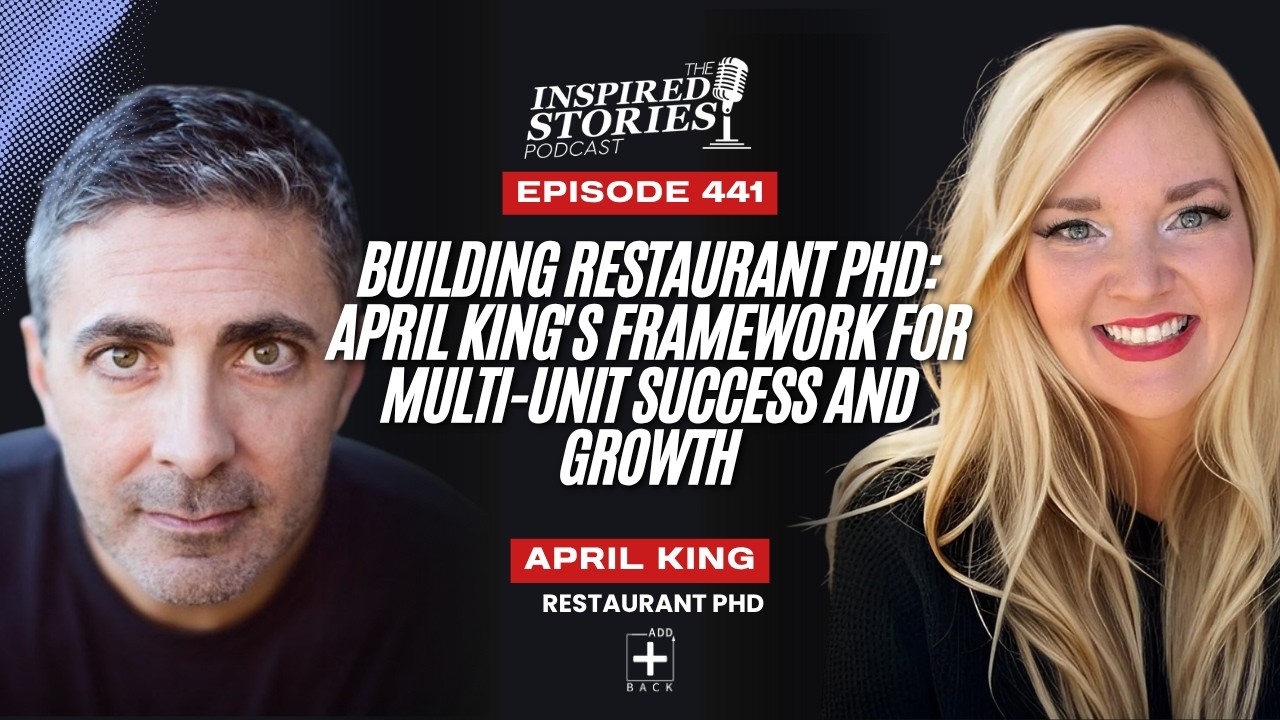
🎙️ From Failure to Framework: April King's Journey Building Restaurant PhD Consulting
In this compelling episode, April King, founder of Restaurant PhD, shares her remarkable journey from starting as a server at 14 to becoming a trusted advisor for multi-unit restaurant operators. Through raw honesty about a professional breakdown that became her breakthrough, April reveals how systems thinking transformed her from a struggling district manager to helping restaurant groups achieve record-breaking performance. Her story demonstrates how the restaurant industry's rapid evolution demands new approaches to training, accountability, and operational excellence.
✨ Key Insights You'll Learn:
Starting restaurant career at 14: complete journey from frontline to district leadership
QSR industry turnover reaching 150-300%: why traditional training approaches fail
Heat map methodology: diagnostic approach to identifying operational gaps systematically
Confirmation of understanding vs information sharing: building effective feedback loops
Train-the-trainer philosophy: creating sticky systems that survive high turnover
AI applications reducing barriers: powerful tools now accessible to smaller operators
Private equity acceleration: rapid scaling outpacing traditional system development
Internal promotion strategies: reducing turnover from 150% to 20% through career pathways
Team accountability culture: peer pressure driving collective performance excellence
Automating failure faster: why technology without systems amplifies problems
🌟 April's Key Mentors:
Mom: Started career by securing first restaurant job at 14, instilling work ethic
Early Restaurant Managers: Recognized leadership potential, promoted rapidly through ranks
Food Distribution Team: Expanded understanding of supply chain and vendor relationships
Restaurant Tech Leaders: Provided insight into back-office systems and contract structures
General Manager Teams: Collaborative peer network sharing best practices and expertise
District Performance Records: Two GMs in top 20 nationally validated systematic approach
Industry Veterans: Access to proven systems from established QSR brands and operations
👉 Don't miss this powerful conversation about turning professional crisis into competitive advantage, the power of systematic thinking, and how vulnerability can transform leadership effectiveness in high-pressure environments.
Transcript
Anthony Codispoti (00:01)
Welcome to another edition of the inspired stories podcast where leaders share their experiences so we can learn from their successes and be inspired by how they've overcome adversity. My name is Anthony Codaspote and today's guest is April Joy King. She is the founder and leader of restaurant PhD, a consulting company that helps multi-unit restaurant groups and franchise systems optimize operations, streamline systems and drive growth.
With over two decades of industry experience, April has become known for her skill in process improvement, leadership development, and food cost strategies. She also holds an AAS in business and marketing technology from Northeast Mississippi Community College, along with certifications from the National Restaurant Association and real estate licenses in Mississippi. Her success lies in integrating operational discipline with brand clarity.
which has helped clients across multiple regions. April's relationship-first approach and passion for innovation have earned her recognition as a trusted advisor in the restaurant world. She has guided fast casual brands and fine dining establishments alike, always focusing on people, processes, and performance. Now, before we get into all the good stuff, today's episode is brought to you by my company, Ad Back Benefits Agency, where we offer very specific and unique employee benefits
that are both great for your team and fiscally optimized for your bottom line. Imagine being able to give your employees free access to doctors, therapists, and prescription medications. And here's the fun part. The program actually puts more money in your employees' pockets and the company's too. One recent client was able to increase net profits by $900 per employee per year. Results vary for each company and some organizations may not be eligible.
April King (01:52)
point.
Anthony Codispoti (01:57)
To find out if your company qualifies, contact us today at addbackbenefits.com. All right, back to our guest today, founder of restaurant PhD, April King. Thanks for making the time to share your story today.
April King (02:10)
Thank you for having me. I'm looking forward to it.
Anthony Codispoti (02:13)
So April, you founded Restaurant PhD earlier this year, but you've spent nearly 20 years developing the necessary skills with stops at a variety of food and beverage and real estate companies. What would you choose as your most formidable career stop along the way?
April King (02:31)
I that each piece of the puzzle was necessary on my journey. So I started in restaurants at 14. My mom came home and said, I got you a job. And it was not optional. So she had a client that owned a restaurant and I started serving. I was put in leadership by the time I was in my late teens. It's like a shift leader, kitchen leader.
When I was 21, I was able to be an assistant manager. You had to be 21 to be a salaried employee and to go through the training. By 24, I was a general manager. By 30, I was a district manager. And so the bulk of my career was running restaurants from all the way to the frontline leader to running multiple operations.
That was.
hard journey, but I loved it. I loved everything about it. I loved learning at each stage. When I got to where I had developed people underneath me that came up and were able to get great results and to develop other people in the industry, I made a couple of career leaps. The first one was to work for a food distributor.
I'm curious by nature. I'm like, okay, I figured out how the inside of the four walls work. Let me see what it looks like on the other end. How does ⁓ pricing work? How does contract pricing work? How does the food get to the restaurant? How, you know, how do the things get in the boxes? What are the difference between the vendors that serve restaurants food? I was a sales consultant working directly with restaurants ⁓ for a year and a half. Then I took a promotion to sales leader.
in the food ⁓ distribution industry. Then I'm like, okay, well, I got that piece of the puzzle solved. ⁓ So I went to SAS ⁓ restaurant ERP tick that supplies all the back office systems for restaurants, ⁓ accounting, labor scheduling, inventory. And so I really, again, how do those contracts work? How are they formed? ⁓ You know, how do they kind of integrate?
with all the different pieces for restaurant. So I feel like that gives me a really unique lens of a full 360 view of the entire industry, which again, I think it's just the whole journey put together that makes me a little bit unique.
Anthony Codispoti (05:25)
Yeah. I'm hearing what you're saying. Like you started out very young, 14, kind of working frontline in restaurant. You worked your way up to assistant manager, general manager, district manager. So you understand the frontline work. You understand managing a team that's doing that frontline work. And then you started to look outside those four walls, right? How does the product get here? How did these contracts work and, and all that. And then you get to go work for a software provider. and so.
Yeah, you're understanding multiple layers of the industry. And then at some point you decide to leave corporate job and start your own thing. What was the impetus behind that?
April King (06:07)
I found myself over since I've been out of restaurants, whether that was in food distribution or tech. My favorite part of the job was not selling the thing. My favorite part of the job was helping operators to be successful, which helped me to be successful in those roles, right? Because they trusted me. So they trusted my product, but
At the end of the day, know, what I enjoyed the most was having those conversations, being able to give some insight into things that I had seen either from my own experience or from working with other operators. So in food distribution, I had eight sales reps under me. So we covered two to 300 restaurants.
When I went to the ERP Tech, I serviced multi-unit restaurants over the east half of the United States. I was often working or speaking with groups that had 20, 30, 200 units. So I just got to work with a lot of different restaurant groups. And just having those experiences gives you a lot of insight, right?
when you hear different things that different groups are doing and best practices, it gives you more information to share. So that was what made the move. It's like, okay, I enjoy this, but my favorite part of working with customers is really getting to dig in to their business. And it may not be aligned with what I'm selling, right? Like if I'm selling food, but they're having a problem with
you know, employee development or technology, I want to be able to veer off into those conversations to really help. And so that was kind of the thought process behind it.
Anthony Codispoti (08:15)
Did you have a first client lined
up when you sort of jumped ship and put two feet in the water at once? Okay.
April King (08:23)
no.
No. I ⁓ there's some things that I needed to kind of build out my experience and the things that I know are successful. They live here and you have to have a way to kind of be able to put that out right into some format so that you can share not just their conversations but so that you can give
you know, who you're working with some real tools, some real things so that after you have the conversation and they try to go back to do the thing, you know, whatever they have a playbook or they have the system ⁓ that kind of helps them run it. So that was kind of my focus. You know, I'm a two feet in at one time. You know, I did get some clients and I still
do some mentoring with some groups that I've worked with in the past, you know, but no, no, I didn't have anything lined up. I just went all in.
Anthony Codispoti (09:30)
And
so how did you get that first one?
April King (09:34)
So a lot of my connections are through LinkedIn. I have a newsletter that I've put out for a while now just because I did want to kind of share some things that I have found along the way that were successful. And so even over the years before I had, you know, restaurant PhD, I often get messages ⁓ that people will send even if it's...
I got one, you know, a couple of weeks ago that was a general manager. She's not coming to me for, you know, to purchase services, but she's just like, you just posted this and it really like hit my nervous system. Like I'm kind of burning out here. These are some struggles that I'm having like with my leadership. How should I have those conversations or, you know, those type things. So whether it's
owners, executive teams, you know, sometimes I just kind of get those little one-off questions and it kind of turns into conversations that open doors for me to help.
Anthony Codispoti (10:46)
So give us a rundown of the services that you're providing there at Restaurant PhD now.
April King (10:53)
Yeah, so my experience was in a QSR brand that is a really old brand, right? So when you think of QSR, you think of, right, like the McDonald's, Taco Bell's, Burger King's, you know, all of the things. One of the great things about working in those companies is that they have very
well thought out, very tenured systems, right? They've kind of figured it out. ⁓ I always tell everybody, you know, back 50 years ago, you couldn't open a location and franchise it nationally. Like that was not a thing. You had to grow from success, even family owners.
you had to open one restaurant and it had to be successful and that one cashflowed the second one. So they grew very slowly and they were really able to track that success. So what I've done is in my career took note of systems that I used that were successful. And then in my own experience where there were gaps,
between what I was using. I made my own systems in those areas. So if I was having trouble holding a general manager accountable or not getting the result that I was needing financially, you know, I'm just built to how do we solve this? How do we put a system in place? Not a one-off, how do we fix this this month? But how do we fix this across all my locations for the rest of time?
So at Restaurant PhD, my first thing that I like to do is I have all of those systems that I used that I know were successful in one of the hardest industries, and I make a heat map. So a restaurant group comes to me. They kind of share.
of like what they're doing. We have an interview, you know, like a one day if they're close, we can do an in-store visit. But it's just a one day interview. Let's go through this. How are you handling things? And then I measure that against my systems and it exposes areas where they can, you know, kind of put in processes or, know.
Anthony Codispoti (13:33)
So are you
almost like a fractional COO for restaurants?
April King (13:39)
Yes, it's, it's so it's similar.
But what I do is I'm not going to go in and directly do the things. It's kind of like a train the trainer. One of the things that I found in running restaurants is, you know, we would have in a lot of restaurant businesses, I would say whether it was a new product rollout or new store opening.
You have people that come in and they do the training and then they leave. And then in QSR, it's not uncommon for turnover to be 150%. So everybody that just learned the thing no longer works there. And you have this whole new staff that can't maintain the standard.
And so when we kind of talk through the gaps or systems that can be used, I'm not just going to go in and implement them. I'm going to work with that executive team, whether it's the owner, the COO, the, you know, above store team to train on it, to train how to roll it out. And that way it's really sticky. ⁓
You know, it's not something that I just come in as a fractional COO and kind of put in place. I'm not monitoring, you know, your, your food cost or your labor costs. I'm going to say this is how I got this. Yes. These are, you know, the development plans or the action plans or the monthly rhythm or the conversations that you should be having so that you can get the result. Um, so just a little nuance there.
Anthony Codispoti (15:20)
this is how you should be doing it yourself.
And so your typical client is like a multi-unit operator, whether it's family owned business, it's maybe a multi-unit franchisee. Is that correct? Okay. And so with the work that you've done across a lot of multi-unit restaurant groups, what is maybe the most common operational pitfall that you see?
April King (15:47)
Yes.
Probably people development or kind of back to measuring it against what I used. People don't know what they don't know and so sometimes they're not getting results but they don't know how to get from A to B. So one of the most common things that I see is multi-unit owners have a lot of restaurants.
and they need goals and metrics to be hit. And they're confused between, want a great culture. I want everybody to like working here, but I also need you to do what I'm asking you to do. And I need you to get the results, you know, for the company. So they kind of struggle with how do I have a great culture and how do I hold people accountable? And a lot of times,
especially owners maybe that ⁓ do own the concepts, you know, they don't have access to a lot of that leadership development coaching, you know, as I kind of went up the ranks, I had to figure that out. I've made the jump from general manager to above store manager. And I was
Anthony Codispoti (17:21)
So when you
were going through that transition, there was nobody that was kind of coaching you. You're sort of figuring it out on your own.
April King (17:29)
No, I did have coaching. So it wasn't exhaustive coaching. So I still had gaps that I had to figure out. But in a national, you know, corporation, there are a lot more resources available. ⁓ You know, there's a whole network of other district managers that have also made the jump that you can reach out to to say, Hey, like, this is what I'm dealing with.
Anthony Codispoti (17:30)
Okay.
April King (17:55)
So a lot of times owners, you know, maybe they started at an ownership level. They never had to make the jump from, you know, the general manager to the owner. And so they don't really know how to get the results. So a lot of them have like a bandwidth, like, hey, I can get up to, you know, 12 restaurants, but when I get past that, I end up kind of closing a location.
because they're kind of doing it all hands on. You know, they're kind of being what we call like a super GM, right? They're trying to run the restaurants themselves because they don't really have that understanding of how do I develop this person to get the results so that they can run the business like I would. ⁓ So that's kind of what I do.
Anthony Codispoti (18:45)
Can you maybe share a specific example of how you help the client overcome a rather significant hurdle? Don't give away any you know personal identifying information but hey I came in here was the situation here's what we put in place and here was the result.
April King (19:07)
So I'm trying to think it's kind of similar to what I just shared. There's an owner that has built a business that is amazing. I mean from the community perspective they have wonderful ⁓
branding, community involvement, like the customer service is awesome. They have great social media following. But the owner, they want to be able to step back some, right? Like either at some point they want to be able to retire and give it to the next generation. ⁓ But they don't want to be so involved in the day to day. So that's kind of where
come in, ⁓ did an audit and looked at just the processes, right? Like how's the communication flowed? What written processes do you have in place? Because my philosophy is if it's not written down, it doesn't exist, right? It's like a family recipe. ⁓ The only thing that lives is what's written. So if you step back,
and you want somebody else to kind of fill in that gap, what do they have to go by? What do they have to look at to help them kind of navigate? So in that example, we just kind of go through how can you step back? What are the areas that you want to step back in that you need somebody else to step up into? What do you want that to look like? Write it down, put it on paper, you know, whether that's that manager having a weekly
you know, meeting or monthly financial review with the teams, whatever it is. So with that one, it's just, it allowed them to not be so hands-on, you know, to be able to take that vacation after they have built that business from the ground up and they have, you know, blood, sweat and tears for 30 years. They can develop those next leaders. They can have them run the business with, you know,
80-90 % of the results that they were getting and just to prepare for that exit, whether that's to go start another business while they still have this one, they can still make opportunities for employees and kind of step back to go do the new thing or whether that's to retire or to get ready to sell it. ⁓ So that's when where I know that they got some extra time back.
They got some breathing room. They got some relief of I'm not gonna have to have my hands on this for, you know, the next 20 years or it's gonna fall apart.
Anthony Codispoti (22:08)
I want to go back to something you said earlier in the interview, April. You were talking about coming up to the restaurant, know, front line, assistant manager, general manager, district manager. And you're like, your comment you made was that was hard. What made it so hard? What was the hardest thing about that early part of your career journey?
April King (22:29)
So I'm a very, again, systems, processes person. I wanna know how things work. And when I step into a role that doesn't have that and you hit those challenges, it's hard sometimes, right? Like it's a challenge. How do I systemize this? How do I turn it into something that is not as hard? And...
like the reference that I made to the Super GM, that leap from running a store and feeling super confident, right? Like you have this, I'm the, you know, I'm getting the best results. Like I'm really good at this. To then stepping into a multi-unit role. And then all of a sudden your stores aren't performing the way that you performed.
you go from feeling on top of the world to feeling like a failure. You know, all of a sudden it's like, I thought I was really good at this, but I haven't developed the skills to make other people really good at this. And it's a challenge because if you're competitive, if you like to be the best at everything, you know, it's hard to see other people struggle, especially when they're underneath you, they're a reflection of you. And so it was, how do I...
help them to be successful for their own development and to make it an actual reflection of what I'm capable of at the same time.
Anthony Codispoti (24:04)
Yeah.
Let's see. I know that, especially given your background in technology, that's probably part of what it is that you're looking at with your clients. And tech now is advancing even more quickly in the hospitality sector. Is there something that you're particularly excited about as it pertains to tech and hospitality?
April King (24:34)
yes and no. I'm a absolute geek when it comes to technology. I love it. I want all the new apps, all the shiny things. I love technology. What I'm excited about most is some of the ways that it reduces barriers for all restaurants to have access to some really cool tools.
So for instance, this past week, I had a client that had access to information from the POS, right? Like we sell this many hamburgers and this many fries, but they don't have a system that tracks their usage. Like how many cases of this am I going through? And I was able to use AI in an hour.
and they have a functional tool that they can access where they can enter in their truck orders, print it by vendor, upload it into a file and it tells them their usage. Never in history have we been able to do that without hiring, right, the developers and the whatever, a big expense. That I'm really excited about. Get resources in the hands of your teams.
so that they can have access to the tools that they need. The no part is if you don't have good systems in place and you go through a bunch of many technology, you're automating failure faster. it is, it is only gonna automate to the systems that you have. So if you don't have well thought out systems of
Anthony Codispoti (26:21)
Automating failure faster.
April King (26:33)
how your general managers get invoices to your office or you know all this if you don't have the processes almost in place manually if you're not following up on those things now then you're kind of you're just automating what what what result is it producing so I really want groups to have the understanding of the basic fundamental processes almost
written or manually and then when that's really working let's automate that because you know that is proven it works in your in your organization but if you go out and just buy the shiny new piece of technology thinking that it's going to fix a lack of accountability in your organization or that it's going to overcome a lack of leadership in your organization it's not it's just going to automate
messy processes.
Anthony Codispoti (27:33)
Yeah. You know, we talked about, you work with multi unit operators, but what's kind of your sweet spot, April? Is it two units? Is it a hundred units? Like where is it that you find that you can be most helpful to groups?
April King (27:51)
Probably that five to fifty. I know that sounds like a big range but it's really not with the way that groups are expanding these days. So there's a lot of groups that maybe were flagship locations that had four or five corporate owned units and then they franchised.
and that can happen really fast. So they can go from having five to now, you know, open in 20 next year with franchisees and that speed exposes lacks of systems, right? Like you may run your five really great and you write processes for your franchisees.
but you don't realize what you didn't put in there until your franchisees are not getting results, right? Until they're struggling and they're like, hey, I bought into this brand because it had the systems and I'm not able to hit my food cost or my labor cost or I'm not making the profit that I thought I would. And so they're going back to get the answers. And so that really fast growth anywhere from
50 to, you know, somebody that just owns five family owned locations.
Anthony Codispoti (29:18)
So are you mostly working with the founders, the concept owners, or do you do much work with franchisees as well?
April King (29:29)
So I work with franchisees as well. So one of the things that's common in the restaurant industry is that you have groups that kind of manage multiple franchises. So you may have an owner that is a franchisee that owns, you know, five locations of this franchise and they also own, you know, five locations of a different franchise.
and then five of another right that way they can build out a smaller area, smaller footprint and have restaurants in non-competing spaces. So it's the same multi-unit right? So they're trying to juggle like these different restaurant concepts they might have 15 or 20 locations but those may be made up of different franchise brands so they're also trying to consolidate
information. Okay, like I have this information and the way I run this one and this information for the way I run this one. But I'm the owner of all of these. So how do I simplify that? Right? Like how do I develop all of my teams across three different brands or two different brands? And so we kind of work with those. What does the franchisor require of you? But in your company, what processes can you put in place? Whether that's
who you hire, how you develop your talent, or how you get the information from all three different concepts into one place so that you can do something with it.
Anthony Codispoti (31:06)
So I want to go back to another thing that you said earlier that kind of blew my mind. said in QSR quick service restaurants, people outside the industry turnover can be over 150%. Is that right?
April King (31:21)
I have seen restaurants that had over 300%. So you're talking about a full new staff three times a year. And then people wonder why they go to, you know, somewhere and they're the sandwich isn't made right or the service isn't where it needs to be. Well,
Anthony Codispoti (31:44)
Yeah.
April King (31:49)
Imagine being a general manager and you know twice a year I tell everybody in your own business imagine in your business that everybody quit and you got a whole new staff and you did that twice a year. Yes all of them while you know ordering accurately and scheduling people and and doing all the things which is why from a top-down level I go with that train the trainer mindset.
Anthony Codispoti (32:02)
And I gotta train all of them.
April King (32:19)
right? Because if you're struggling in restaurant, if the general manager is kind of struggling and you have this corporate team that rushes in, right? And we do this, you know, two day training and all of the employees know all of the things. Okay, well six months later, they're not going to be there. So it, the turnover is, is crazy.
Anthony Codispoti (32:43)
Do you have any advice for operators on how to reduce that turnover?
April King (32:48)
⁓ Yeah, so in some of our locations our turnover ran 20 % which was crazy for the industry and I think that it's a lot of the simple basic things that start before someone even gets hired. What are we?
putting out in our job descriptions, who are we attracting? What are we interviewing on? What kind of questions are we asking? When we hire somebody, what is their first impression of our business? How do we onboard them? How do we train them? How do we develop them? Which sounds...
like that should be you know that everybody should know that in the corporate world you know in the corporate world it's like yes you know we have these corporate recruiters and we have these you know they can go to orientation at the corporate office and somebody sets up their tech and all of that I know I've been in those roles in a restaurant that's not you know you have a general manager that is having to
Anthony Codispoti (33:43)
It's managing 101. ⁓
April King (34:06)
Managed this whole staff that's already turned over there all new they're fighting fires every day You know, they tried to take their hands off the thing whether that was, you know, given the assistant manager The ability to order the truck, but now we don't have half the product So we're you know having to tell customers that we're out of things So then this person shows up for orientation and so it's just they're
A lot of them are constantly in firefighting mode. Being able to get systems in place to get your operations to a point where you can really start onboarding the right way, letting people feel supported and trained from day one makes a huge difference. And people want to see a path in any industry. It doesn't matter just because that person, you know,
has a GED and started as a line cook doesn't mean that they have any less ambition to run the restaurant one day. So how do we show them how to do that? A lot of our reduced turnover was because we were 90 % internal promotions, but a lot of owners struggle because they don't know how to do that. They don't know how to get that result. They don't know how to train that person from, you know.
the cook, to the kitchen leader, to the assistant manager, to the general manager, to the above store manager. And that makes a huge difference when employees see that in a company, they see internal promotions, they're like, hey, I wanna stick out here, this is a path, this is a way for me to get somewhere.
Anthony Codispoti (35:47)
And so a big part of what you're doing is helping them to put those training systems in place, helping them to identify those people who have the potential and how to bring them along. Because, you know, if somebody doesn't have that system in place, they don't have that training, they don't have that background. I might just be expecting, you know, the guy that's running the grill to, you know, just continue to elevate himself. And he may have that desire to elevate, but he needs somebody to show him the ropes.
April King (35:52)
Yes.
So that's kind of where that initial heat map, know, like tell me about your onboarding, tell me about your training, tell me about your orientation process, ⁓ tell me what resources you have in the restaurant that show a clear path, and then what tools do you have in place to be able to develop that person? you have any kind of ⁓ training, know, development programs that are offered?
whatever every six months or annually that different levels can attend to develop their skills and to be able to step into that ⁓ next role. I might, you know, look at the heat map and see that there's a bench planning gap, right? They don't have any way of identifying in all of their different locations, the next set of leaders. It's not on paper. It's not, okay, I need this general manager to identify the
You know, they have two assistant managers. have two shift leaders. Who are the next two shift leaders? Like what is your bench? Let's write it down. Let's start working with them now. What can we offer? What systems can we put in place to start training that next group throughout the whole company?
Anthony Codispoti (37:36)
So if I'm starting to connect the dots on your approach here and help me fill in the gaps if I'm missing things, obviously as a client comes and says that they want to work with you, they've already got ideas in their own head of what it is they need to fix, some of what their problems are. And so you come in with that understanding, but also with the understanding that they may not even know where their gaps are.
you've been in the industry so long and you've seen it from inside, from outside, from service provider levels. And so you know the questions to ask that they weren't even thinking of. So you say, well, you came to me with these lists of things over here and I've got ideas. And now from this one day interview that we did together, I think, you know, the heat map, you call it. Now I've got another list of things that we're going to also work on over here.
And as we start to check items off these lists, you're going to see a lot of things become smoother. know, things are going to turn around. ⁓ Turnovers going to reduce. Margins are going to increase. People are going to be happier. More free time for the owner. Am I sort of seeing this correctly?
April King (38:43)
Yes. So that is where my company is different than any other like I'm in white space land. There there's nobody else doing this because consultants a lot of times have a consultant background right. They came up with with the business background not a restaurant background.
so they may not be able to see what's missing. And in the same space, a restaurant owner may think they know what the solution is, so they go seek a consultant or coach to help them with their business. And that person is maybe happy to take their money, but they're only gonna help them with the piece of the business that the restaurant owner is asking for help with.
When I was a district manager, we broke a lot of brand records. So I was the first district manager to have two general managers that were top 20 general managers in the same year. And we're talking a brand that had at the time maybe 1,700 to 2,000 locations. And I had two general managers that were in the top 20 across customer service.
you know, sales increases, food costs, labor costs, like all the things. So I was like the top district manager. Because of my lived experience, I know what works. I've done it. And to be honest, when I stepped back from that role, it's because I had developed an employee that was a shift leader for me when she was 17. And at that time, she was a district manager.
and she was producing results better than me. So I'm like, okay, right? Like my work is like, you know, now not only can I run them, but I can develop people to run them, which is, and she wasn't even one of the two, you know, top 20 general managers, but I can develop people and I know the systems to be able to put in place to get results consistently. So it's the only business where somebody
can have a diagnosis, right? Like if you don't know what's wrong, you got the doctor, you got the mechanic, right? Like there's a diagnostic tool. People don't offer that because they don't have it. They don't have the information. And if you do have the information, if you do have the information, you're not gonna share it because you're running restaurants, right?
Anthony Codispoti (41:30)
They don't have the experience that you do.
Hmm.
April King (41:37)
Like if I'm a successful brand and I have the systems in place, why am I going to teach the competitor across the street how I'm successful? So there's a big gap. The people that are successful aren't sharing the information. The people that are sharing information maybe don't have the background to know if it actually works. And the people that are seeking help,
don't know what they don't know.
Anthony Codispoti (42:08)
You know, and I think
if I'm going to distill this down into sort of a marketing or sales pitch for you, what really like, you know, caught my attention here is that you had two manager, you were district manager, had two of your GMs at the same time that were in the top 20 list and a restaurant chain that had 1700 locations at the time. Like to have one in the, you know, talking about, you know, top fraction of a percent, you had two in there.
April King (42:32)
Mm-hmm.
Anthony Codispoti (42:38)
I think that says a lot about what you know and understand about how restaurants are run and maybe even more importantly, your ability to train other people to take that knowledge and run with it.
April King (42:38)
huh.
Yes, so it all goes back to the systems in my framework. If you have the right systems, it's plug and play, right? Like if I have ⁓ a coaching rhythm for how you talk employees into a shift when they're clocking in and the five minute.
conversation that you have with them as they clock out, right? If I have the tools to know when my employees come in, like how to assign them to their positions, how, you know, par levels for trucks, right? Like if you have all the systems in place, well, when that person gets promoted, you just take the next leader and you change them the systems, like the system works. So as long as you're, you know,
using the system you can train anybody to run a restaurant. You just you have to know the systems and so that's where I really kind of work with owners to say what what are we missing? Why are we not getting this result? How can we put a plan together so that this restaurant this is a bad reference I don't want to say dummies but I used to say that you know it's like
Restaurant for dummies right like the books that used to be really popular that was you know, say links Yeah, I know I know that what that was an old reference but back back before the internet was huge we had those books and we were like we loved them, know, because they would teach you things and so it's kind of like that, you know, if you have enough written systems and the way that you think
Anthony Codispoti (44:14)
Maybe a better way to say it now is like restaurants for noobs. I hear my kids use that term all the time, noobs, newbies.
I know it well.
April King (44:38)
you know, the way you want things to go in the restaurant, all you gotta do is plug in a new leader, teach them how to use the checklist, the playbooks, how to have troubleshooting guides. You know, if I'm a manager and I'm struggling with my food costs and I can go, you know, to a playbook that's a troubleshooting guide and say, okay, check this. If it's not that, check this. If it's not, you know, if you have all the tools available, then it makes it really simple.
Anthony Codispoti (45:06)
What are some of the biggest shifts that you've seen in the restaurant industry in the last 10 years, April?
April King (45:12)
So kind of what I've mentioned, which is that...
you had a lot of mom and pop, know, 30 years ago even, you had brands that were generationally owned. They had to grow slowly. They had to grow successfully. There was no, you know, maybe a lot of money accessible. You had to cash flow one to build another. So you knew how to grow restaurants successfully. ⁓ Today, we have a lot of, you know,
private equity companies and investment groups that are infusing a lot of money into newer brands to be able to grow really fast. sometimes they don't have that legacy of systems, They don't know what they don't know. So maybe they have one restaurant that they've opened. It was kind of a flagship restaurant. Maybe they even grew to...
three or five pretty quickly. And now they got a bunch of investment backing and they are just growing at a crazy pace that outpaces those systems. They just don't have as much time to learn what success looks like slowly. And so it's a really fast, well now I have to produce, right? Because I'm being backed by investors. So if I did grow really fast and now I'm struggling, like I need
to catch up as quick as possible. And so that's a huge shift. It just this speed that new restaurants can open. There are brands in this space. There was a brand that I was reaching out to when I was in restaurant technology. And at the time they had less than a hundred locations. Now they have close to 700. And that was
Three or four years ago? So when you talk about massive scaling, and so there's that period, right, of being that under 50 units where they really gotta get some stuff in place. they want that huge growth, otherwise you're gonna have that huge growth, but like I said, then you're gonna have franchisees that are.
coming back or you know even if it's your own you're gonna have all these restaurant owners that are like hey I'm having these problems how do I fix it and then you're just in constant firefighting mode right like if you kind of don't have the basics down before that that huge growth
Anthony Codispoti (48:00)
That makes a lot of sense. Yeah. April, I want to shift gears and I want to ask you about a serious challenge that you've overcome. How did you get through that? What did you learn going through the process?
April King (48:01)
Big difference.
It's funny that you asked that because the other day I was preparing for a newsletter. I have a LinkedIn newsletter that I put out weekly for restaurant operators. And so a lot of times what I'll do is I'll kind of go through old pictures or whatever, you know, and kind of get inspiration for whatever I'm going to write about. And I saw this big video. So I would sometimes I would, you know,
video myself and send it out to my general managers. We didn't have all the tech tools. ⁓ So that was an easy way for me to communicate. And it was the most sad, pitiful, pity party video that I have ever seen. Like I was embarrassed watching it back. And I was sitting in my car and it was probably four minutes and I was just crying.
because I had gone from general manager, you know, to run in multiple restaurants and we had a new product that rolled out. And so there was certain things, right? Like you want it, it's gotta all be the same. So you gotta have the same marketing materials up at the restaurants and the same, you know, messaging on your sign and your employees are all, you know, aware and knowledgeable of the new items.
And so I was kind of going around to the different restaurants and doing like an audit, right? Like, okay, we just rolled out this product. How did everybody do? And it was awful. you know, like the one restaurant, didn't have, they don't have it on the, you know, on the marquee, the reader board, you know, you've got another restaurant that doesn't have the promotional material up, you know, inside the restaurant. You go to order it through the drive through and
you know, it's made wrong when you get it. And so I was just having this vulnerable moment with my general managers, people underneath me. And I was crying and I said, this is awful. Like, this is really bad. And I know that it's my fault. Like, because at the end of the day, I'm the one.
Like, so I was recognizing in that moment that I was failing and I was frustrated, but I was also asking, how am I failing? Like, I know as a store manager that I was capable of it and now I have multiple and y'all, you know, it's not translating. So I'm failing. Where, what steps have I missed?
And that's kind of where a lot of the framework came from of what I have now. That was the turning point. That was a, I don't know how to get the results and I'm struggling and I'm tired and I'm working all these hours and I'm sending the emails and I'm like, you know, telling you how to train your employees and I'm giving you calendars of dates of when to have done, right? Like have your...
backline employees trained on it by this date and have your marketing material, you know, and cover it in your manager meeting and I'm sending out information, but I'm not getting the result. And so that's when I'm like, how do I get the result? Because just telling people how to do this thing is not accomplishing the goal, which is what owners and you know, CEOs, executives are experiencing.
Anthony Codispoti (51:45)
You're not getting the result.
April King (52:03)
I'm telling them, but it's not happening. And so that was where I kind of put in a system of not only sharing the information, but that whole feedback loop. Like, how do I get the accountability? How do I get the standards? How do we put a system in place so that everybody is successful? And that's kind of what I built to fill in the gaps. And that's kind of what I help groups with now.
Anthony Codispoti (52:29)
Okay, so I want to go back through this a little bit.
You, you kind of hit what I'm going to call a rock bottom moment, right? You're, you went from general manager to district manager. What you were doing as GM was working. What you're doing as district manager somehow is not working. You feel like you're giving all your GMs the info that they need, but something's not working. You are emotional with this video that you send out and you're like, I don't know what I'm doing wrong here.
April King (52:35)
Yep.
you ⁓
Anthony Codispoti (52:56)
And so how did you get from there and that frustration and understanding that something is broken to figuring out what the actual system needed to be? Cause it sounds like you were giving them all the data. were given them the calendars. You're giving them all the marketing materials that they needed. To me, that sounds like you've done your job. To me, it sounds like, you you should be wagging your finger at the GMs, but you kind of fell on his sword and you're like, no, this is on me.
And so what did you change specifically?
April King (53:30)
So one thing that I coach on through all levels of organizations is how do we confirm understanding? People are afraid to, you know, raise their hand or say, I don't know what this means. You know, maybe I'm sending an email that says, whatever, you should have this, this and this done.
Anthony Codispoti (53:44)
Hmm.
April King (54:01)
Well again, if you want internal promotions, they may not know what that is or how to do it effectively. Maybe they tried to do it, but it wasn't effective because they didn't really understand all the context behind what you were asking them to do. And so one of my things is to gauge competency, you know? ⁓ So once...
I don't just need to shoot you an email and tell you to have this, you know, training on this new item. Like, maybe we need to have the conversation. Explain to me how you are going to host this training, right? Like, talk me through how you're gonna do this in-store training. Like, who's gonna be there? What time of day are you holding it? Like...
How are you going to make sure that the employees actually know how to make it that you're not just standing in front of them for five minutes saying, you know, we've got this new item and this is how you make it and then that's it. Like, how are you going to confirm that they know how to make it? Right? Like, how are you going to test them? Are you going to watch them? Like, so one is making sure that there's understanding. It's not just a sharing of information, but there's got to be that feedback loop of I'm giving you information.
What are you taking from that? Like give it back to me so that we're on the same page. Once I know that you have clear understanding, now we can hold one another accountable, right? So now that I've confirmed that I know how you're gonna host your training, like how you're gonna follow up with your employees, how you're gonna share this information, how are you gonna hold them accountable to that standard?
And now that I know you know, I can hold you accountable to this standard. So now that's, you know, the day of instead of me driving around and trying to check all the things, you know, how are you going to hold yourself accountable and having general managers come up with plans? So a lot of times the day of they'd be like, well, I want you to know that everything's great at my store because I don't want to feel like failure. I don't want you to feel like failure.
So on the day of, I'm gonna send you a picture of the in-store materials. I'm gonna send you a picture, you know, like of the reader board, like I'm gonna show you whatever, you know, all the things. So it's kind of that self accountability piece ⁓ because a lot of times people don't, you know, know something they're afraid to say, I don't know what this means or I don't know how to do it.
Anthony Codispoti (56:46)
That makes a lot of sense. It's hard to raise your hand and say, I'm a little bit lost here. ⁓ so in that particular example that you gave where new product launches and it was, it was a flop because people didn't know how to make the product, the marketing materials weren't up. The way to fix that going forward is, ⁓ you want that feedback loop. You want them to send you a picture of that menu board, send you a picture of, I don't know, maybe a video of their employees making the new thing or.
or something like that. some of those, I'm guessing some of your GMs respond favorably to that. Yeah, hey, we want to be good team members. We want to make sure that, you know, we got this and you can kind of spot check us. But are some of them resistant? And they're like, hey, that's a little too much micromanaging for me. Do you get some pushback?
April King (57:36)
Yep.
Anthony Codispoti (57:38)
How do you
handle that?
April King (57:45)
You gotta have accountability. And to your point, I was working with a group the other day that would assign out tasks to the restaurant employees, just like on a piece of paper. And the employees that did the most would go back on that piece of paper and they would initial things as they completed it without being asked.
And so I asked the owner that I was working with, why do you think those employees initial those items? Well, because sometimes they're picking up the slack, right, of the other employees. So they want you to know out of the 10 things that got assigned, my initials are next to seven of them, which means that the other employees only did three. So the only people that I have found
Anthony Codispoti (58:29)
you
April King (58:46)
that don't want accountability are people that may not be the best for your team. If it's not micromanagement, if it's really their plan, their system, like their, this is how I'm gonna let you know if we've kind of already talked through it and I'm providing, you know, training and development and really trying to help you be the best that you can be. And I'm asking you,
How are you gonna do a great job? Like, you know, I don't care if it's like necessarily a specific, you have to send me a picture or whatever and it's...
Anthony Codispoti (59:24)
So I'm
the GM that's reporting to you. can kind of in conjunction with you come up with my own system for sort of self reporting, which on one level, April makes a lot of sense because now, like you said, it's my system. I'm I'm bought into it. It was my idea. But on the other hand, like now you've got, you know, 10 GMs reporting to you that each have sort of their own mechanism for reporting back to you. Does that make it harder for you?
April King (59:55)
depends on what it is. are certain things, I mean so we had a basic system for everybody across the board for certain things. So like end of the month financials, a general manager, they're responsible for the performance of their unit. So there were items that they all filled out the same way, right? Like this is you know the goal.
this is where we landed, this is my plan to fix that type thing. And so there were systems on that level that were across the board. But individually, I would work with my general managers professionally, personally, like what are your goals? What are you trying to achieve? What skills do you want to make better?
and let's make kind of some individual plans for those things. So we'll sit down, you know, and have that conversation. Here's kind of where you're at across the group. Here's where you would like to be. You're a smart person. You know, what do you need to work on? And they would put those things out, whether it was, you know, the new
store LTO, you know, maybe I had a general manager that that had that they were a rock star, right? Like when I went around and checked, so maybe they don't have to send anything back, you know, at all on that thing. Maybe there's another area. So there was some streamlined systems, loops, and then there were some flexible ones, which is where everybody felt like they were getting that personal development. They felt like they were going to be able to reach that next level. They were going to be able to
you know, refine or learn skills that maybe they hadn't achieved yet. And then the last piece was we were very team oriented. A lot of restaurant groups, general managers feel like they're on an island. You know, it's just them and their restaurant and they're the top of the food chain. And, you know, maybe they don't want to reach out to their boss because they don't want to feel, you know, inadequate or to say that they don't have the answers.
So we did a lot of different, have all the general managers to where we could identify, this one's really strong in food cost. So if you have a question about that, reach out to them. This one is super on point with labor costs. This one's really great at marketing and bringing in sales. This one's really good at different things and just having a network that they could use to reach out to one another.
And when you hold people accountable to that level, they don't want anybody on the team that brings them down. So if there was a general manager in the group, you know, if we did have a group rollout and there was somebody that was consistently like pulling group numbers down or whatever, you know, they were frustrated, right? Because those employees that want to initial the boxes that want to look good, that want to have the best district numbers or whatever, like that was how we had to.
in the top 2000.
Anthony Codispoti (1:03:19)
Right. Top 20.
Right. You know, I like to ask my guests a question about like a podcast or a book that they might recommend to the listeners. But it strikes me that maybe the the best resource that you could offer up is actually the newsletter that you put out on LinkedIn. Can you say more about that?
April King (1:03:40)
So it's a weekly newsletter. I kind of put out different whatever areas to the business. ⁓ Sometimes it's something on a story level that general managers can find beneficial last ⁓ week. think it was you know how one of my restaurants did a really great job of local community marketing and kind of thinking outside the box and really able to attract ⁓ you know new
new people in the community to their restaurant. So sometimes it's on a store level of different things that you can do, whether that's marketing or food costs or those type things. And then a lot of times it's financial or systems or food costs or scheduling or leadership development. I've shared a newsletter where it kind of has that development plan that I was speaking to you about in the action plan and kind of how I used those.
on a regular basis. yeah, probably a great way for them to kind of connect and see what I'm about.
Anthony Codispoti (1:04:43)
So and you can find that newsletter on her LinkedIn page ⁓ and you can connect with April's ⁓ April joy King if you just search for that on LinkedIn, you'll find her ⁓ also ⁓ Other good ways to get in touch with her her website is restaurant PhD consulting comm and her email address if you want to connect with her directly is April at restaurant PhD consulting comm
And I've just got one more question for you April, but before I ask it, I'm going to ask all the listeners to pause just for a second and go to your podcast app that you're listening on right now and hit the follow or subscribe button. Make sure you continue to get more great interviews like we've had today with April King from Restaurant PhD. So last question for you, April, you and I reconnect one year from today and you're celebrating something big. You're very excited. What's that thing you're celebrating?
April King (1:05:40)
finishing building out all of my systems and kind of being able to scale that so that I can work with more restaurants and help more groups at the same time. So I have the kind of the diagnostic formula but if I really want to work with you after that and you need help in you know getting adoption
quicker in your organization or getting access to the right tools. That's really a one-on-one kind of journey. And so I'm really building out a lot of the framework to be able to help a lot of groups at once, whether that's kind of bringing in some more consultants that know my system that can be able to help. But that's what I'm going to be able to celebrate from the time I started in leadership at 21.
I wanted to help people be successful and my whole journey is about being able to help other people to be successful in this space. And so I want to help as many people as I can. And so that's what we're going to be celebrating is being able to help a lot of people get some really good ⁓ results for their businesses.
Anthony Codispoti (1:07:00)
Looking forward to that. April Joy King from Restaurant PhD. I want to be the first to thank you for sharing both your time and your story with us today. I really appreciate it.
April King (1:07:09)
Thanks, Anthony. It was great to be on.
Anthony Codispoti (1:07:11)
Folks, that's a wrap on another episode of the Inspired Stories podcast. Thanks for learning with us today.
Connect with April:
Email: april@restaurantphd.com
LinkedIn: April Joy King (search for weekly newsletter for restaurant operators)
Website: Restaurant PhD Consulting